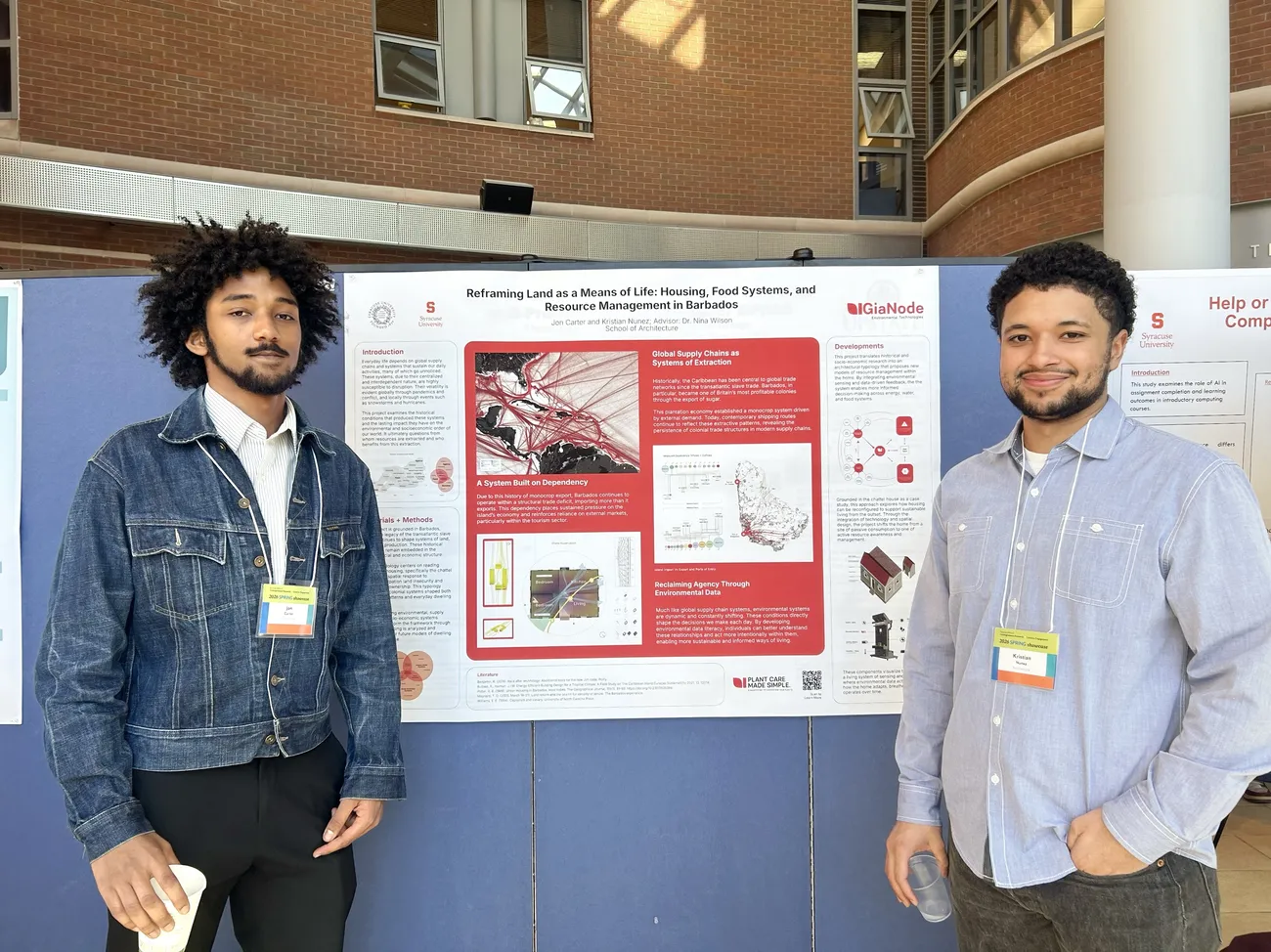
- Jon Carter ’26 and Kristian Nunez ’26 of Syracuse University’s School of Architecture developed an award-winning senior thesis project that could serve as an action plan to improve food, housing and energy security for Caribbean countries.
- In July, Carter presented their research at an international architecture conference, introducing their ideas to a global academic community.
- Their startup, Gianode, is a patent-pending environmental intelligence platform that features a sensor network designed to monitor air, soil, water and energy systems and help users with their decision making.

School of Architecture alumnus Jon Carter ’26 takes in the sights of Brisbane, Australia, where he presented research at the 2026 Association of Collegiate Schools of Architecture (ACSA) International Conference.
For two Syracuse University School of Architecture graduates, a senior thesis became a blueprint for change. Jon Carter ’26 and Kristian Nunez ’26 have a vision for Barbados that would ease its reliance on the global supply chain and advance sustainable, self-sufficient housing, farming and energy through new technologies. “There’s a lot of ideas in play,” Nunez says.
For Carter and Nunez—both with family ties to the Caribbean—a broad idea about housing grew into their award-winning thesis project, “Farming Equates Revolution: Toward a New Tropical Modernism,” earning a Dean’s Citation for Excellence in Design Research as part of the School of Architecture’s annual James A. Britton Memorial Awards. And in July, Carter presented their research at the 2026 Association of Collegiate Schools of Architecture (ACSA) International Conference in Brisbane, Australia.
“Australia was the perfect context for our project—many of the ongoing issues were extremely relevant and made our work very well received,” Carter says. “It was inspiring to know that professors are actively looking for solutions to the problems we face globally, and I hope to contribute to this narrative.”
Encouraging Digital and Environmental Literacy
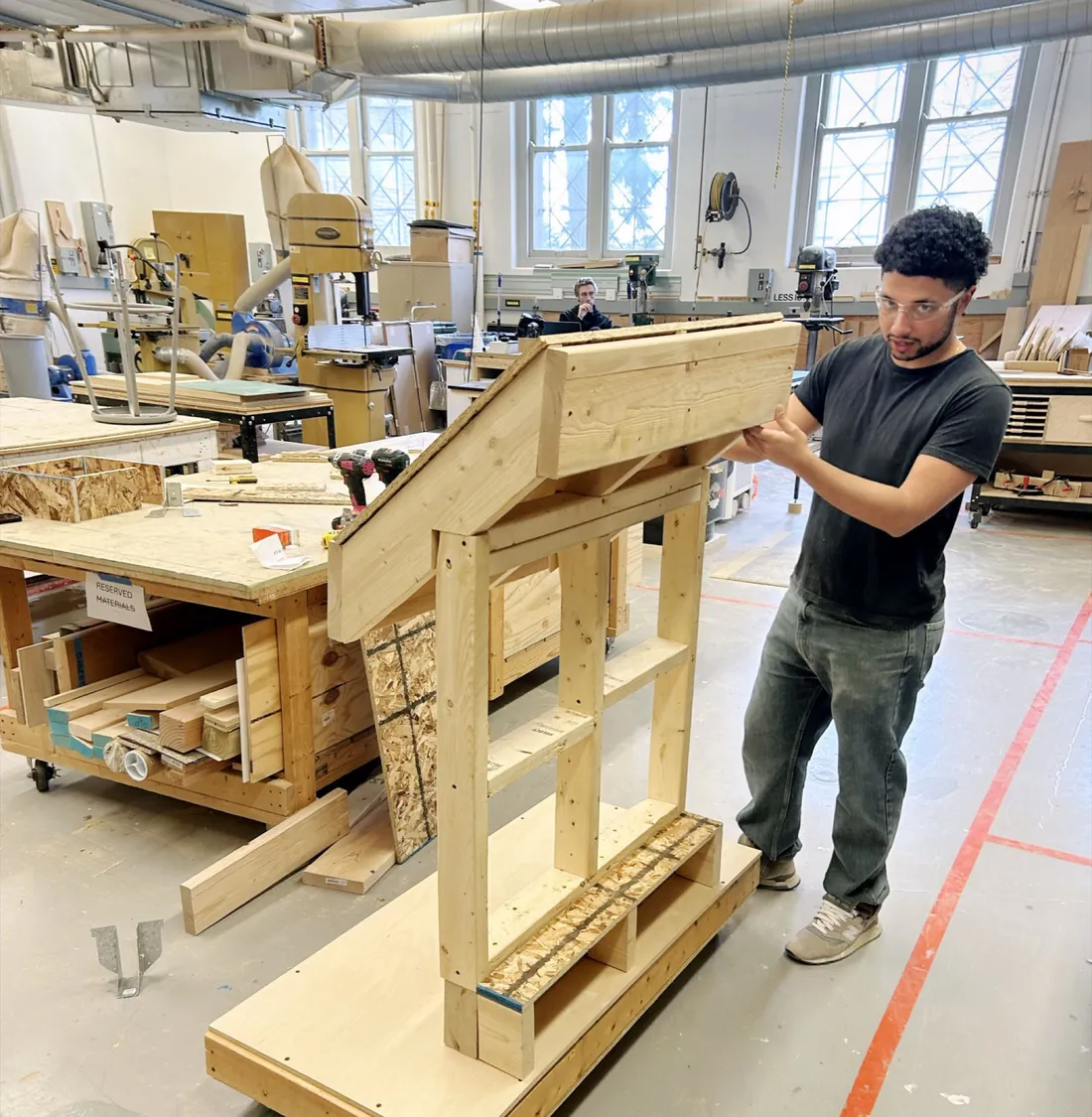
In the School of Architecture wood shop, Kristian Nunez ’26 works on the frame for their Gianode prototype that uses a sensor network to capture environmental data and provides guidance for changing conditions.
Along the way, they launched Gianode, a patent-pending environmental intelligence platform that features a sensor network designed to monitor air, soil, water and energy systems. It collects data in real time and uses artificial intelligence to offer guidance as conditions change. The pair want to put this network directly in the residents’ hands—for use in homes and on farms, creating a decentralized system that encourages digital and environmental literacy, enhances their independence and supports localized resource management.
“We’re trying to educate people on the environment they live in,” Carter says. “The decentralized system allows them to understand their environment better.”
Redefining a Colonial-Shaped System
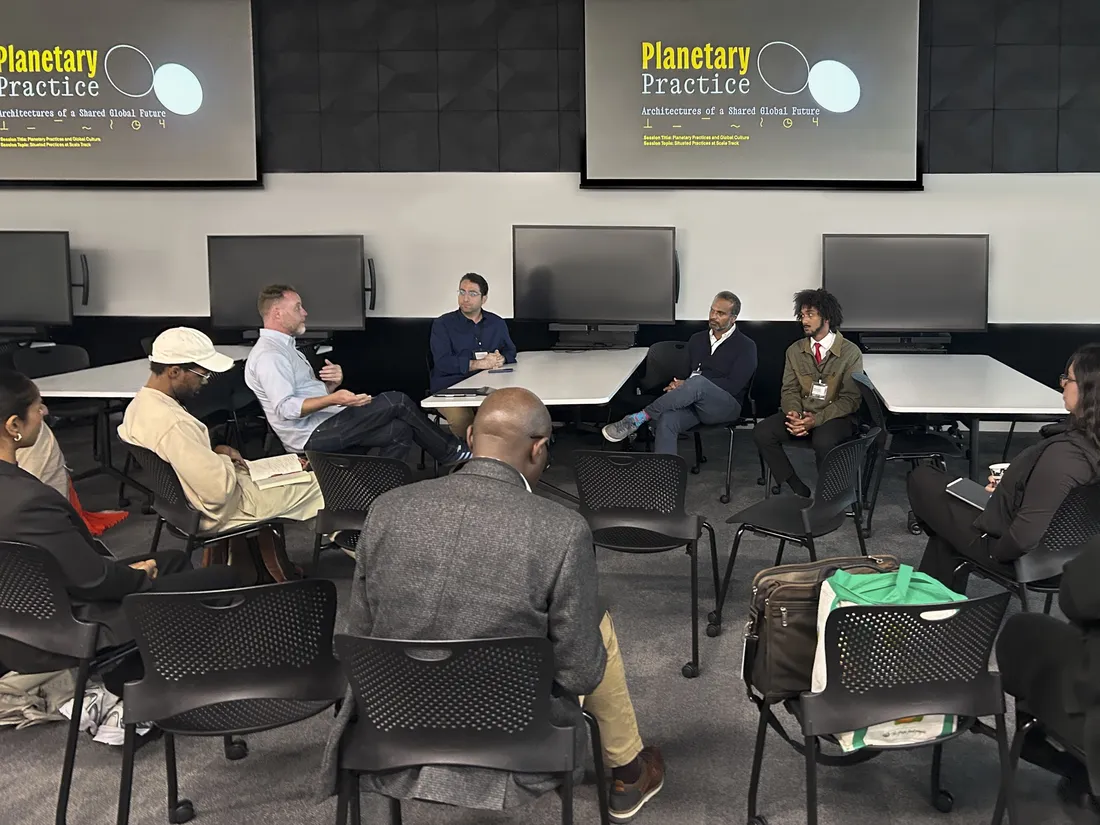
At Queensland University of Technology, Carter receives feedback about his research from professors and educators attending the Planetary Practices and Global Culture presentations at the ACSA International Conference.
With Barbados’ history rooted in the transatlantic slave trade, Carter and Nunez recognized how that influence shaped the country today. At the heart of their project is an adaptation of the chattel house—a type of residence used by today’s working-class people and historically recognized as the small, wooden homes of landless plantation workers who moved them from place to place. “Our initial research focused on this idea of the chattel house as a unit to explore housing on the island,” Nunez says. “From there it evolved to how we can understand these housing systems and propose a new technology that can monitor these systems and effectively contribute to people’s daily lives.”
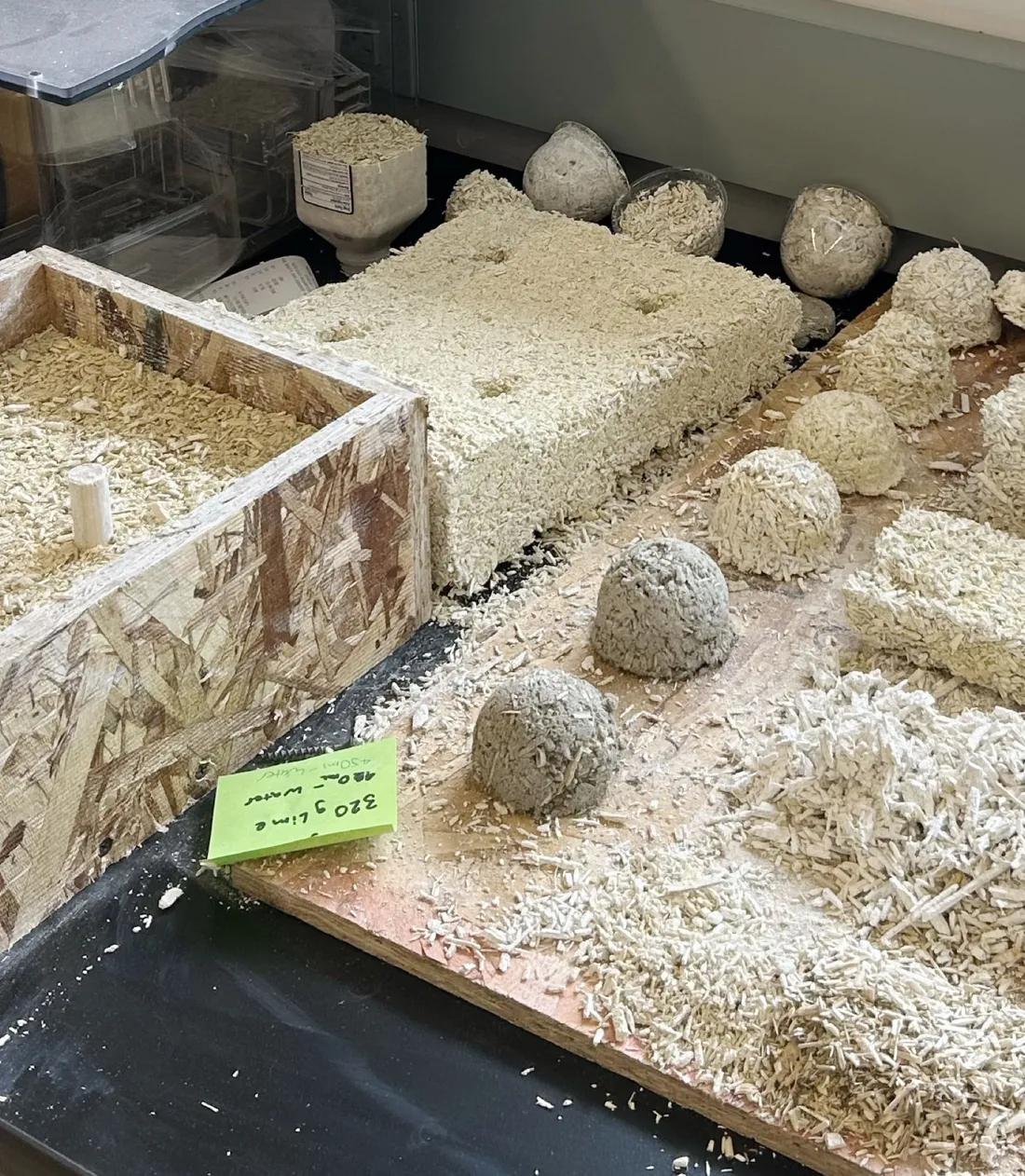
Carter and Nunez experimented with hempcrete and adobe bricks separately as part of their research on sustainable building materials.
Their exploration led them to propose the use of hempcrete—which combines hemp hurd, limestone (prevalent on the island) and water—as a sustainable building material for chattel homes that would be equipped with their sensor technology. The project also emphasizes solar and wind power, taking advantage of the Caribbean climate and trade winds.
“Their research contains important transferable findings that are applicable to other built and cultural topologies shaped by slavery and presents a novel human-building-land dynamic that could be replicated to promote climate and economic resilience in other contexts,” says School of Architecture assistant professor Nina Wilson, who served as their thesis advisor and supported their submission to the ACSA conference.
Building Out a Startup Venture
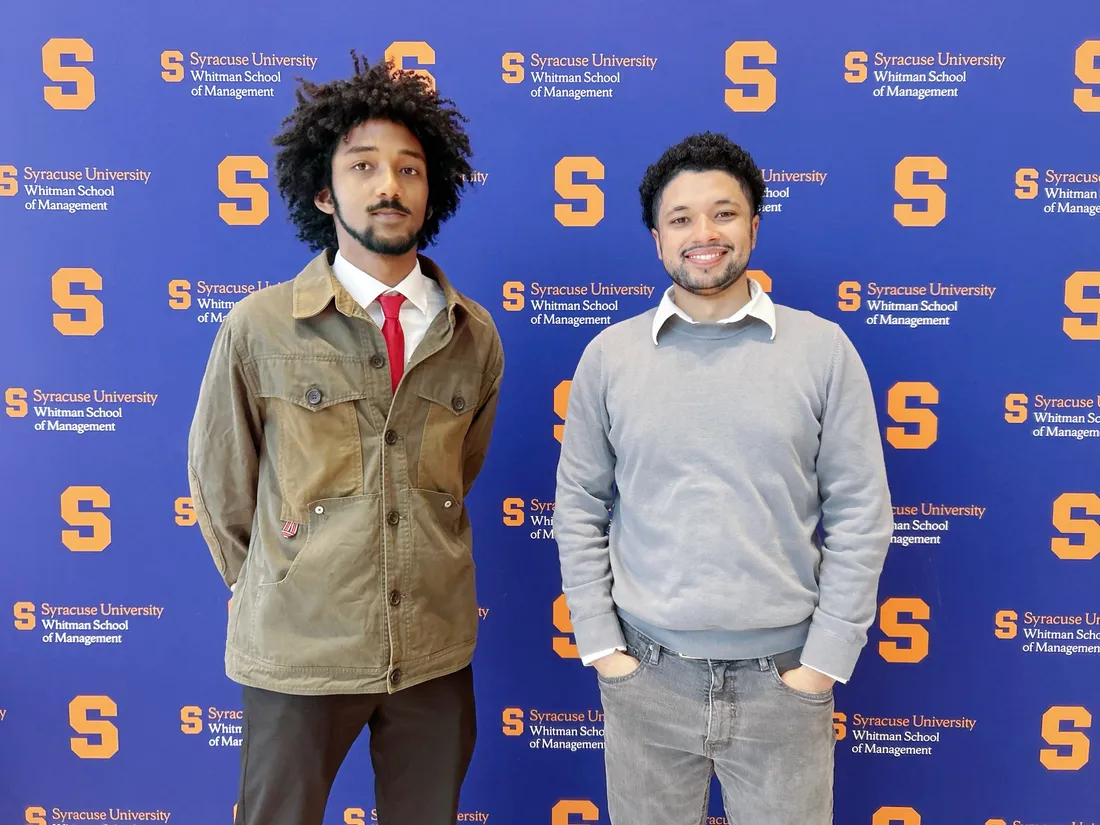
As entrepreneurs, Carter and Nunez pitched their startup, Gianode, at the Whitman School of Management’s Panasci Business Plan Competition.
During their ongoing research, Carter and Nunez have drawn on collaborative and interdisciplinary skills they developed in the School of Architecture. Carter worked as a research assistant in Wilson’s lab, which features research on mycelium-based composite materials. They also received a grant from SOURCE (Syracuse Office of Undergraduate Research and Creative Engagement) and guidance from Couri Hatchery program manager Indaria Jones ’14, who helped them connect their research to developing Gianode as a business.
With support from the National Grid Foundation and the nonprofit Buffalo Go Green, they are creating an educational program focused on food and energy security for Buffalo youth. Since graduation, Nunez is a deputy project manager at AECOM, a Fortune 500 firm, and Carter is working with School of Architecture Advisory Board member Colline Hernandez-Ayala ’89, who heads Blackbird Urban Design Studio, to develop an architecture firm focused on affordable housing. The two continue to pursue external funding opportunities to move Gianode forward.
It was inspiring to know that professors are actively looking for solutions to the problems we face globally, and I hope to contribute to this narrative.
Jon Carter ’26
In collaboration with Buffalo Go Green, they plan to introduce the youth educational program in Barbados in three years and meet with government officials. “We are actively reaching out to local governments and organizations to implement this research for the people on the island who can benefit from it the most,” Carter says. “We just want to keep the ball rolling.”