- Aerospace engineering major Emanuel Boutros ’27 has immersed himself in projects involving indoor air quality, fluid dynamics, music and math education.
- Research at the Syracuse Center of Excellence in Environmental and Energy Systems created the opportunity for Boutros to contribute to a paper and give a presentation at an international conference.
- This summer, Boutros is researching urban air flow and its impact on drone flight.
Cleaner indoor air, the history of organ music, mathematics education linked to social justice, drones navigating a city skyline—the research Emanuel Boutros ’27 does sounds complex, but all of it starts the same. “The only thing that ties my projects together is any research starts with a question,” says Boutros, a Renée Crown University Honors student and aerospace engineering major in the College of Engineering and Computer Science. “And if the question is interesting, I want to work on it.”
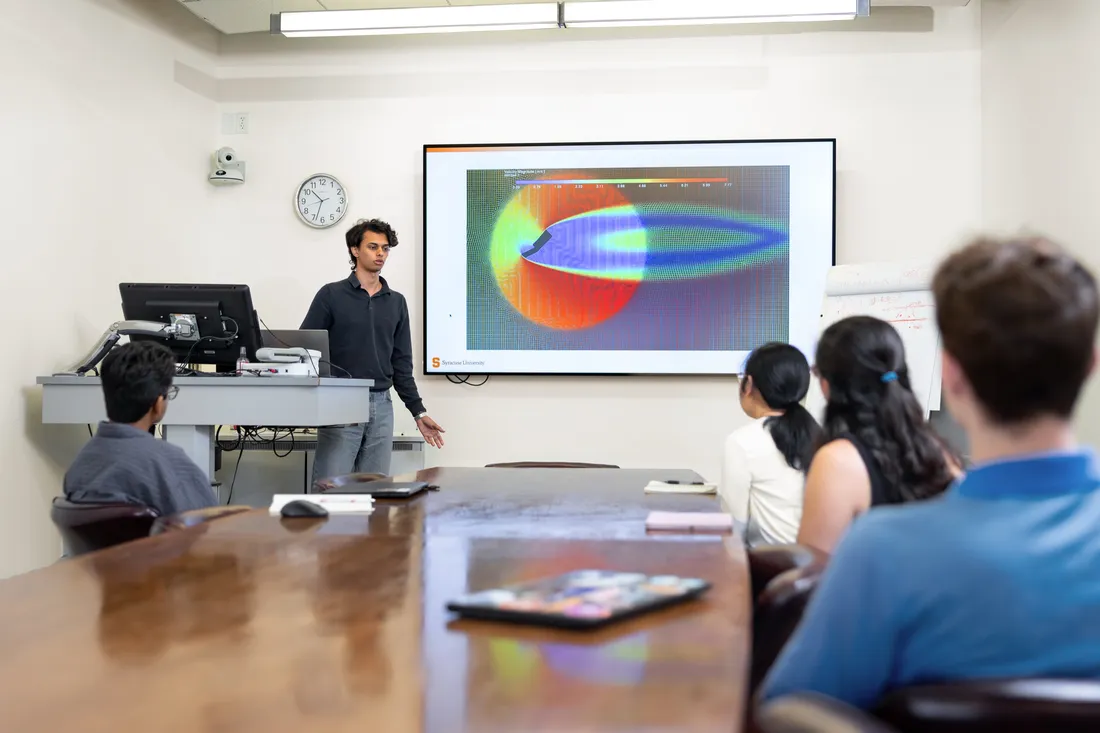
Aerospace engineering major Emanuel Boutros ’27 gives a presentation on his urban airflow project during a weekly meeting with Professor Yiyang Sun and other members of her undergraduate research team. The image represents an early 2D version of the flow field around the Center of Excellence building, and Boutros is explaining corrections he needed to make to improve its accuracy.
This summer he’s exploring how urban airflow could influence drone use for the delivery of medicine. When traffic congestion slows the delivery of medications or supplies to an emergency, drones offer a faster alternative. “Because of their size and shape, drones are affected easily by turbulence, and this turbulent airflow is very pronounced in dense urban areas with buildings and skyscrapers,” he says. “We want to understand this air movement, so we can understand its effect on drones and whether they will be functional.”
With the support of a Bridge Award from the Syracuse Office of Undergraduate Research and Creative Engagement (SOURCE), Boutros runs computer modeling simulations in the Fluid Dynamics Lab of Yiyang Sun, assistant professor of mechanical and aerospace engineering. As a case study, he’s using the uniquely shaped Syracuse Center of Excellence in Environmental and Energy Systems (Syracuse CoE) building.
He’ll build the model in stages, moving from a 2D flow-field study to a 3D one and will ultimately model a drone as a large particle navigating through the flow using the simulation. “Simulation is very interesting to me because we can see and describe exactly the movement of the air and how it interacts with objects,” he says.
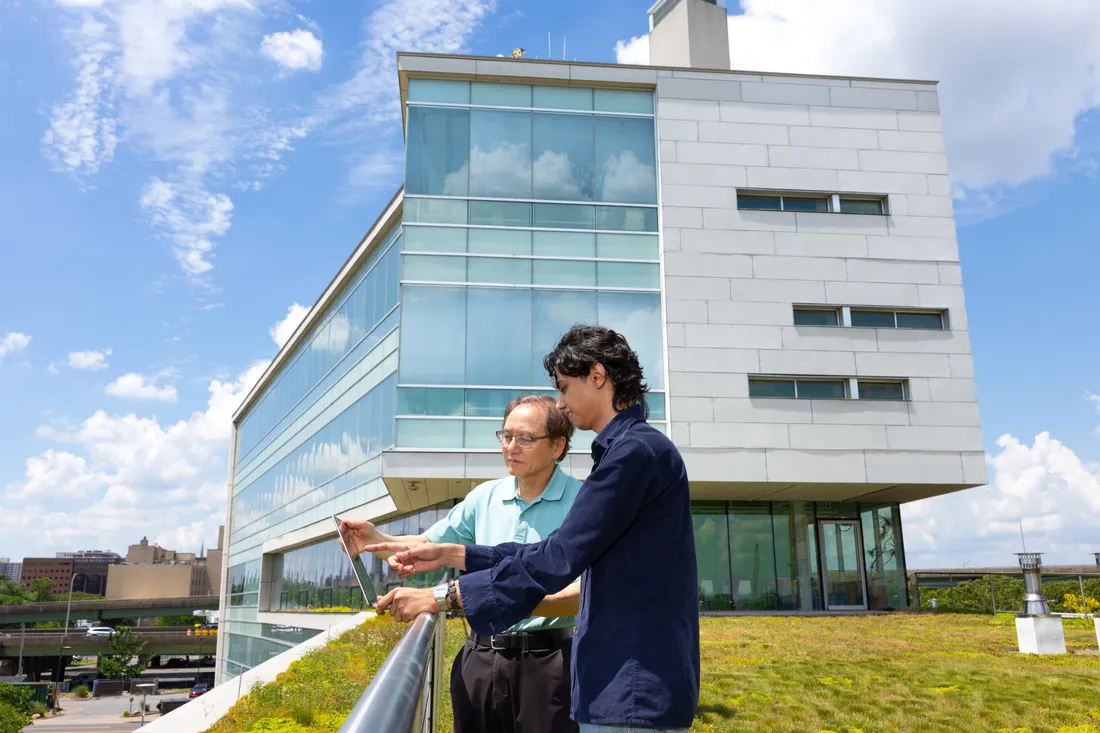
Boutros shows Professor Jianshun “Jensen” Zhang, executive director of the Syracuse Center of Excellence in Environmental and Energy Systems, how he’s modeling air flow around the uniquely shaped Center of Excellence building. Boutros previously worked with Zhang on an indoor environment research project.
Among the challenges will be characterizing wind movement and changes in the velocity flow-field when it hits the building and causes turbulence. This shift creates vortices—swirls of wind—and a phenomenon known as vortex shedding, where the flow peels off the building in a repeating train of vortices. “If a drone is flying where there’s a lot of vortices, it won’t be able to maintain a straight-line movement,” he says.
It was a fluid dynamics course, taught by mechanical and aerospace engineering associate professor John Dannenhoffer, that motivated Boutros to major in aerospace engineering. From there, Sun’s Compressible Flow course drew him to her simulation lab. Sun appreciates Boutros’ enthusiasm and his collaborative approach to research. “I truly enjoy mentoring and working with Emanuel on research,” Sun says. “He is highly driven and has great potential to develop into a successful independent researcher.”
Exploring Performance in an Indoor Environment
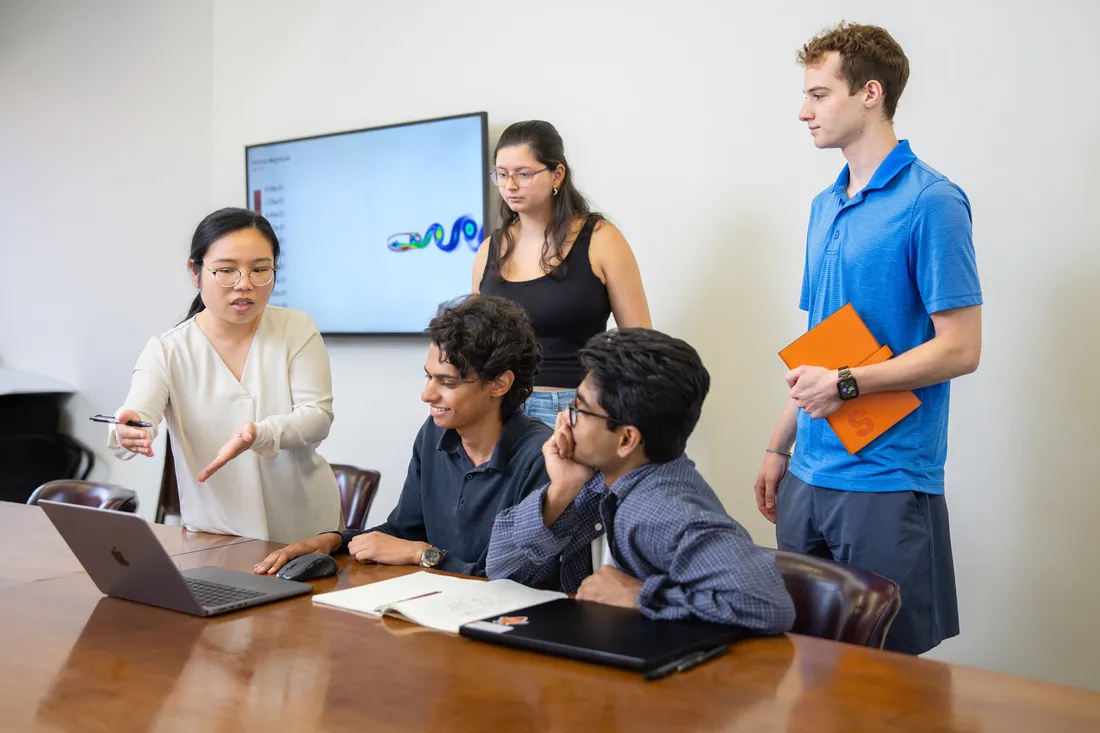
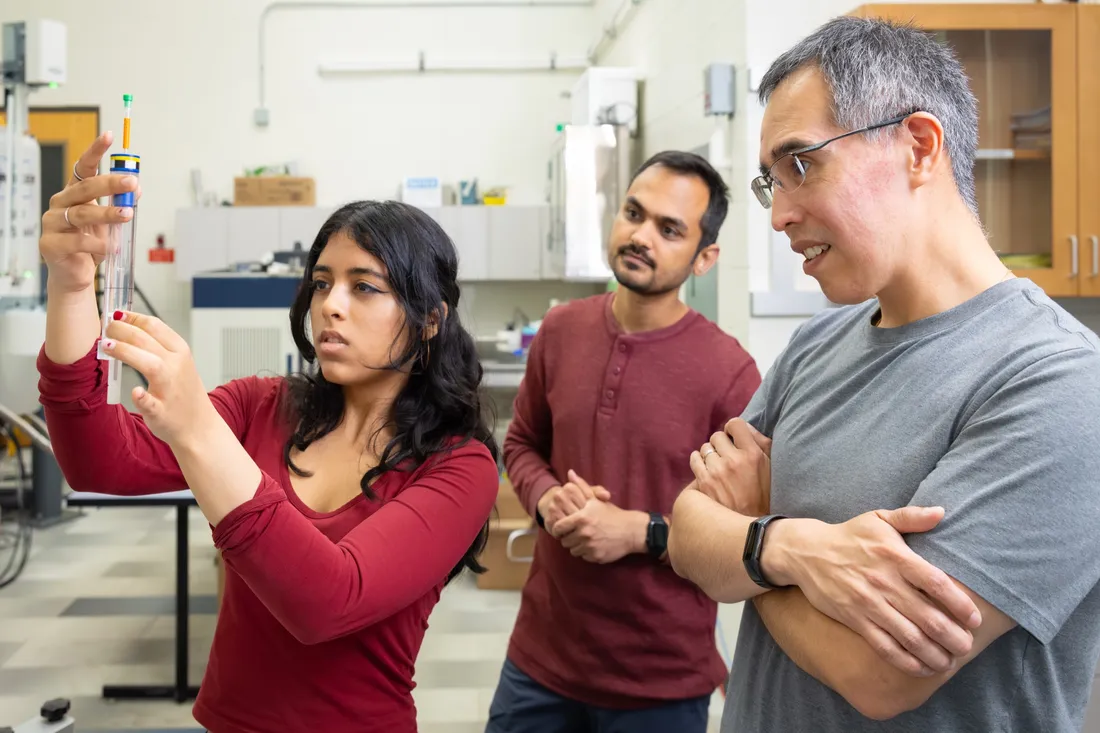
Professor Yiyang Sun (left) shares an insight on Boutros’ research as he looks on with fellow undergraduate researchers (from left) Sona Flask ’27, Darren Prashad ’26 and Owen Hedgelon ’27.
As a research intern at Syracuse CoE, Boutros spent three years studying a personal environmental control system designed to improve the comfort, health and performance of office workers. “Emanuel was highly motivated, diligent and thoughtful in accomplishing the work,” says Jianshun “Jensen” Zhang, professor of mechanical and aerospace engineering and executive director of Syracuse CoE.
Working under Zhang, Boutros got the system’s personal ventilation units into working order, wrote an operation manual and tested them with sensors—measuring airflow, air speed and temperature. He then ran an office-environment experiment with more than 120 participants to gauge the units’ effect on comfort, productivity and cognition, assisting Xin Guo, a Ph.D. student working with Zhang. The work led to a conference paper and a presentation with Zhang’s team in May at the International Conference on Indoor Air Quality, Ventilation and Energy Conservation in Buildings in Los Angeles. “Being at a conference for the first time was an amazing experience—getting to talk to people from every corner of the world who are doing the same exact work or similar work, and you can share what you’re doing,” he says.
Engaging with Organ Music and Mathematics
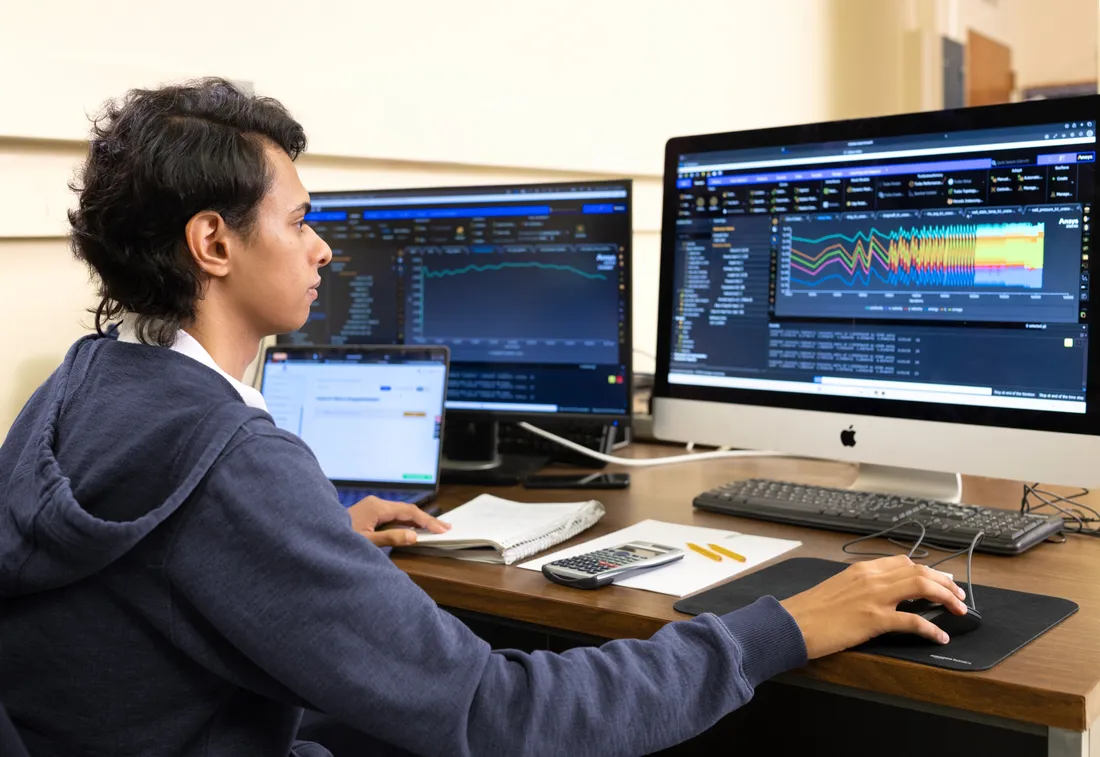
Boutros works on his airflow simulation modeling in Professor Sun’s lab in Link Hall. Along with a SOURCE grant to support this research, he’s received SOURCE awards for an online organ encyclopedia project and for a mathematics education-social justice initiative.
Along with his passion for research, Boutros has served as a First-Year Seminar peer leader and is active in several student organizations. He also plays the organ and is earning a minor in private music study under the tutelage of Anne Laver, associate professor at the Setnor School of Music in the College of Visual and Performing Arts. Laver invited him to contribute to an online organ encyclopedia project that features biographies of underrepresented composers, organists and organ makers.
Boutros received a SOURCE grant to support that work as well as for a project with Nicole Fonger, associate professor of mathematics and mathematics education in the College of Arts and Sciences and School of Education. He worked with Fonger on incorporating local history and real-world issues into math lessons and collected and analyzed data on how students reacted to this methodology.
For Boutros, it’s all about learning. “I like sitting in a class and learning from a professor explaining an interesting topic,” he says. “And research is learning. I like to make some sort of contribution.”