- Syracuse University has one of the nation’s top business schools for undergraduates.
- Experiential learning opportunities and mentorships help students turn dream careers into reality.
- Alumni are a valuable resource, returning to campus to guide founders and their ventures.
As a youngster, Trey Augliano ’27 spent hours browsing the U.S. Patent and Trademark Office website. “I had a thousand patent ideas before I was 12,” he recalls with hint of hyperbole. “I love building things.”
This same enthusiasm pervades his business studies at Syracuse University, where he has participated in the ‘CUSE Student Venture Accelerator. For six weeks, Augliano and a dozen other student founders engaged in hands-on learning and mentorship building in the Couri Hatchery Student Business Incubator.
“The University has one of the biggest entrepreneurial communities I’ve ever encountered,” says Augliano, a junior majoring in marketing management and entrepreneurship and emerging enterprises (EEE) in the Martin J. Whitman School of Management. “The mentors and advisors at Syracuse genuinely care about what you’re creating.”
They include Linda Hartsock, founder and retired executive director of Syracuse University Libraries’ LaunchPad.
She was among six facilitators who helped Augliano navigate his entrepreneurial journey—a science-based, direct-to-consumer beauty retailer called Utopia.
“Linda taught me to think about Utopia not just as a product, but also as a platform with an infrastructure behind it,” he says. “She helped me see how different parts of my business connect with one another. They’re where real value lives.”
Syracuse has one of the biggest entrepreneurial communities I’ve ever encountered. The mentors and advisors genuinely care about what you’re creating.
Trey Augliano ’27
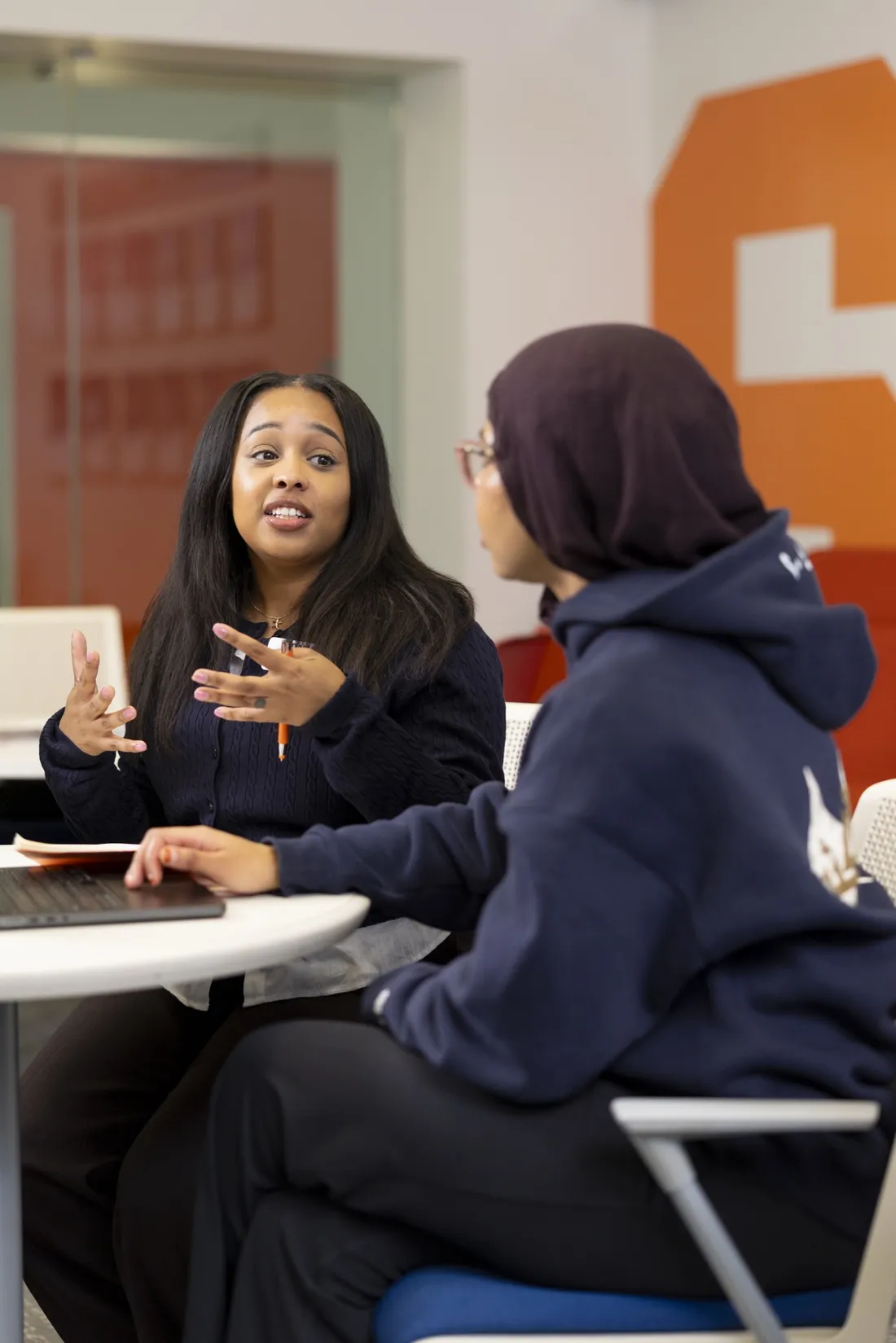
Indaria Jones ’14 directs the ‘CUSE Student Venture Accelerator. The six-week program is part of the Couri Hatchery Student Business Incubator, which she has reactivated.
Indaria Jones ’14 hears these kinds of comments a lot. The award-winning business leader established the accelerator as an extension of the Couri Hatchery, which she reactivated in 2022. The goal of both programs is to foster an entrepreneurial ecosystem in the Whitman School.
“The accelerator emphasizes hands-on support for a small cohort of founders ready to launch or scale,” says Jones, who has been recognized by Forbes 30 Under 30, CNY 40 Under 40 and the National Black Caucus of State Legislators. “We hold the program at the beginning of spring semester, so founders can prepare for the Panasci Business Plan Competition toward the end of the academic year.”
This year’s Panasci competition winner was Bruno Arriola ’28, who, along with his brother, Benjamin ’26, designed a clinician-first, AI copilot called MedicFlow.
Bruno credits the accelerator for teaching him how to communicate value. “Instead of building the technology, I focus on users, distribution and long-term impact. I now think more like an entrepreneur,” he says.
Coming Full Circle
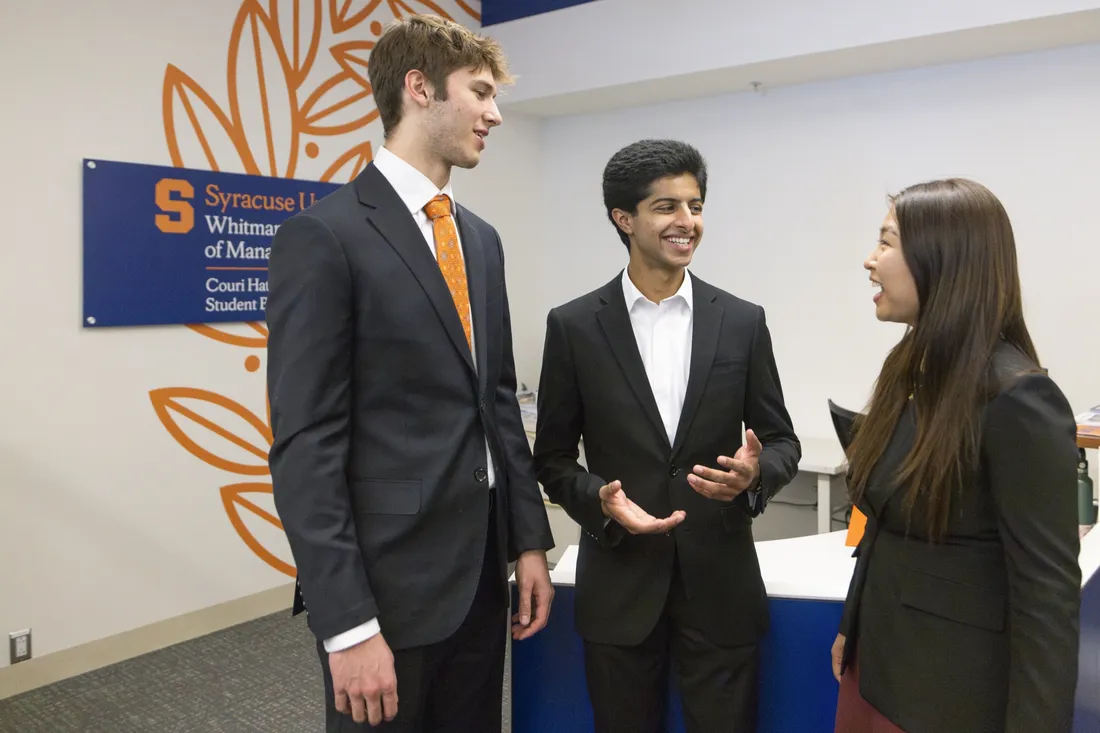
The Student Venture Accelerator contributes to the University’s entrepreneurial ecosystem, Jones says.
The Couri Hatchery is a crown jewel on campus. Located on the first floor of the Whitman building, it supports one of the few business schools in the nation with an academic department devoted solely to entrepreneurship: EEE.
Therefore, the Student Venture Accelerator exemplifies the hatchery’s innovative ethos. “Each session [of the accelerator] blends founder storytelling, candid discussion and Q&A. Participants get direct access to successful entrepreneurs,” Jones says.
This year’s accelerator culminated with a presentation by Joshua Aviv ’15, G’17, founder and CEO of a Boston-based, portable electric vehicle charger company.
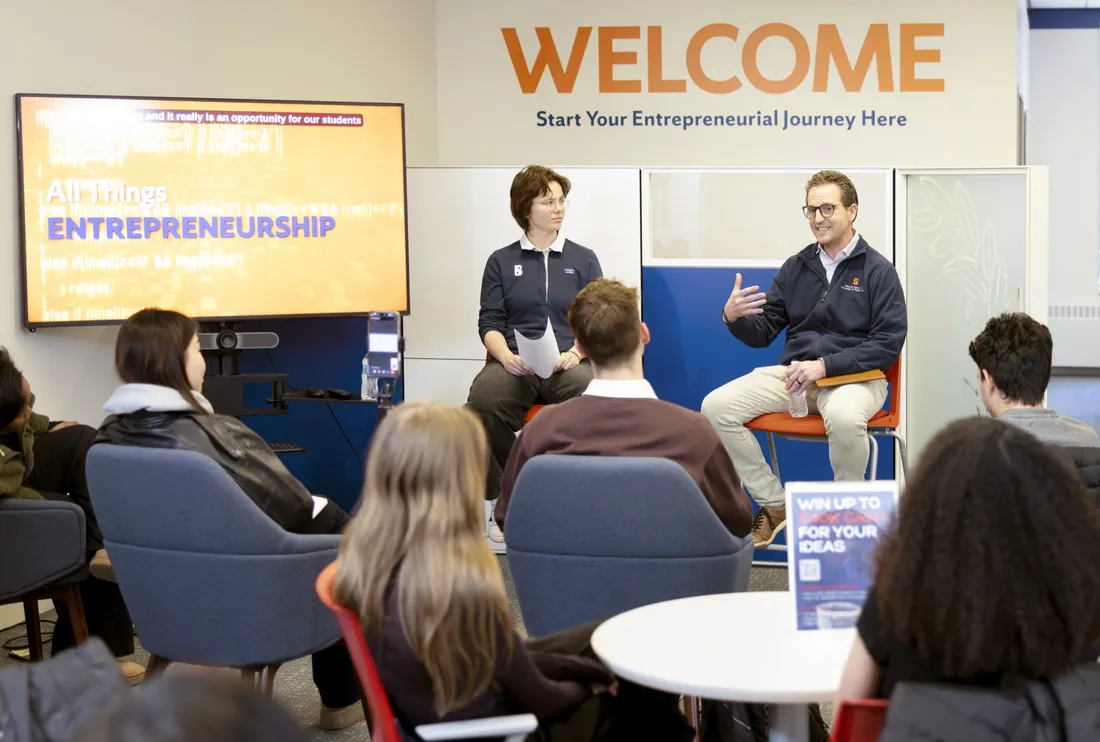
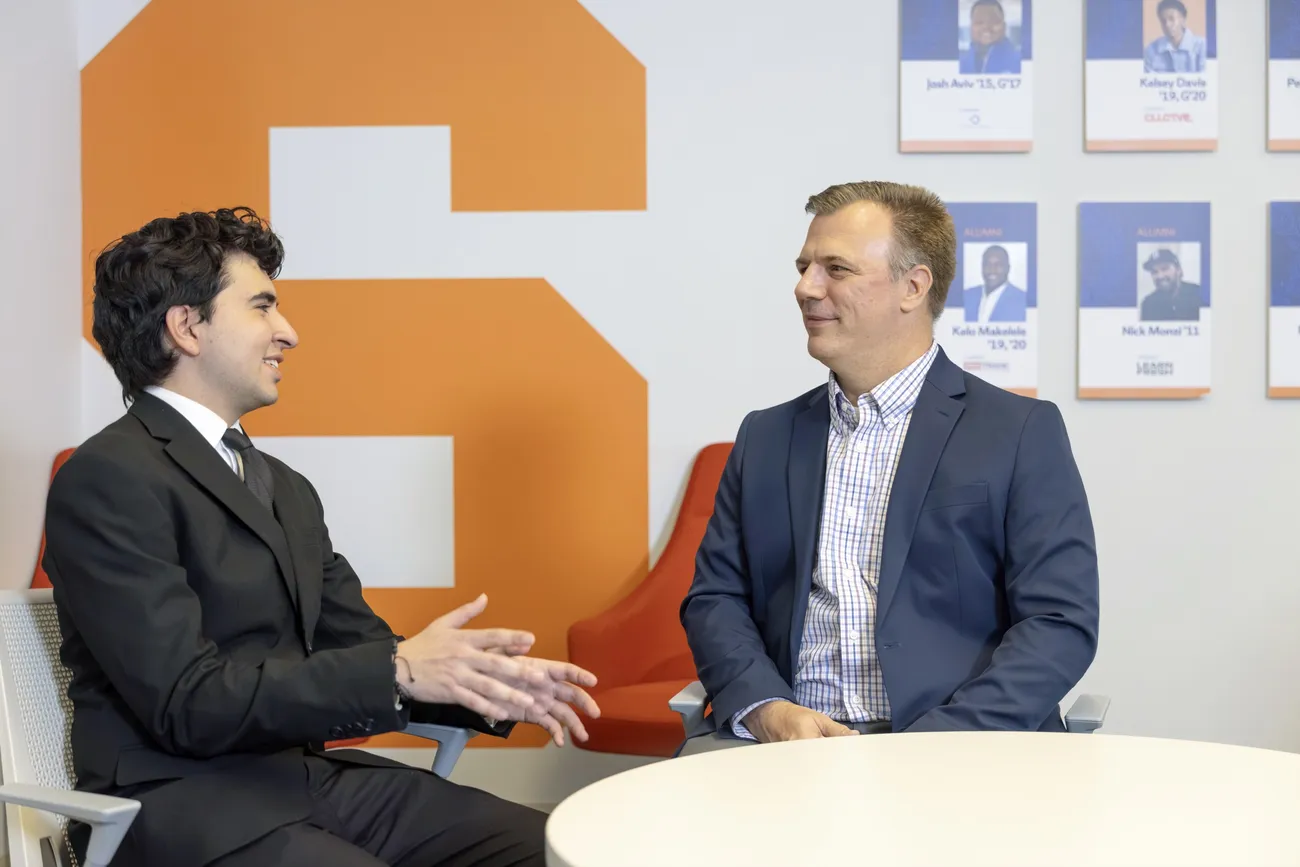
Peter Forsgren G’97 (right) with members of the Student Venture Accelerator. A ‘CUSE50 Alumni Entrepreneur awardee, he is co-founder and COO of a financial services company in Pittsford, New York.
The inaugural ‘CUSE50 Alumni Entrepreneur awardee recalled “sitting in the very same seat” as the audience. “I was a student entrepreneur-in-residence at the Couri Hatchery and an active student founder at the LaunchPad,” recalled Aviv, who built his prototypes in the MakerSpace and Syracuse Center of Excellence in Environmental and Energy Systems.
He told attendees to “always be pitching [because] you never know what will become of it.” Case in point: Aviv scored a $1 million investment on ABC’s Shark Tank, joined Techstars’ global network and visited the White House.
His story, from start to scale, “brought the accelerator full circle,” Jones says.
Exceeding Expectations
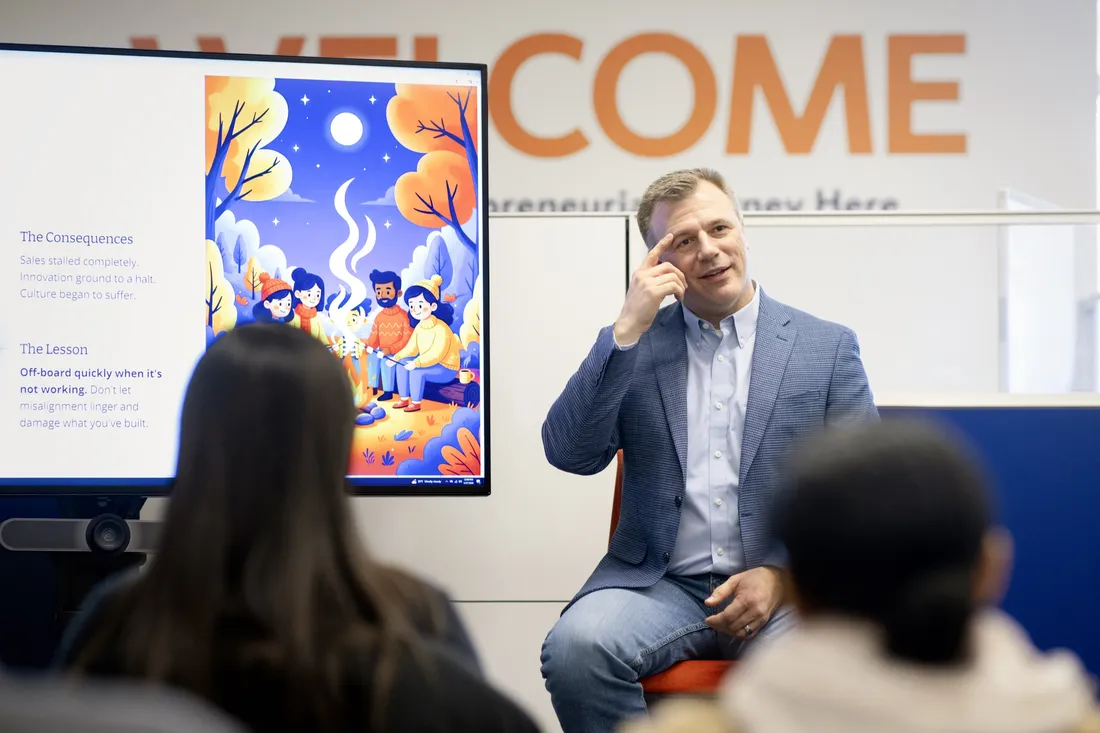
Frank Shultz ’03, a ‘CUSE50 Alumni Entrepreneur winner, operates a Philadelphia-based venture studio. He encouraged founders to think outside the box and question everything.
Aviv’s remarks particularly resonated with the husband-and-wife team of Alexis and Jayson Bromley. Members of the Class of 2014, they’re co-founders of Bromley Bio Med, a medical device venture in New York state’s Southern Tier.
The Bromleys prove that the accelerator is a free service for everyone, including alumni, affiliated with Syracuse and the SUNY College of Environmental Science and Forestry.
“The program exceeded our goals and expectations,” says Alexis, a physician who has co-designed a novel incision and drainage (I&D) medical device called InDeazy. “We learned how to grow and scale our business while building meaningful relationships through networking.”

Alexis Bromley ’14 (pictured) and her husband, Jayson ’14, have designed a novel incision and drainage medical device called InDeazy. She says the accelerator “exceeded their goals and expectations.”
Some of the Bromleys’ conversations were with venture capitalists from the Orange Business Angel Network.
Others were with mentors like Frank Shultz ’03, a ‘CUSE50 Alumni Entrepreneur winner operating a venture studio in Philadelphia.
“Frank took us through the process of starting a business, referencing the successes and failures he’s encountered along the way,” Alexis continues. “He taught us a lot about leadership development.”
The Bromleys also frequented the MakerSpace to refine their prototype—a “small, sterile instrument that completes the entire I&D process in under three minutes,” declares Jayson, an NFL player-turned-biotech innovator.
His and Alexis’ interest in customer discovery (a scientific process that validates core business assumptions) inspired her to enroll in a five-week course sponsored by the National Science Foundation.
“It complemented the accelerator experience and reminded us not to create solutions to problems that don’t exist,” she says.
Breaking the Mold
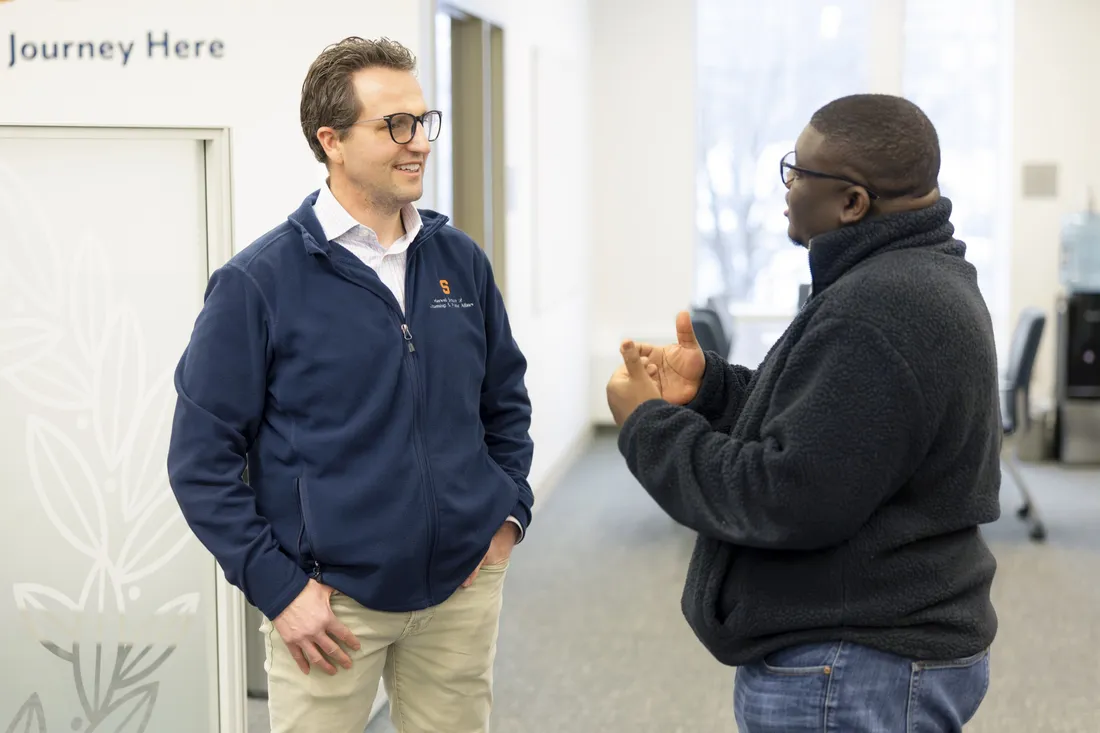
A student founder shares a candid moment with Forsgren (left). “The best leaders inspire those who want to grow with their company,” Forsgren said.
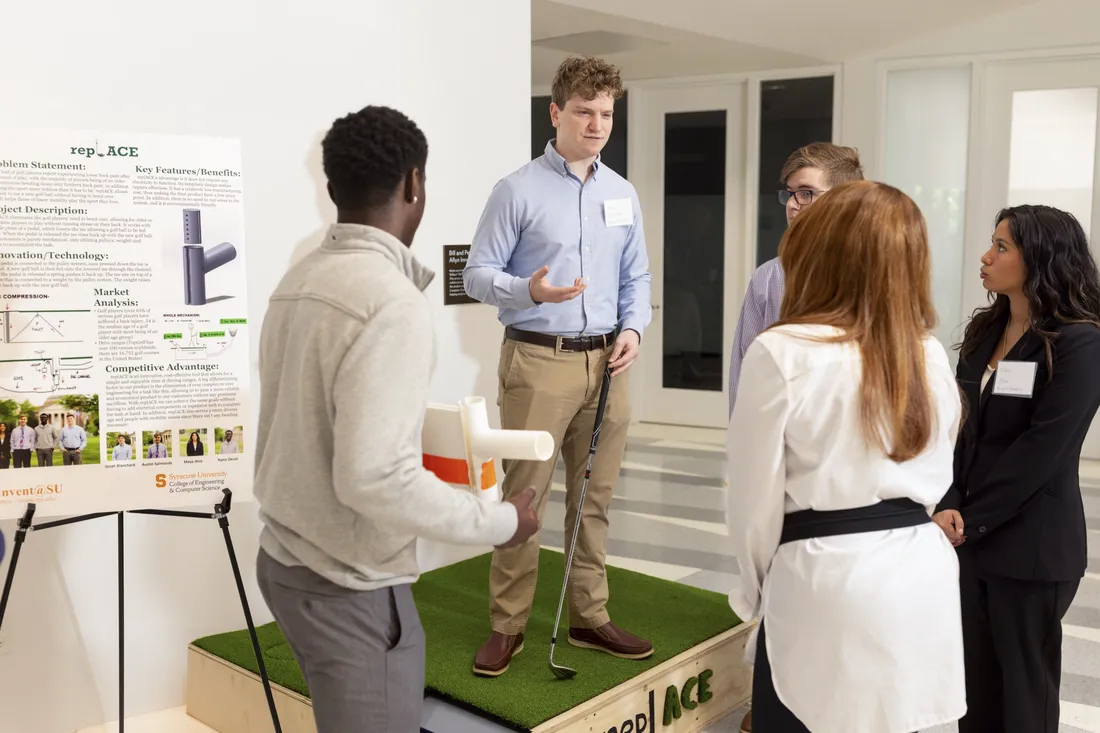
Products in the Student Venture Accelerator span multiple industries. From a web-first experiential learning platform to a healthy ice cream alternative to an NIL-inspired program for emerging filmmakers, the program buzzes with activity.
“The best way to learn entrepreneurship is to do it,” states Professor of Entrepreneurial Practice John Torrens G’93, who also is EEE’s deputy department chair. “The accelerator gives founders a structured sprint with real mentorship and accountability.”
The program also has the distinction of promoting entrepreneurship and intrapreneurship.
Peter Forsgren G’97, co-founder and COO of a financial services company in Pittsford, New York, notes that an entrepreneur operates independently, whereas an intrapreneur innovates within the structure of an existing business.
“Both have similar goals, but intrapreneurship is an excellent growth element for entrepreneurs and small companies,” adds the ‘CUSE50 Alumni Entrepreneur awardee.
Programs like the Student Venture Accelerator encourage founders to question everything and break the mold.
Frank Shultz ‘03
During his visit to campus, Forsgren invited founders to surround themselves with people who believe in what they’re doing. “The best leaders inspire those who want to grow with their company,” he said, referring to employees, shareholders and customers.
Shultz agrees, adding that outside-the-box thinking fosters long-term success.
“Programs like the Student Venture Accelerator encourage founders to question everything and break the mold,” he says. “Attendees learn from our tales about climbing the mountain, while we, in turn, benefit from their energy and unbiased perspective.”