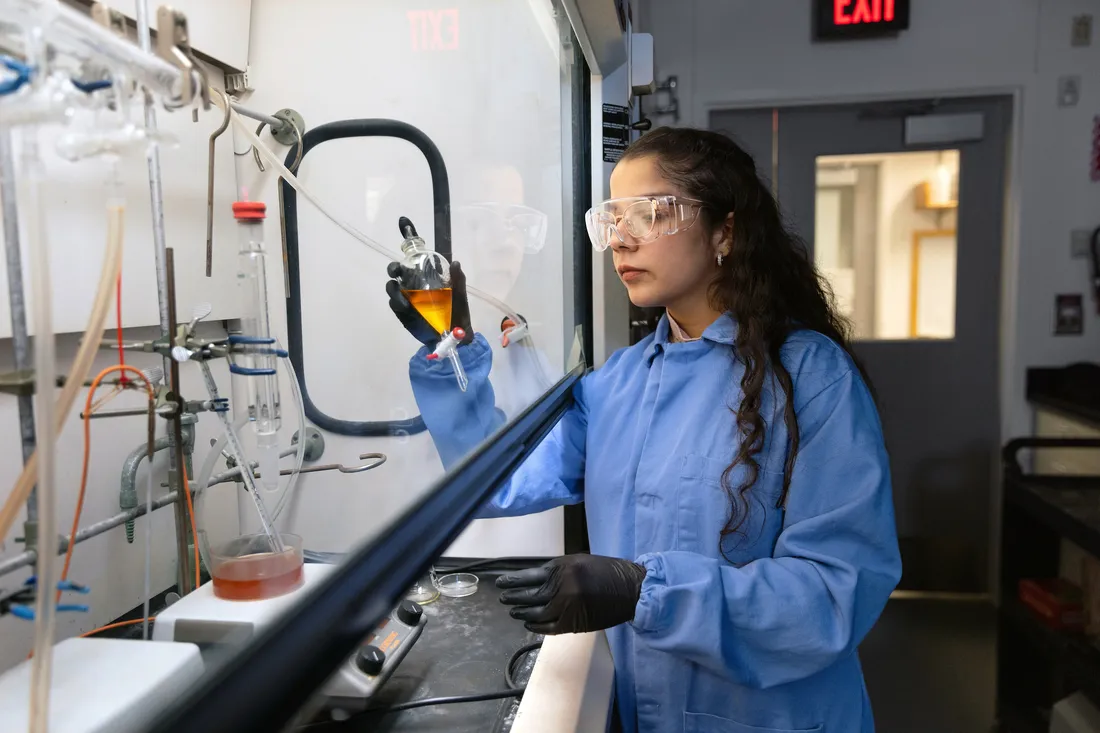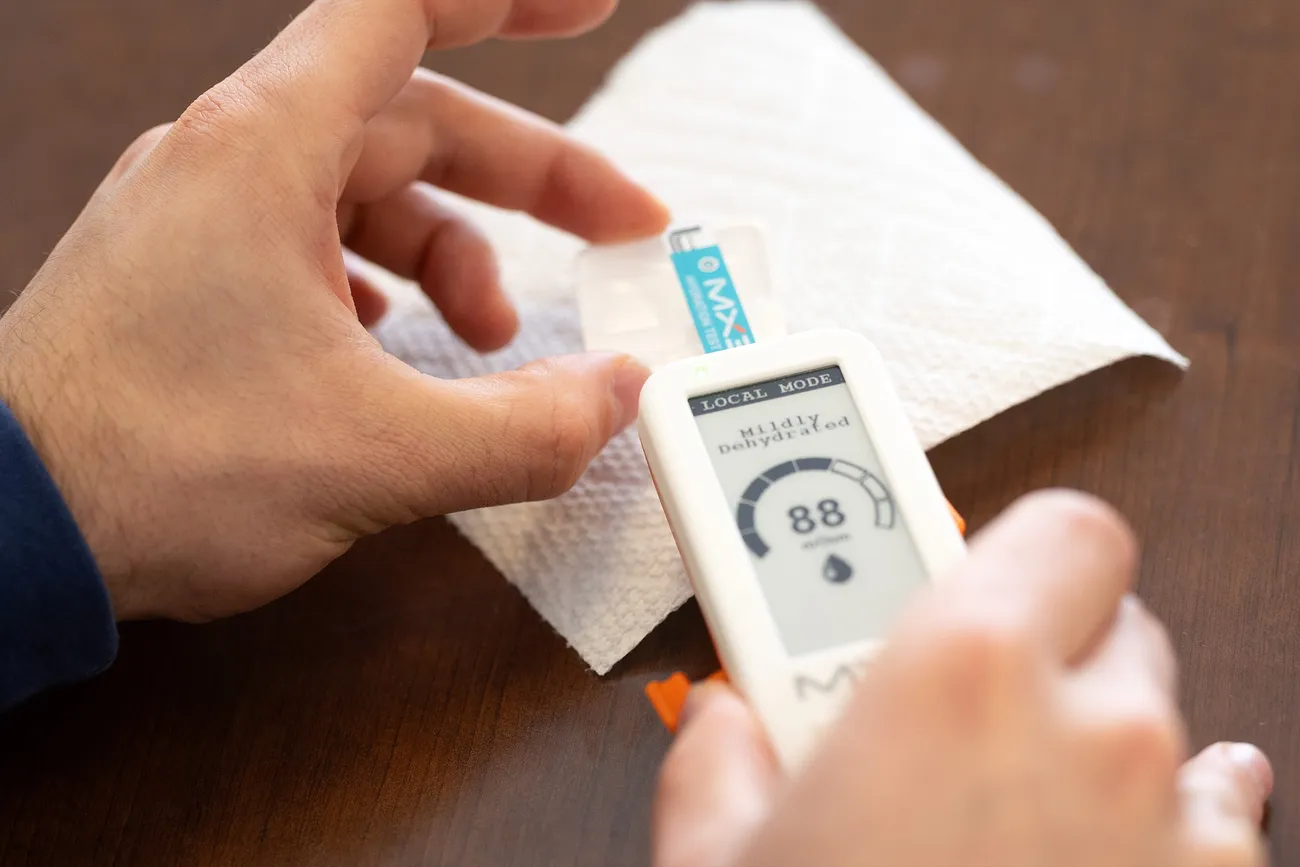
Experiment one: Apply a saliva test strip to the tip of your tongue to measure hydration level.
Experiment two: Attach electrodes to your hands and feet and send an electrical current through your body to determine its composition.
Experiment three: Step inside a Bod Pod, displacing air to measure your body volume.
Analyze: Examine data collected, compare hydration differences after consuming sports drinks and water, ask questions and create a report.
This is what undergraduate research at Syracuse University can look like.
“I always like to encourage undergrads to know that research is a fun, creative process,” said Jessica Garay G’18, G’23, assistant professor of nutrition and food studies at the David B. Falk College of Sport, who led one cohort of the Syracuse Office of Undergraduate Research and Creative Engagement (SOURCE) Explore program. “I hope this showed them that there are fun, hands-on things you can do that are research and can be applicable to your life, regardless of your career path.”
Introducing Research Opportunities
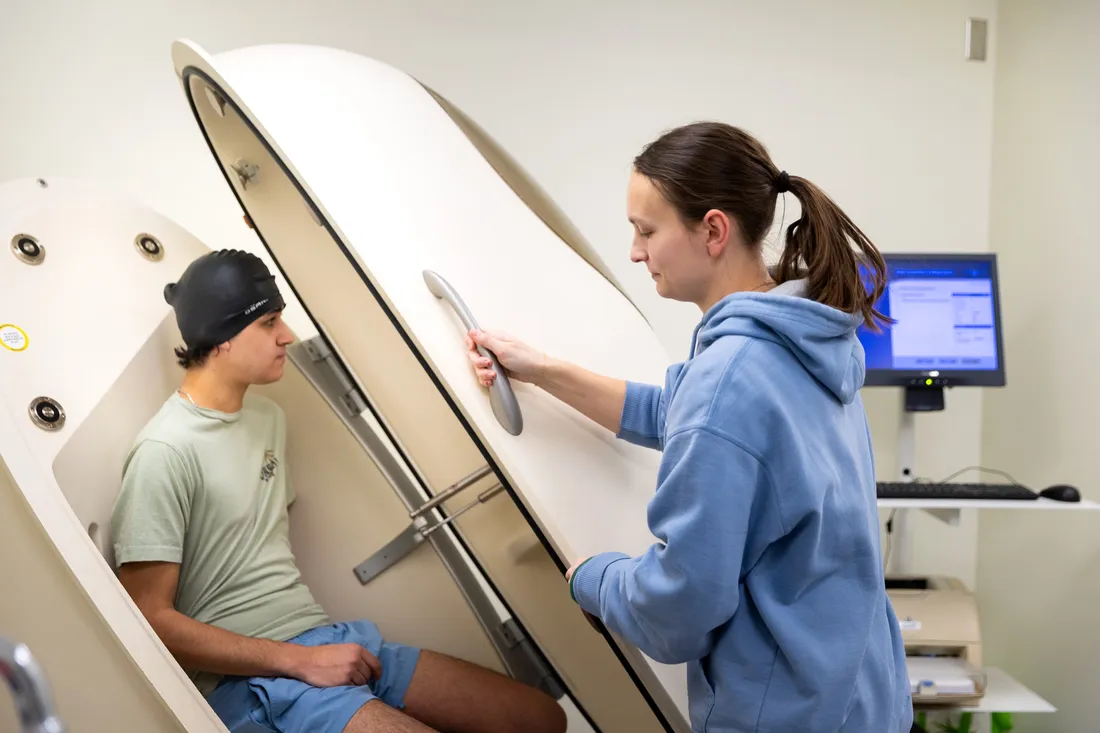
With assistance from exercise science doctoral student Meredith Krieger, health and exercise major Gabe Patel ’29 enters the Bod Pod at Falk College during a SOURCE Explore workshop that examined the relationship between body composition and hydration status.
Garay’s work with the students was one of six six-week workshops featured in the SOURCE Explore program, which introduces first- and second-year students to research and ongoing opportunities with SOURCE. Health and exercise science major Gabe Patel ’29 appreciated that the experience related to his major and career alignment. “SOURCE is such a good opportunity to get into research,” he said. “Having this program as a steppingstone really opens up a lot of possibilities.”
Other workshops focused on archival research, artificial intelligence, communications, fashion design and military history. The students were also mentored on creating poster presentations and giving pitches on their research. They presented their findings at a poster session on Feb. 27.
“First- and second-year students sometimes don’t feel like they have the skills or confidence to pursue research, and the Explore program shows them that not only can they learn and develop these skills, but they bring a lot to the table themselves,” said SOURCE assistant director Odette Marie Rodríguez G’25. “These projects have pushed the students to grow and test themselves and have also shown that they have the kind of skills necessary to pursue undergraduate research.”
Capturing Veteran Stories
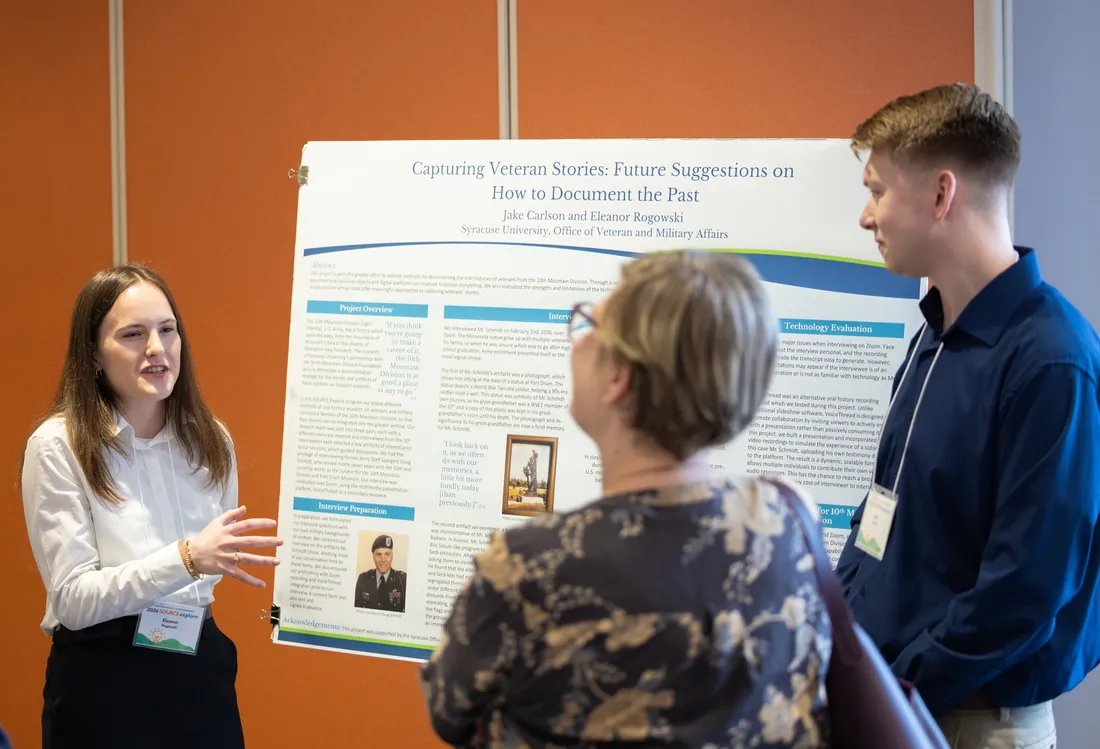
Air Force ROTC cadets Eleanor Rogowski ’28 (left), a history and international relations major, and Jake Carlson ’29, an information management and technology major, discuss highlights of the interview they conducted with Army veteran Doug Schmidt, curator for the 10th Mountain Division and Fort Drum Museum.
Grace Chavez ’29, an Army ROTC cadet majoring in political science, and Alec West ’28, a history and economics major, embraced the opportunity to contribute to an oral history project with military veterans. “The preservation of oral history is incredibly valuable not just for historical purposes but also for understanding how to work with veterans in other areas,” Chavez said.
Under the guidance of School of Information Studies associate professor Beth Patin, assistant professor Sebastian Modrow G’15 and doctoral student Isaac Meth, six students contributed to a collaboration with the Army’s 10th Mountain Division Foundation and Fort Drum Museum and the University’s D’Aniello Institute for Veterans and Military Families to test different recording technologies and develop a digital archive of veterans’ stories.
These projects have pushed the students to grow and test themselves and have also shown that they have the kind of skills necessary to pursue undergraduate research.
Odette Marie Rodríguez G’25, SOURCE assistant director
The students designed and conducted artifact-based interviews—a method championed from the start. “We’ve learned that when people have artifacts—a map, a picture, an item—they can often lock into that item and tell stories differently than if we were just having conversations,” Patin said.
That approach proved its power when Chavez and West conducted a studio interview with retired 10th Mountain Division Lt. Col. Marc Cleveland. A social work graduate student who served as a project facilitator, Cleveland shared a binder of letters and pictures from his time in the service. “He emphasized that these artifacts kept him going when the going got tough,” Chavez said. “It reminded him that he had people back home cheering him on.”
Patin and Modrow were impressed with the students’ dedication and effort in moving the project forward—and look for students to continue contributing to the project. “You could really tell they were as excited about the project as we were,” Modrow said. “You could feel their enthusiasm and passion, and it carried through the entire process.”
Weaving Looms on the Horizon

Jane Moss ’29, a public relations major with fashion design minor, creates a design pattern, working on a loom.
Students in the fashion design workshop, led by associate professor Todd Conover ’95, G’21 and assistant teaching professor Kirsten Schoonmaker, explored the relationship between materiality, structure and form and their interaction in different applications or environments. They were encouraged to see design as a system, reviewing pieces from a 1970s collection by the late fashion designer Bonnie Cashin. They also studied materials under a microscope. And while arts-based majors sometimes struggle to recognize their creative work as a form of research, Schoonmaker and Conover sought to shift that perspective through Explore, helping them see how their creative practices are research methods and tools for exploring themes and answering questions. They looked to demystify “research” for the students, noting it’s the act of asking questions, including sifting through information and following curiosity.
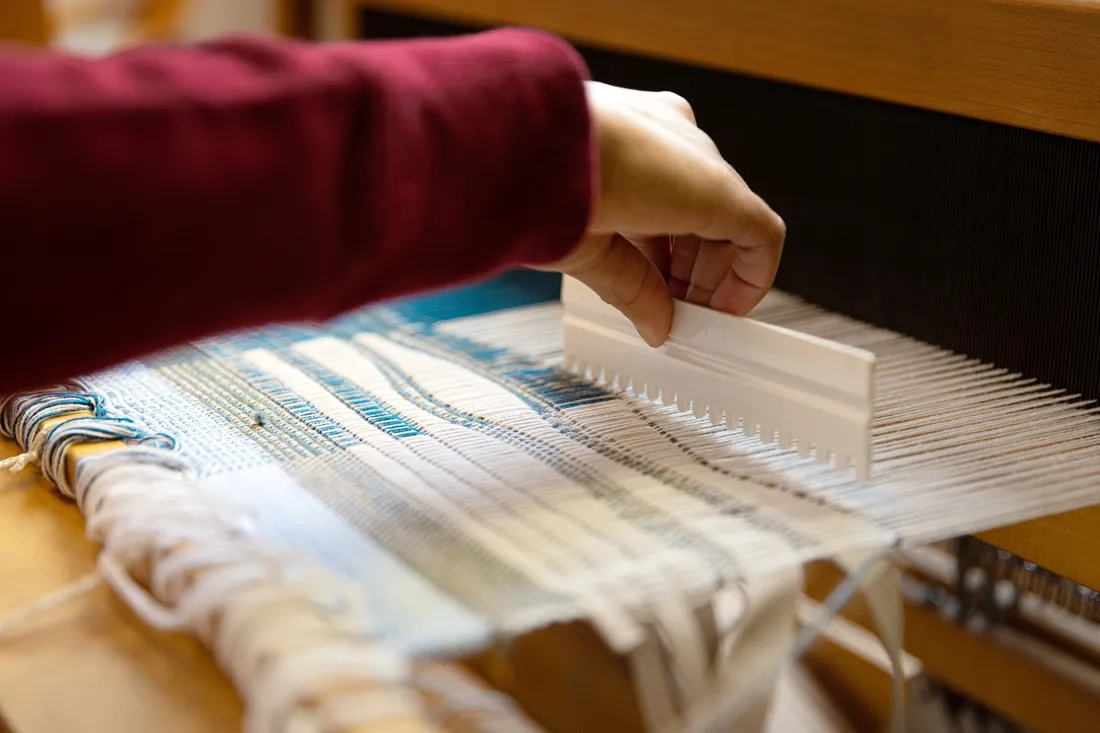
Weaving on a loom requires a steady hand to manage the fibers.
“It was interesting to see the thought process of people who design clothes,” said fashion design major Leila Pierre Louis ’28, who researched the history of the knitting machine and put the fashion design program’s one to use. “There are so many limits to the knitting machine. It was a lot of experimentation to see what’s possible, especially since you want to create unique designs.”
Fashion design major Shalease Allen ’28, who has an interest in fiber engineering and sustainability, discovered she liked to weave materials on a loom. “It was a great learning experience,” she said. “I learned a lot during the hands-on process of research and a lot more about myself and what I like in fashion.”
That’s exactly what Conover and Schoonmaker had in mind when they had the students use the program’s knitting machine and looms to create their projects. They watched as the students’ approach changed from tentative to all in. “By the end, they’d taken ownership of it,” Schoonmaker said. “It gave them a great opportunity to become confident in their ability to explore.”