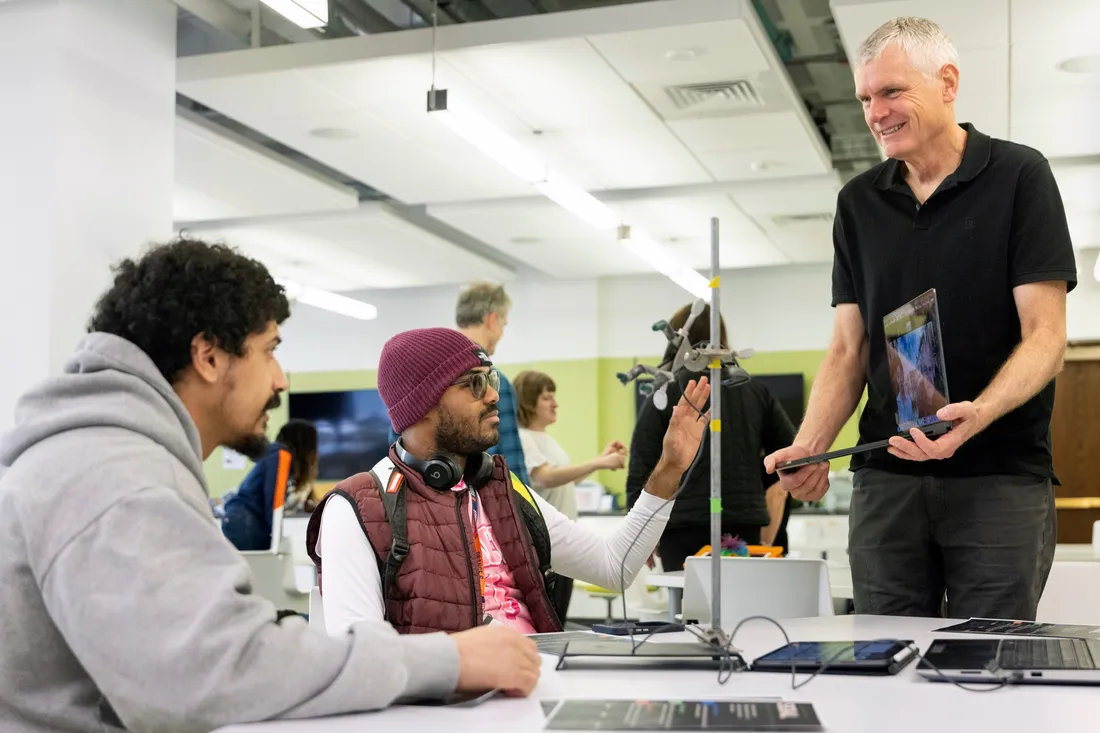
- Professor Jennifer Schwarz is a soft-matter physicist who studies how living and nonliving matter learns.
- She develops mathematical models to predict the behavior of materials like sand, cells and chromatin in cell nuclei.
- Her research has implications for disaster prevention, civil engineering, robotics, pharmaceuticals and machine learning.
At the southern tip of Cayuga Lake in Central New York lies a scenic, 40-acre farm. Billed as “Ithaca’s Orchard Playground,” the property is home to Syracuse University professor Jennifer Schwarz.
It’s also where she does some of her best thinking.
“The place offers a crash course in natural phenomena,” says the theoretical physicist, who occasionally invites students to extract DNA from raspberries or operate a tractor. “It shows me how small, individual parts interact to create complex, collective behaviors.”
A member of the Soft Matter Physics Group in the College of Arts and Sciences, Schwarz studies the behavior of tiny, deformable materials. They range from living matter, including cells, tissues and chromatin (RNA, DNA and proteins in chromosomes), to nonliving matter, like ordinary beach sand.
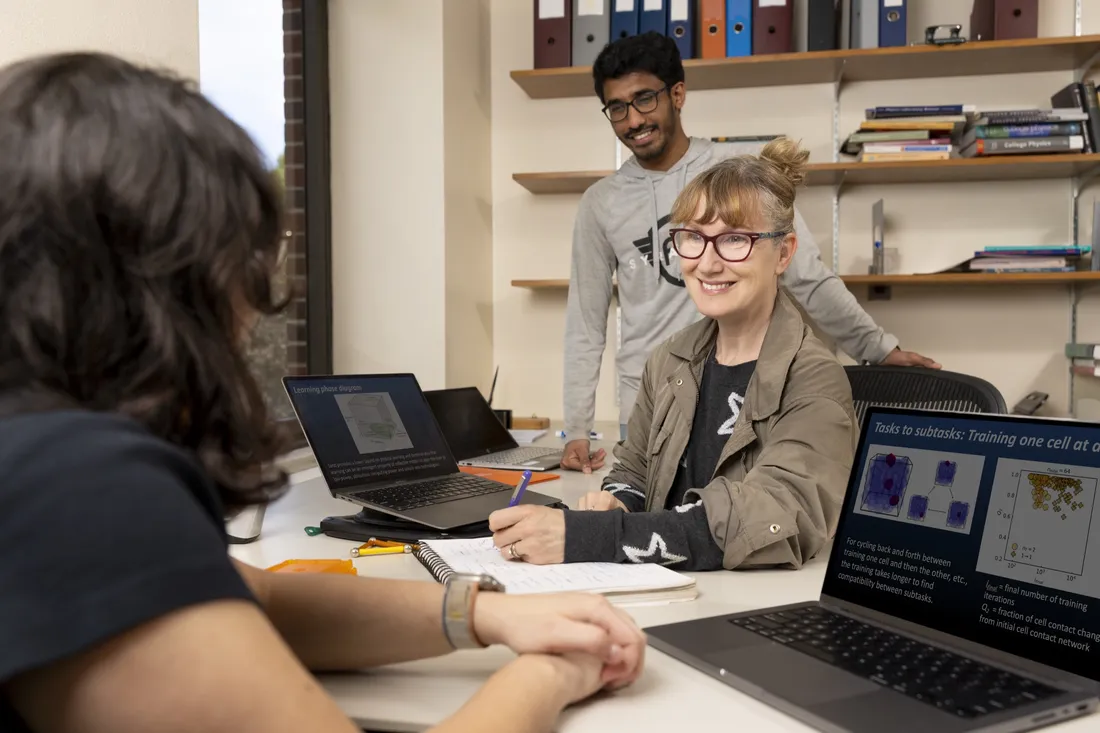
Professor Jennifer Schwarz is a theoretical physicist who studies how living and nonliving matter learns. “An experimentalist asks what happens. A theorist asks how it happens,” she says.
The activities of these systems are evident on Schwarz’s farm and her computer screens in Syracuse’s Physics Building.
“Everything is made of atoms,” she says, noting living and nonliving matter are governed by the same physical laws. “What changes is how the components are organized, interact and potentially modify their own interactions, giving rise to behaviors as diverse as rigidity and learning.”
Schwarz is particularly keen on how living and nonliving systems learn.
Instead of conducting experiments in a lab, she performs equations, algorithms and computer simulations that predict macroscopic behavior. “An experimentalist asks what happens. A theorist asks how it happens,” she clarifies.
While living and nonliving materials are made of atoms, their diverse architecture prompts a wide range of actions, movements and interactions.
Take sand, which has the uncanny ability to act as a solid, liquid or gas.
“Under a microscope, sand is a seemingly simple granular material. But when grains of sand interact to form large-scale, unpredictable systems [behavior described as ‘emergent’], they reveal fundamental lessons about soft matter,” Schwarz says. “One lesson is that learning is a property of matter itself.”
Driving the Direction of Research
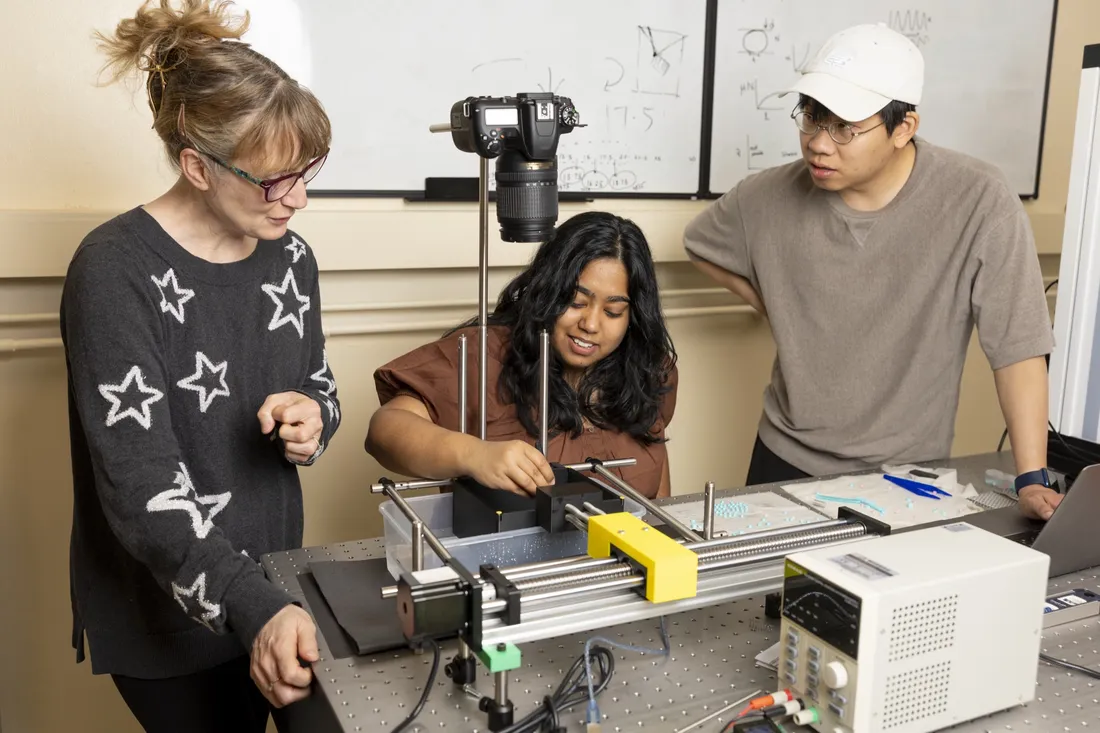
Schwarz with graduate researchers Ananya Verma and No “Arnold” Chen. “Jennifer lets experiments drive the direction of the research,” says Assistant Professor Nidhi Pashine.
Since joining the faculty in 2005, Schwarz has helped vault Syracuse’s soft-matter group to national prominence.
She characterizes soft matter as materials that are easily deformed by relatively small forces or changes in temperature.
Most soft matter contains disordered systems, which are collections of atoms without clearly defined behaviors and structures. “Disordered systems appear random and chaotic, but they’re not,” Schwarz says. “They follow strict, immutable laws of science and math.”
Working alongside professors Alison Patteson and Nidhi Pashine, she explains that disordered systems can process information and adapt to their environments—in other words, “learn”—differently.
“There’s associative learning, where matter establishes a connection between two or more different spatial regions,” says Schwarz, citing, as an example, the way in which Russian psychologist Ivan Pavlov trained dogs to associate the ringing of a bell with food. “Then there’s non-associative learning, where behavior increases or decreases in intensity after repeated exposure to a single stimulus.”
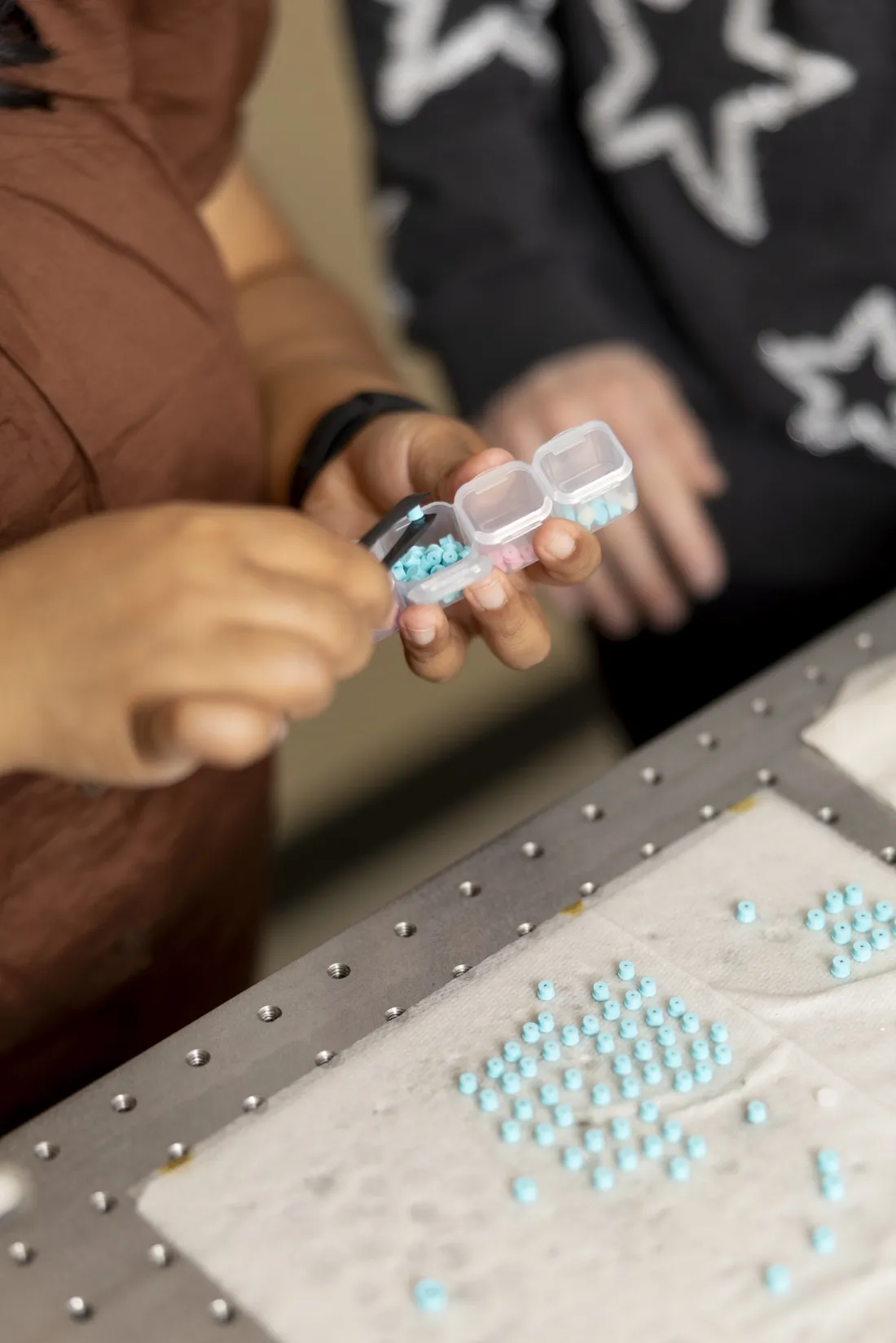
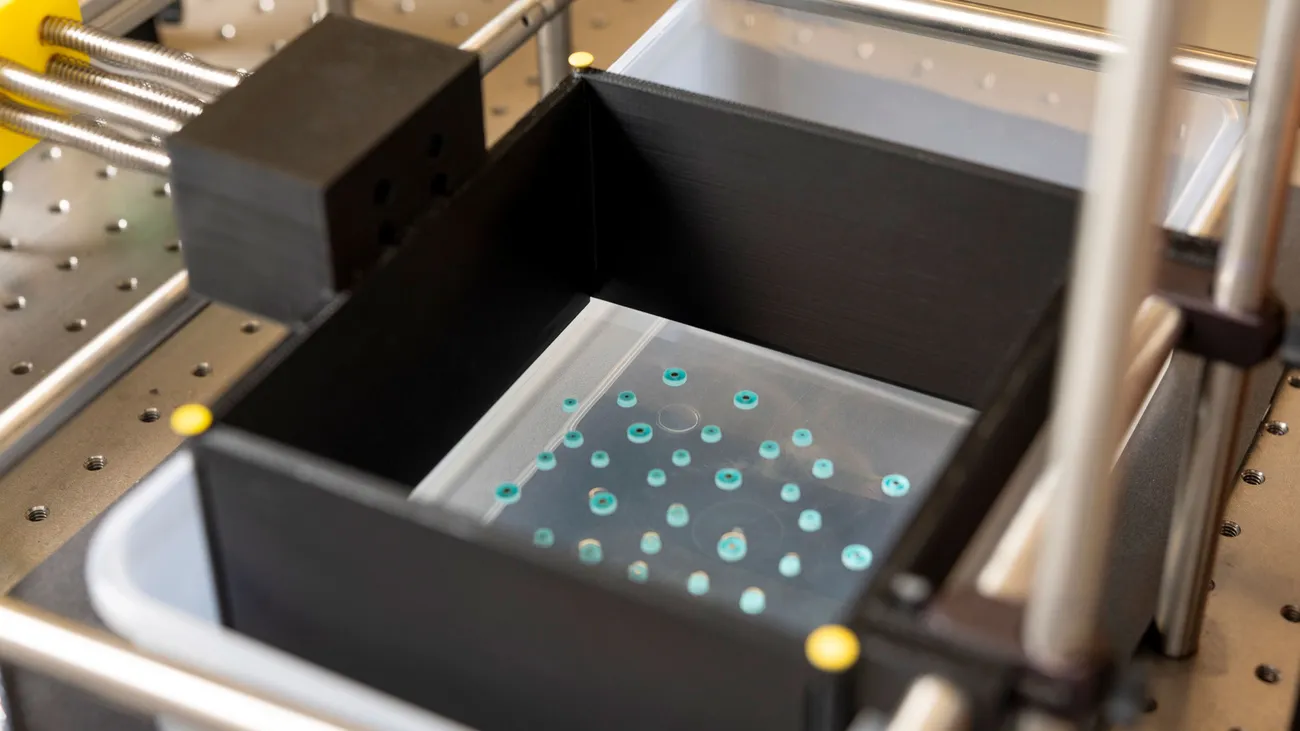
Working with 3D printed particles enables students like Verma to learn about emergent behaviors in different systems.
Convinced that sand can learn associations, Schwarz uses two-dimensional modeling to simulate particle-level behaviors.
“When grains of sand encounter stressors, they rearrange their contacts and force-bearing structures, transmitting mechanical information throughout the packing,” says Schwarz, who recently co-authored a preprint titled Learning Associations in Reconfigurable Particle Packings Via Local Cyclic Driving. “Microscopic activity can indeed dictate macroscopic behavior.”
Understanding how grains of sand come together to form a macroscopic granular system has many real-world applications—disaster prevention, civil engineering, robotics and pharmaceuticals, to name a few.
For this reason, Schwarz’s diverse background in materials science, biology and neuroscience is advantageous. “Jennifer lets experiments drive the direction of the research,” says Pashine, a frequent collaborator. “Due to her broad expertise ranging from neuroscience to condensed matter physics, she brings fresh and valuable perspectives to our collaborative work.”
The Power of the Liberal Arts
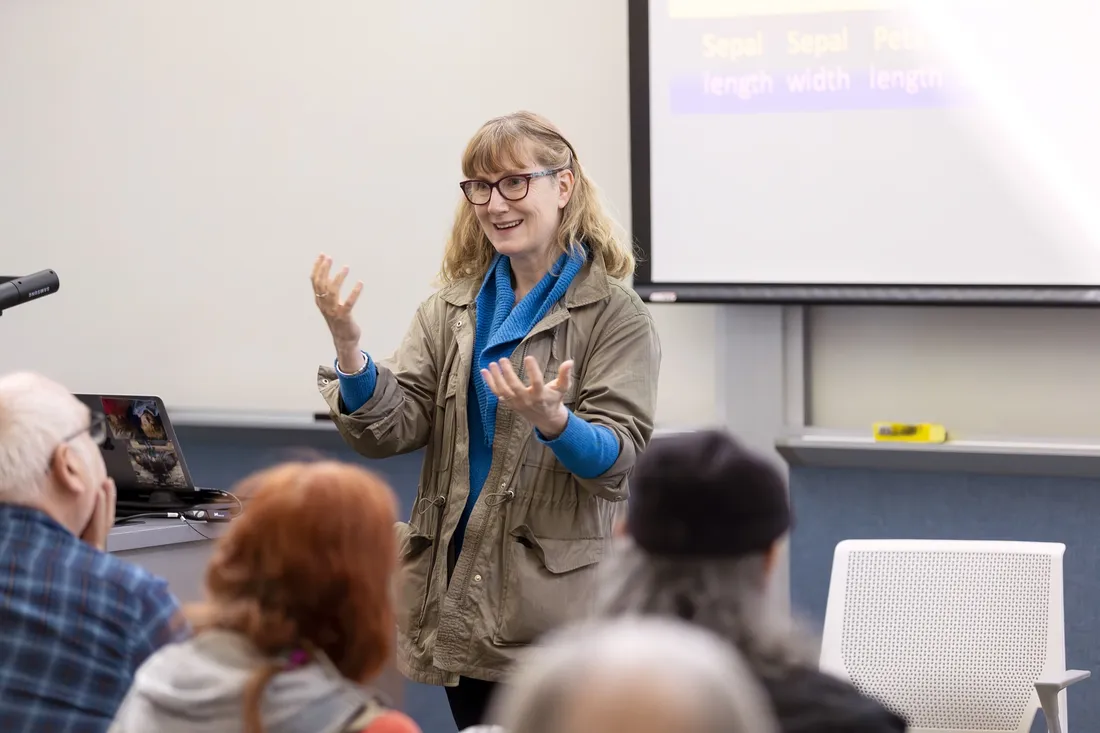
“Science and story help us see how learning is written into the fabric of existence,” says Schwarz at a Bio-Art Mixer.
A Harvard-trained biophysicist, Schwarz originally came to Syracuse as a postdoctoral researcher. Two years later, she landed a tenure-track position, and success followed. A prestigious CAREER Award from the National Science Foundation. A dozen other federally funded research projects. Countless peer-reviewed research papers. And a handful of departmental teaching awards.
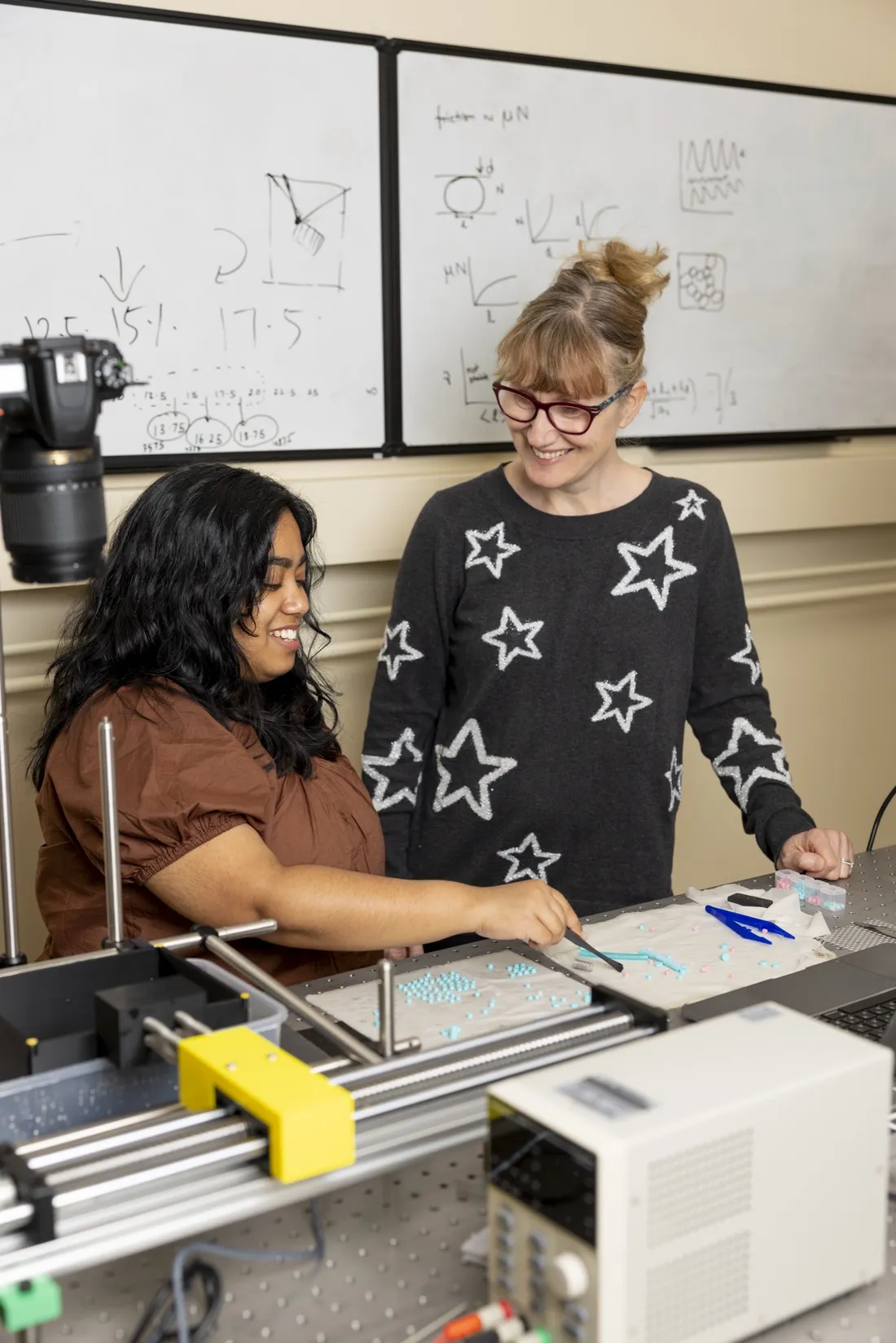
A beloved teacher and distinguished researcher, Schwarz is a longtime advocate for women in STEM.
Schwarz is especially proud of being named a 2023 American Physical Society Fellow and a 2020 recipient of the Newton Award for Transformative Ideas during the COVID-19 pandemic from the U.S. Department of Defense.
“I believe in the power of the liberal arts,” says Schwarz, who recently collaborated with novelist Debbie Urbanski G’04 on a Bio-Art Mixer. “Science and story help us see how learning is written into the fabric of existence.”
In addition to co-directing the BioInspired Institute’s Designer Biology cohort, Schwarz serves on the University’s new Disordered Systems faculty cluster.
She also is a longtime advocate for women in STEM, a trait supported by her mentor M. Cristina Marchetti.
This summer, Schwarz looks forward to reuniting with the Syracuse professor emerita at UC Santa Barbara, where Schwarz is co-organizing a monthlong program on brainless learning.
“We’re bringing together physicists, biologists and neuroscientists to explore how physical systems learn,” says Schwarz, who also is teaching in July at the Boulder School for Condensed Matter and Materials Physics at the University of Colorado Boulder. “We know that learning is not confined to the brain, that even single-celled organisms don’t need neurons to respond and adapt to their environment.”
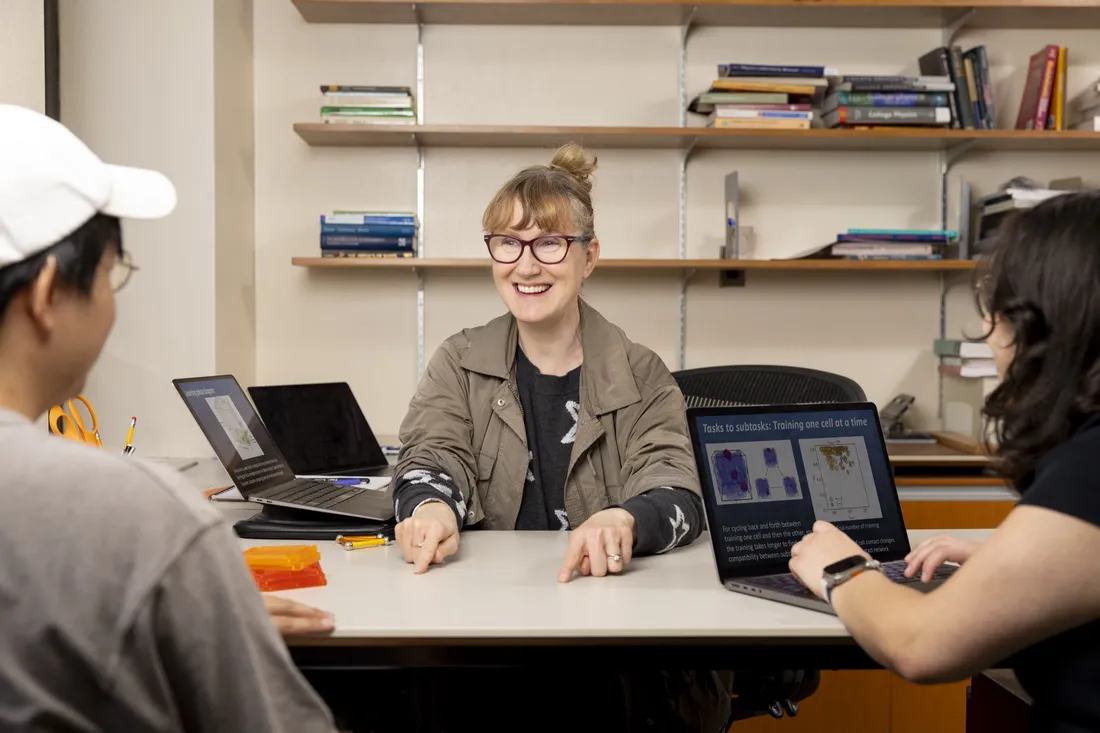
“Studying sand and cells forces me to think about machine learning in a more efficient, sustainable way,” Schwarz says.
She has reached this conclusion by studying how interactions among many simple components can collectively give rise to memory, adaptation and learning.
One of her goals is to develop energy-efficient processes that mimic how the brain learns.
“AI systems consume vast amounts of electricity,” Schwarz concludes. “Studying sand and cells forces me to think about machine learning in a more efficient, sustainable way. Just as importantly, I gain profound insights into the true complexity of learning.”