A college education offers many benefits, like career readiness, higher wages and more job opportunities.
But a Syracuse University education delivers something more—experiences that build confidence, shape who you are and open your mind to new possibilities.
Here are a few courses that provide engaging content to help students see themselves and the world through a wider lens.
Literature and Censorship

Courses like ENG 406 enable students to relate to literature in meaningful, new ways.
One of the College of Arts and Sciences’ many intriguing offerings is Literature and Censorship (ENG 406), taught by Associate Professor Chris Forster, an authority on obscenity in Modernist written works.
Robyn Luk ’25 considers the course a “welcome interruption” to traditional English courses. She praises Forster, also an Emerson Faculty Fellow, for creating a “safe space” to have “challenging conversations about books, college and life.”
“He taught me that nuanced thought is crucial to understanding the political landscape of our time,” says Luk, whose assignments have taken her to the Special Collections Research Center. “I relate to literature differently now.”
Issues and Challenges: U.S. Healthcare Delivery
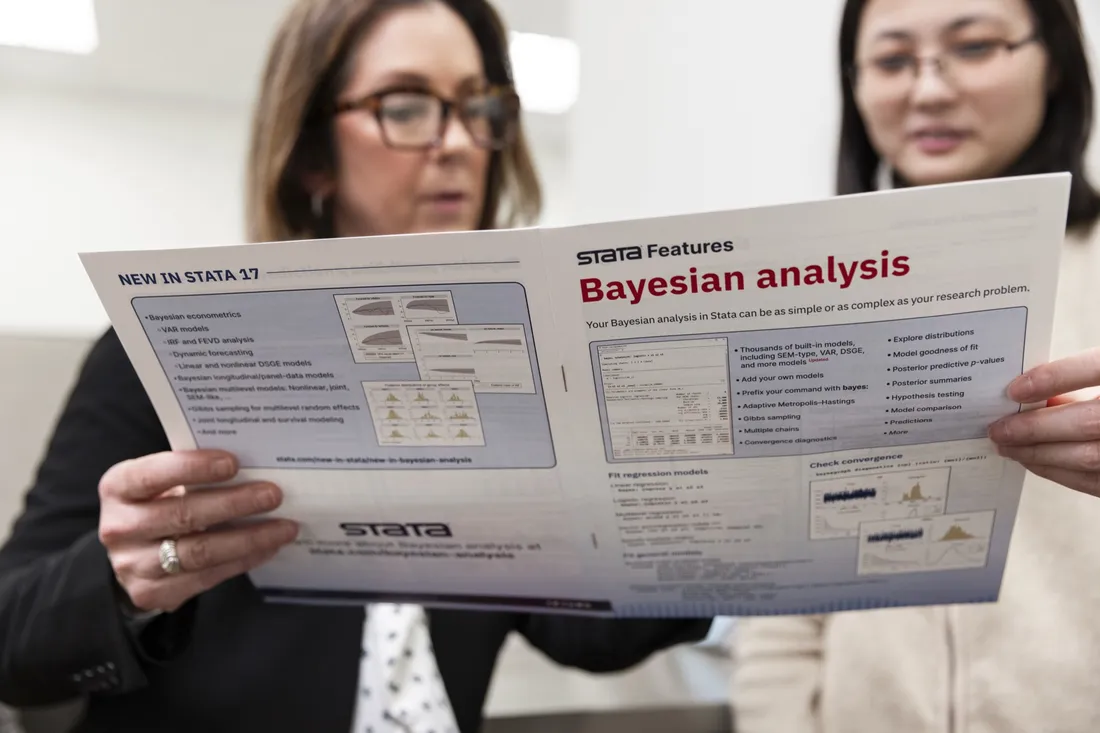
PHP 313 explores the interrelationship among policies, problems and people, observes Avi Kumar ’27.
As public perception of U.S. healthcare remains mixed, students and faculty seek to understand why the system is as complex and decentralized as it is.
Bhavneet Walia does her part by teaching Issues and Challenges: U.S. Healthcare Delivery (PHP 313). An associate professor of public health in the Maxwell School of Citizenship and Public Affairs, she investigates healthcare efficiency, maternal-child health and disability research.
“Professor Walia knows our healthcare system’s strengths, weakness and gaps,” says David B. Falk College of Sport scholar Nicole Shanguhyia ’25, who reunited with Walia for her Honors Thesis.
Adds biotechnology major Avi Kumar ’27: “Asking questions and having open-ended discussions help us see the interrelationship among policies, problems and people.”
Perspectives of Business and Management
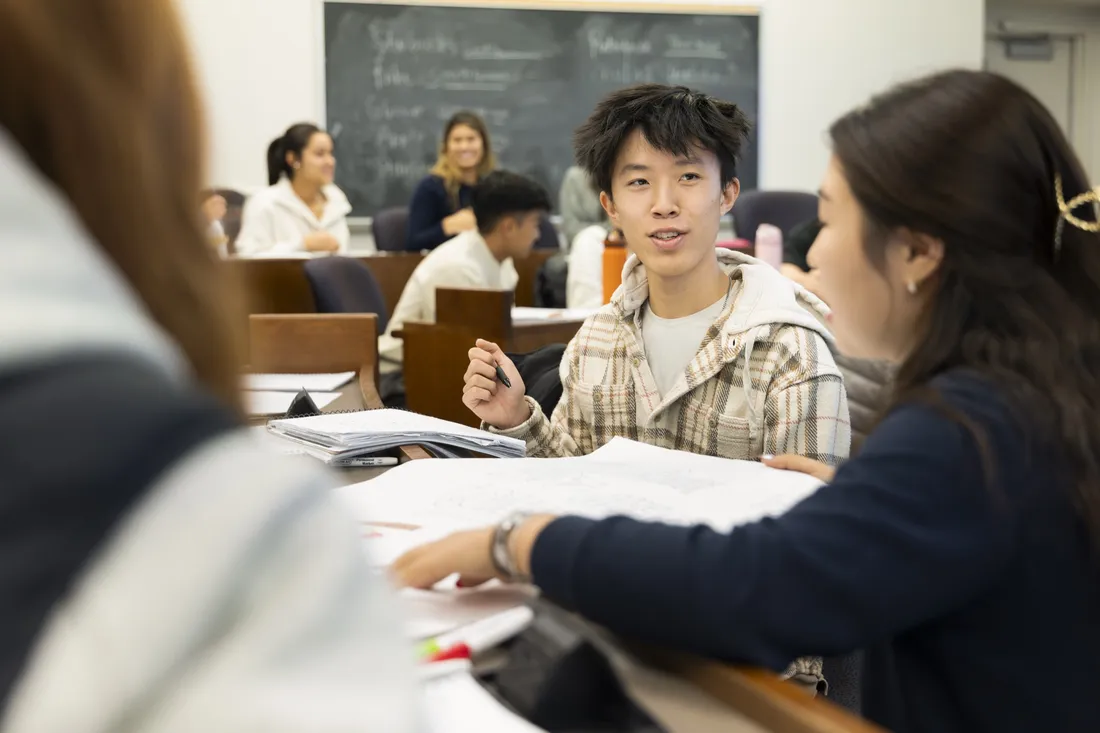
Ethan Yan ’29 (above) applauds the “collaborative” learning atmosphere of SOM 122.
Perspectives of Business and Management (SOM 122) is a rite of passage for many first-year students in the Martin J. Whitman School of Management. They include Sophia MacKay ’29, whose instructor is Assistant Teaching Professor Elizabeth Wimer G’06.
“She’s so inspiring,” says MacKay, a dual major in chemistry and management. “Her fast-paced lectures and intriguing activities ensure an in-depth understanding of the material.”
Ethan Yan ’29, a dual major in entrepreneurship and emerging enterprises and sport management, agrees, noting that Wimer’s “collaborative approach” will remain with him for the rest of his academic career.
Coincidentally, Wimer’s son, Quinn ’29, takes SOM 122 from Professor of Practice John Petosa L’95. A dual major in business analytics and sport management, Quinn lauds Petosa’s interactive teaching style. “I’m gaining fundamental knowledge of many aspects of business while learning about the Whitman School.”
Advanced Media Management: AI for Media Professionals
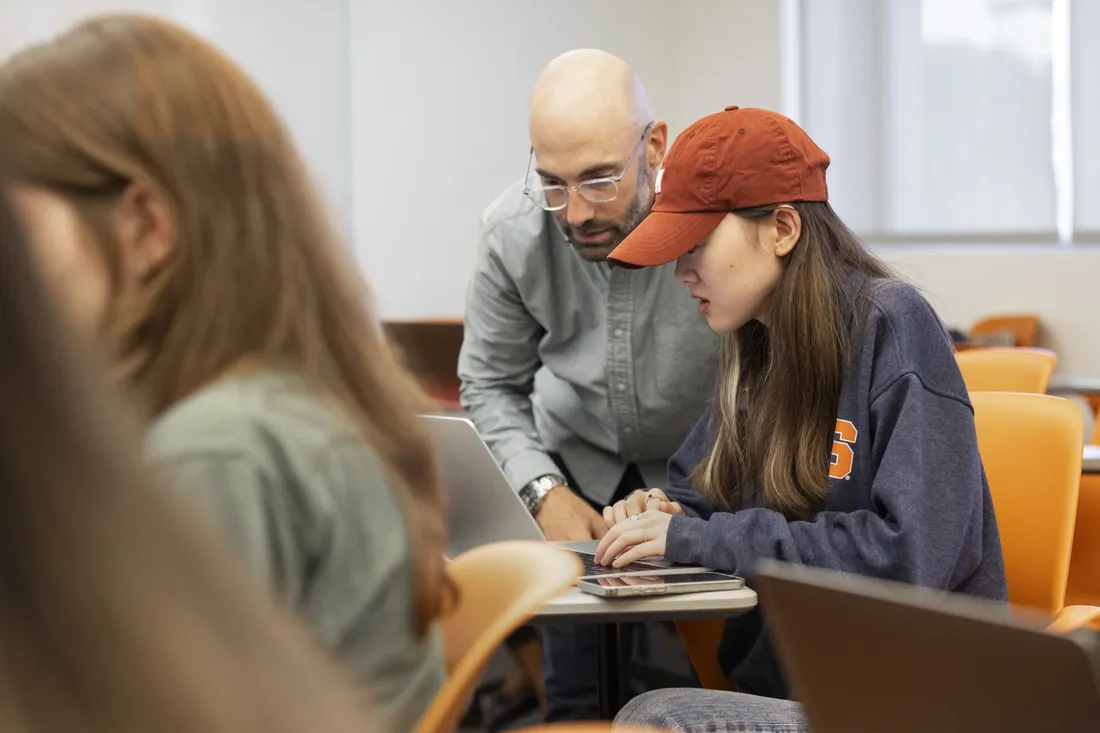
Associate Professor Adam Peruta ’00, G’04 (above) is “ahead of the technology game,” notes Francesco Desiderio ’27.
Associate Professor Adam Peruta ’00, G’04 is preparing students for the AI-driven evolving media landscape. Consider Topics in Advanced Media Management: AI for Media Professionals (MMI 380), which is part of the first and only STEM-designated degree program in the S.I. Newhouse School of Public Communications.
“The program bridges media, technology and business—preparing students for careers across entertainment, digital marketing, content strategy, news and emerging platforms,” says Peruta of the school’s Advanced Media Management program, which he also directs.
MMI 380 garners praise from students like Jason Cespedes ’28, who considers it his “most favorite class” at Syracuse, and Francesco Desiderio ’27, who insists that Peruta is “ahead of the [technology] game.”
Newhouse Fellow Ryann Phillips G’25 puts it this way: “Professor Peruta has changed how I look at AI—for the better.”
Mental Health Disorders
One of Melina Iavarone’s most memorable courses at Syracuse was Mental Health Disorders (PSY 395), led by Afton Kapuscinski G’08, G’12, an associate teaching professor in Arts and Sciences’ psychology department.
“The course challenged me while satisfying my curiosity,” says the 2024 graduate, who is now a second-year law student at Boston College. “It was scientific and theoretical.”
In addition to Kapuscinski’s “incredibly interesting lectures,” Iavarone enjoyed familiarizing herself with the Diagnostic and Statistical Manual of Mental Disorders, which provides a standardized, universal language for classifying and diagnosing mental disorders.
“The experience helped me develop an objective, methodical writing style that has served me well in law school,” she says.
Hendricks Chapel Choir
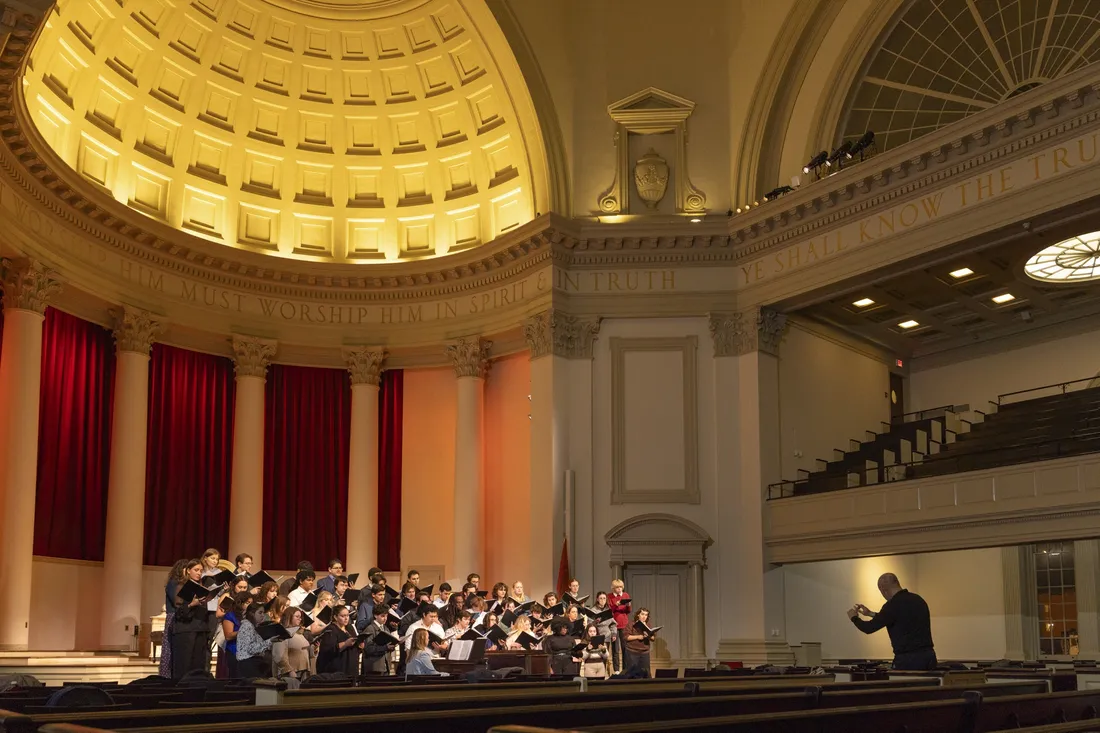
Creative collaboration is key in ENV 540, where students from all disciplines come together to make music.
For nearly a century, the Hendricks Chapel Choir (ENV 540) has enabled students of all majors to indulge their passion for creative self-expression.
“It was an enriching experience,” recalls organist Abbie Wood ’25, who also served as the soprano section leader of the 40-person mixed choir.
The former music major from the College of Visual and Performing Arts (VPA) recalls many concerts and recording sessions with the group, including tours of England and Scotland in memory of the victims of the Pan Am 103 bombing.
ENV 540 also allowed her to collaborate with director José “Peppie” Calvar and University Organist Anne Laver. “As students, we learned a lot from each other and how to work together as a group,” Wood says.
Environmental Sociology

SOC 403 considers society’s complex relationship with natural resources.
Joseph “Rick” Welsh is something of a folk hero in the Maxwell School, where he’s known for his research into food policy and rural development as well as his sense of humor.
Environmental Sociology (SOC 403) is Welsh’s calling card—a course examining society’s complex relationship with natural resources. “We look at how society creates problems and then tries to solve them,” says the sociology professor half-jokingly.
Broadcast and digital journalism major Luke Burgess ’26 considers Welsh one of the funniest, most insightful professors he’s ever had. “He took a topic I didn’t know much about and made it relevant to me.”
Women, Rap and Hip-Hop Feminism
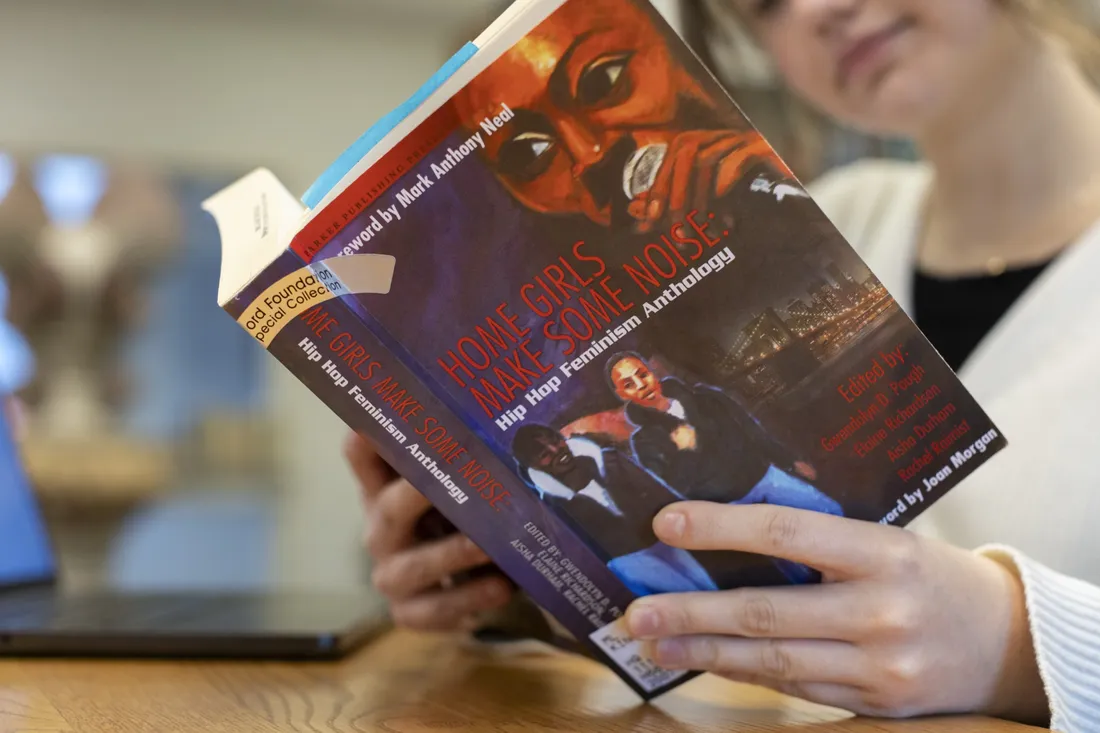
Students enrolled in WGS 473 explore the links between feminism, rap music and hip-hop culture.
Although Jadeeva Smith ’06 is out of college, her appreciation for Gwendoyln Pough, professor of women’s and gender studies in Arts and Sciences, continues to grow.
Smith took Women, Rap and Hip-Hop Feminism (WGS 473), a course that’s as vital today as it was in 2004, when Pough introduced it at Syracuse. That same year, Pough helped make “hip-hop feminism” part of the vernacular with the publication of her book, Check It While I Wreck It.
“Professor Pough’s class was a modern and sophisticated look at the dichotomy between womanhood and hip-hop,” Smith recalls. “It challenged me to reexamine myself and everything I stood for.”
The Science of Shipwrecks
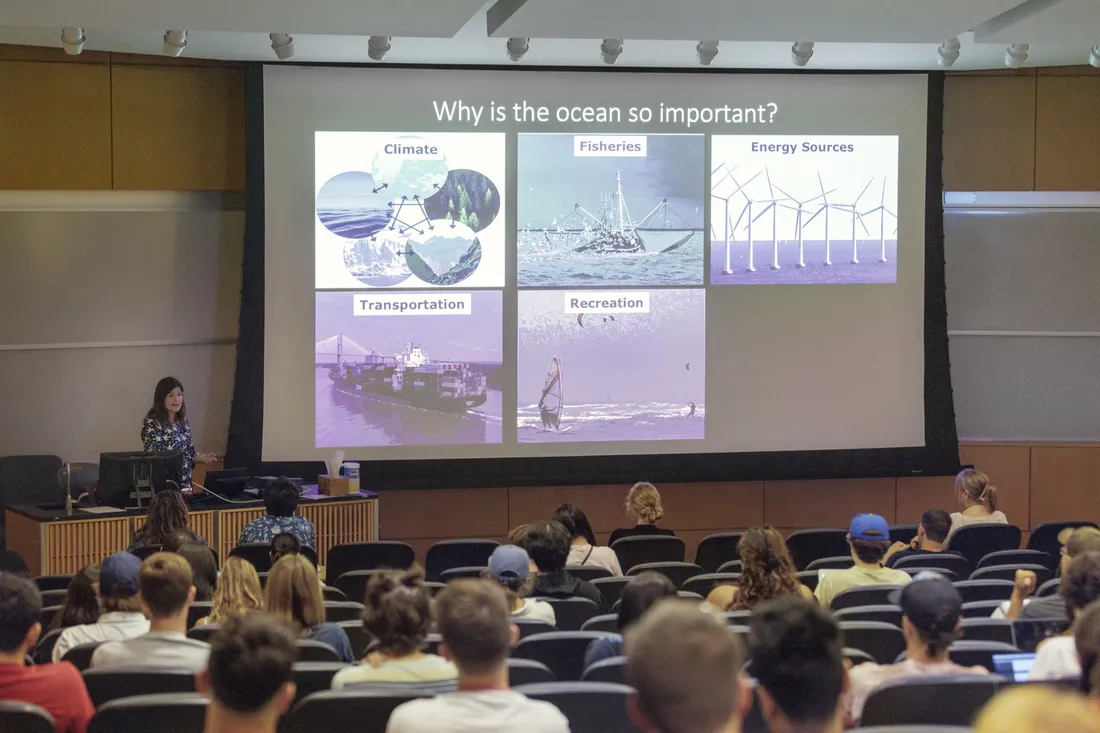
“Every day with Dr. Newton [above] is like a page from an illuminated manuscript,” says Stanislav Nedzelsky ’17.
Cathryn Newton was a 16-year-old college sophomore when she helped her father unearth the famous Civil War battleship USS Monitor off the coast of North Carolina.
“The experience changed my life,” recalls the dean emerita of Arts and Sciences, who also serves as professor of Earth and environmental sciences.
The landmark discovery prompted one of Newton’s—and the Renée Crown University Honors Program’s—most popular courses: The Science of Shipwrecks (HNR 250). In addition to learning about major shipwrecks throughout history, Newton accompanies students to the legendary Woods Hole Oceanographic Institution in Massachusetts to “experience oceanography as an oceanographer does.”
Says Stanislav Nedzelsky ’17: “Every day with Dr. Newton is like a page from an illuminated manuscript.”
Art, Activism, Modernity
Joanna Spitzner ’92 is a professional artist who connects everyday experiences to larger social issues. This ethos permeates Art, Activism, Modernity (AIC 321), where she explores publicly engaged, community-based and socially active projects.
“We look at the history, theory and practice of these kinds of artworks,” says Spitzner, a student-turned-professor in VPA’s School of Art. “They teach us to be brave and not follow convention.”
AIC 321 covers a variety of forms—from mural and street art to large-scale installations and performance art to statues and monuments.
Spitzner practices what she preaches, observes one student. “Much like the artworks we study, her work is a tool for dialogue, solidarity and protest.”
Introduction to Film and Media Arts
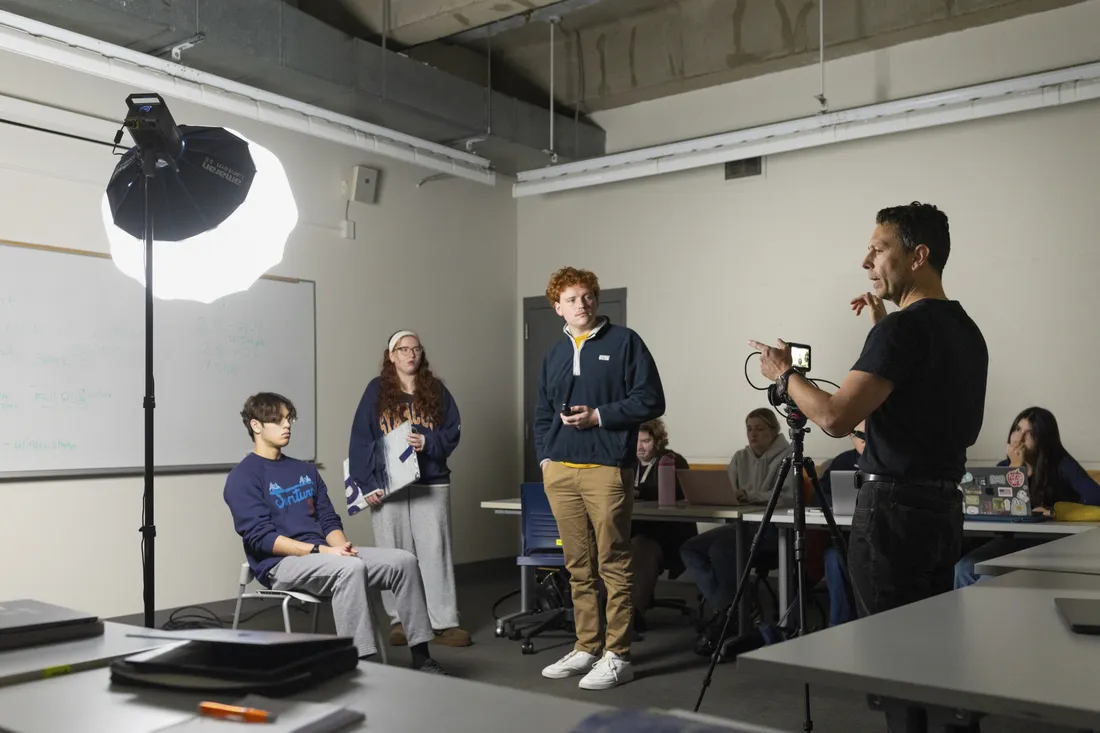
Michael Hicks G’18 (right), who teaches FMA 153, considers the creative process a “living thing.”
“The creative process is a living thing,” says Michael Hicks G’18, an instructor in VPA’s film and media arts department. “Each step [along the way] is an opportunity for surprise, spontaneity and new meaning.”
He’s one of the instructors of Introduction to Film and Media Arts (FMA 153), which explores the media-making process, from gaining inspiration to honing an idea with state-of-the-art postproduction tools.
“We learn about filming, editing and color grading,” says one student, “alongside working with existing footage or material in a collage or mashup style.”
By engaging in original projects, students find their own voice, Hicks explains. “It’s proof that process is just as important as the final product.”