- Professor Nick Bowman of the S.I. Newhouse School of Public Communications is an expert on the user experience of immersive and interactive media.
- His research includes the cognitive, emotional, physical and social benefits of gaming.
- Bowman is the founder of the Interaction Lab, which informs systems design and public policy debates about gaming.
At the end of a long day, Nick Bowman likes to retreat to his basement, boot up his PC and browse his massive video game library.

Communications professor Nick Bowman studies the psychological benefits of video gaming and virtual reality. The St. Louis native got bit by the gaming bug in the 1990s.
Today, the Syracuse University professor has selected Fallout 76, an online role-playing game set in post-apocalyptic Appalachia. Slugging coffee from a porcelain beer stein, he fends off enemies and takes down bosses for weapons, food and clothing.
“Many people think gaming is antisocial or bad for you,” says Bowman, a globe-trotting media psychologist and communication scholar. “The truth is that it acts as a ‘third place’ where you can develop social skills in a low-pressure environment.”
Based in the Newhouse School, he oversees doctoral and master’s programs in mass communications and media studies, serves as founding director of the Interaction Lab, and leads graduate and undergraduate courses.
“Gaming is an accessible and affordable way to unplug for a few minutes—which is to say that it’s mundane,” says Bowman, who has a dozen books and more than 160 articles to his name. “And that’s what makes it interesting.”
Socializing at Scale
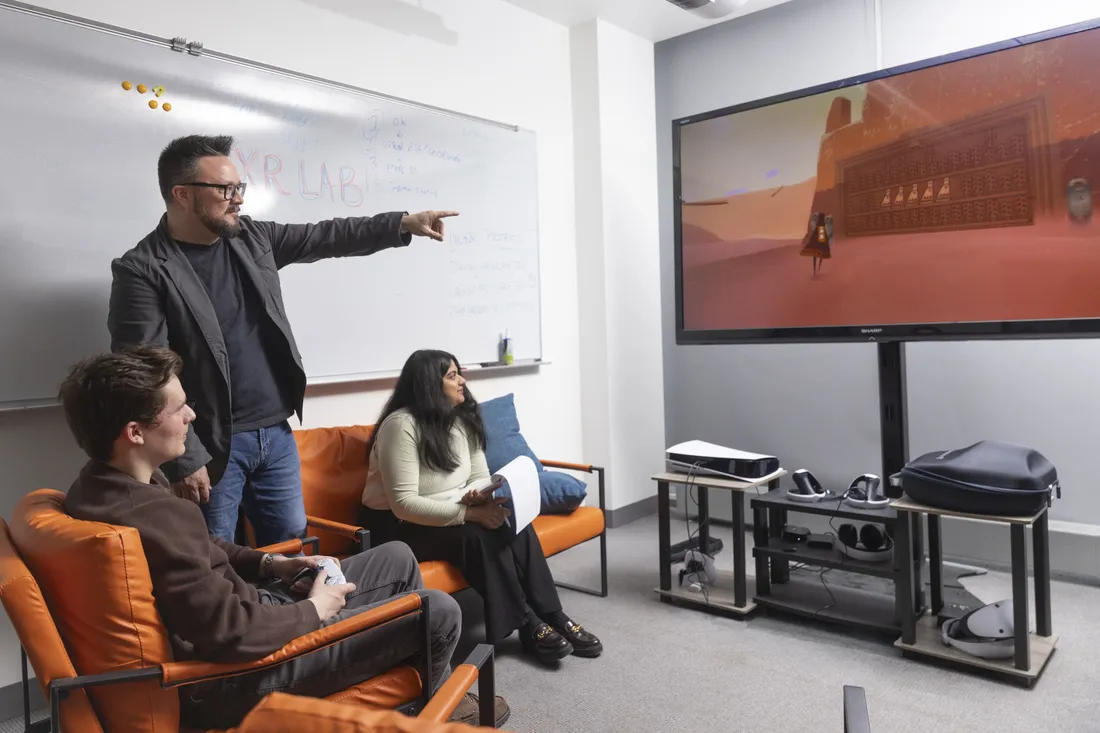
Bowman with sophomore Evan Mastroccio and doctoral student Janaki Nair. A media psychologist and communication scholar, the Newhouse School professor teaches and conducts research worldwide.
From their humble origins as university lab experiments in the 1950s, video games have evolved into a $250 billion industry with more than 3.6 billion players worldwide.
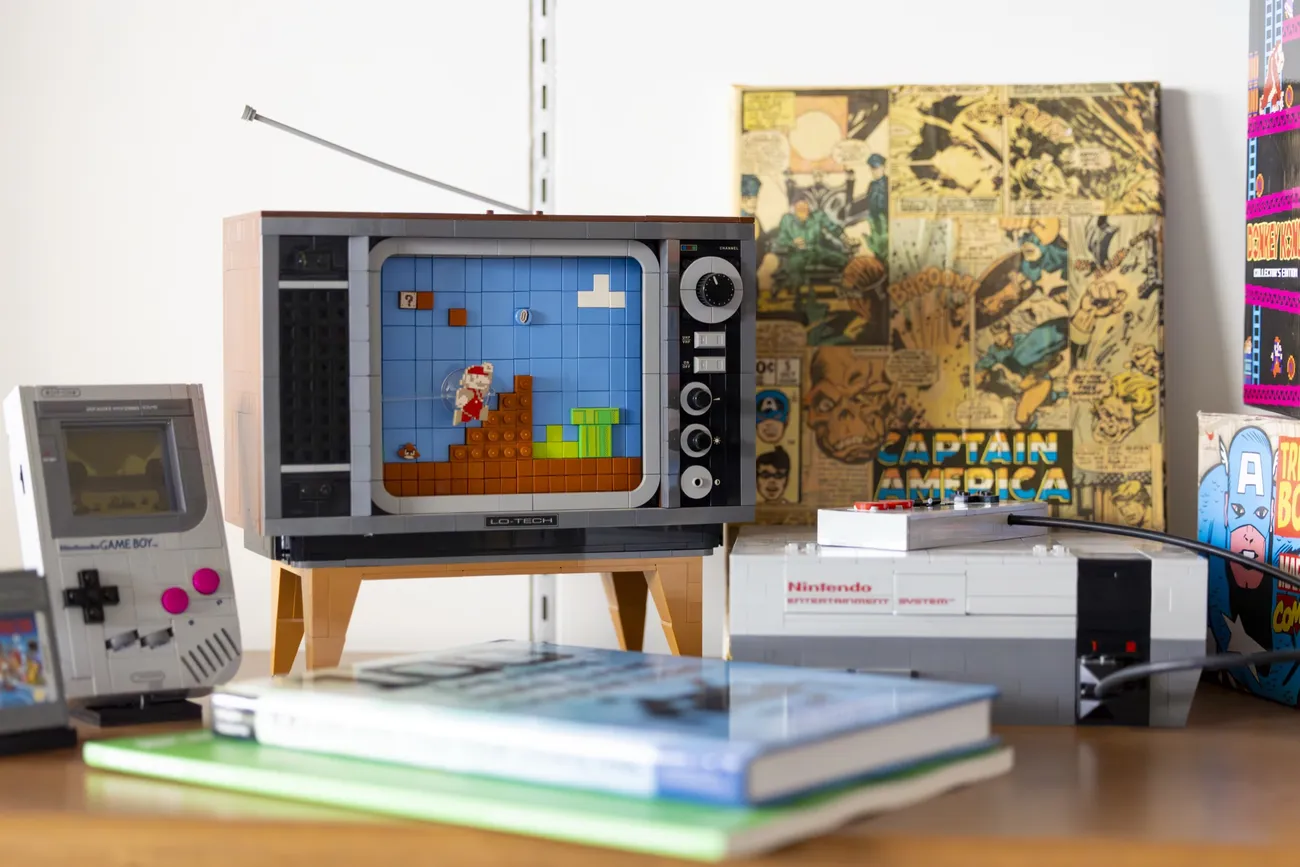
“Almost everybody plays them, and those who don’t often engage in gaming culture,” Bowman says. “Watching livestreams of games like Pokémon and Super Mario is almost as popular as playing them.”
Convinced that gaming improves cognitive function, he divides his research into three foci.
One examines video games as “interactive safe spaces,” helping users process grief and trauma in a safe, controlled way.
“We obtain a sense of agency by engaging directly, rather than passively, in a gaming experience,” says Bowman, launch editor of the open access journal Global Perspectives in Communication.
He also studies the cognitive, emotional, physical and social effects of gaming on users. Known as “demands,” player perceptions provide developers with important clues about video game engagement.

Among Bowman’s avatars is an Otto-themed 1981 Porsche 930 Turbo, which he has customized for the racing game Gran Turismo 7.
A third area involves player-avatar relationships. More than a “second self,” an avatar can be any number of things—an asocial tool, an independent social character or a collaborative partner.
“Nothing about interpersonal communication requires the other person to be human. It’s all perceptual,” he says. “Bonding with a game character makes the narrative more meaningful, proving that humans can socialize at scale.”
Game On

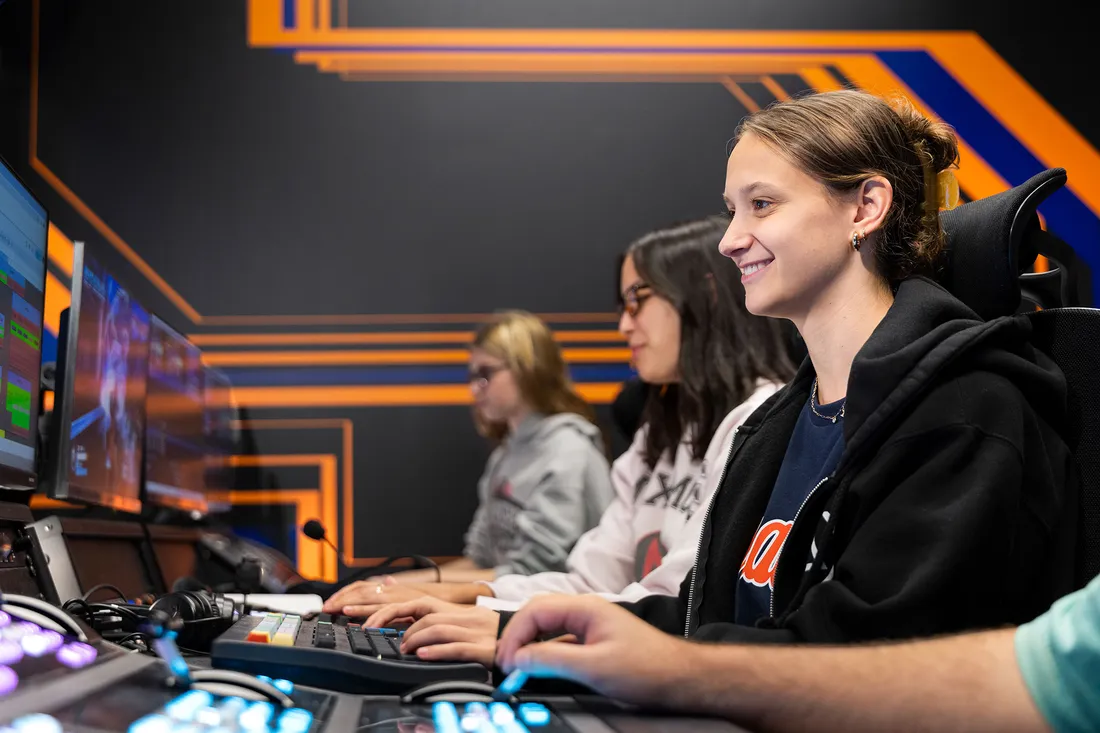
“Gaming is great therapy,” says Bowman, noting the popularity of Syracuse’s Esports Gaming Room (Barnes Center at The Arch), Gaming and Esports Center (Schine Student Center) and Digital Scholarship Space (Bird Library).
Growing up in St. Louis, Bowman got bit by the gaming bug in the 1990s.
He realized, early on, that humans are intrinsically driven to enjoy video games—that interfacing with the virtual world satisfies psychological desires. “[Video games] help us feel competent when we win,” Bowman says. “They let us make choices on our own, and they give us the ability to connect with others.”
Following faculty appointments on both sides of the Atlantic and a Fulbright Fellowship in Taiwan, Bowman arrived at Syracuse in 2022.
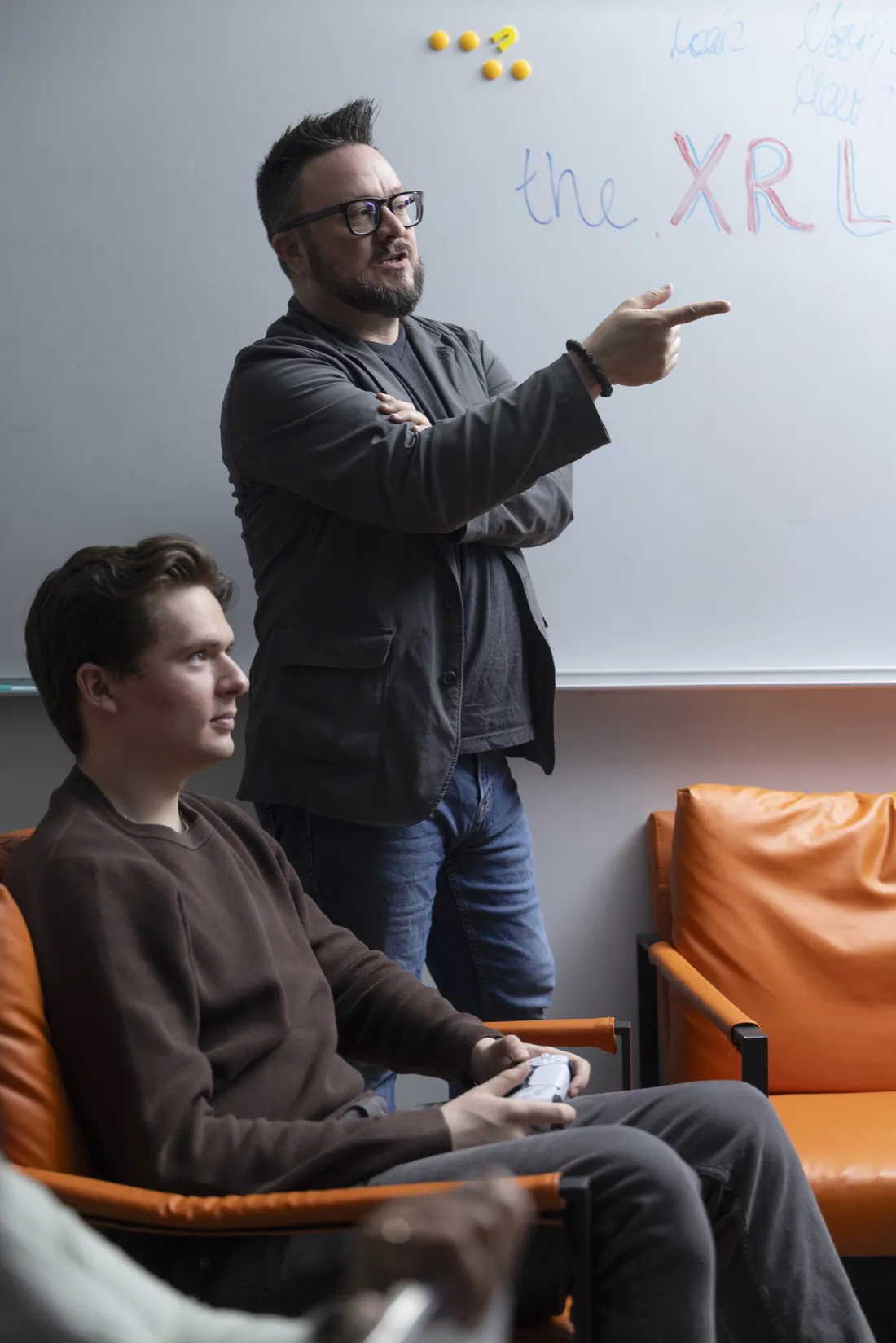
Bowman’s Interaction Lab offers undergraduate research opportunities in conjunction with SOURCE.
He’s since founded the Interaction Lab, which informs systems design and public policy debates about gaming and offers research opportunities through the Syracuse Office of Undergraduate Research and Creative Engagement (SOURCE). The lab also maintains a play-testing partnership with Atari.
Elena Zhao, a doctoral student in mass communications and the Interaction Lab’s manager, uses the facility to study mood management and, more broadly, the “therapeutic potential of gameplay.”
One of Zhao’s favorites games is Cyberpunk 2077 because it allows her to navigate a world so “thrilling and alienating that [she] feels real emotion.” “The phenomenological gap between ‘this is a game’ and ‘this is affecting me’ is where my research lies,” she says.
Adds Bowman: “Whether you want to relieve stress, build brain power or just take a break, gaming is great therapy.”