The future of sustainable multifamily housing in cold climates may be residing in two retrofitted student apartment buildings on Syracuse University’s South Campus. The buildings—part of the ambitious Sustainable South Campus project—now serve as real-world testbeds for state-of-the-art energy efficiency technology.
Funded by the U.S. Department of Energy (DOE) Advanced Building Construction (ABC) Initiative and the New York State Energy Research and Development Authority, the project combines prefabricated insulated wall panels, high-performance windows and doors, real-time monitoring and next-gen HVAC systems to significantly cut energy use while improving indoor air quality and occupant comfort.
We’re expanding this network and this cohort, and Syracuse is really a hub now—recognized as one of the leaders in this area.
Bess Krietemeyer, associate professor, School of Architecture
“The big-picture goal is to demonstrate that retrofit approaches like ours can be cost-effective and scalable, while achieving 75% thermal energy savings,” says School of Architecture associate professor Bess Krietemeyer, the project’s lead investigator who collaborated closely with College of Engineering and Computer Science (ECS) professor Jianshun “Jensen” Zhang, an expert on built environmental systems and executive director of the Syracuse Center of Excellence in Environmental and Energy Systems. “Our data so far is showing we’re hitting the target.”
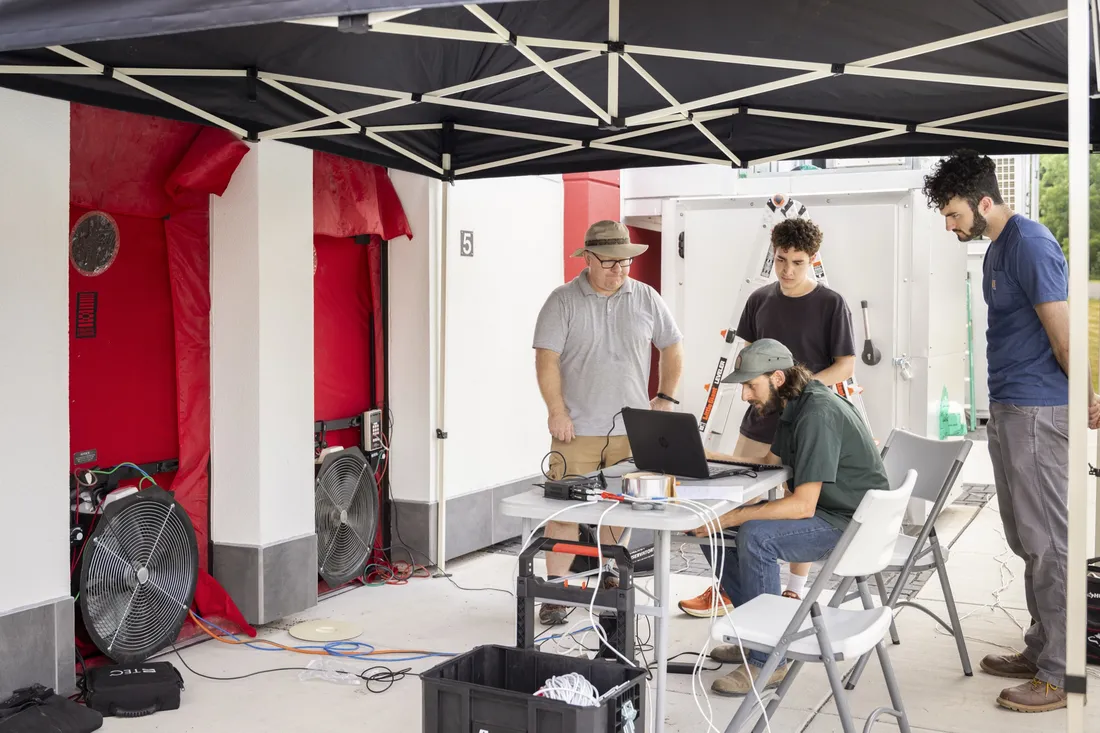
Members of the Taitem Engineering team monitor blower door testing on the retrofitted Lambreth Lane apartments. Taitem is among the project’s partners.
According to recent reports, buildings account for about 75% of total electricity consumption and 38% of carbon dioxide emissions in the United States. With energy savings, reduced emissions, improved comfort and indoor air quality, the retrofit offers insights on how buildings adapt to extreme changes in weather conditions and how the building materials moderate indoor temperatures.
With the project’s success, one goal is to implement similar projects in low- and middle-income housing. The Syracuse Housing Authority (SHA) has served as an advisory partner, and Krietemeyer—an expert in sustainable built environments—hopes the retrofits can be applied to some SHA buildings as well as other properties in the area and in New York City. “The idea is that we can expand the retrofit solution to multiple building types and climate regions,” she says.
Tracking Change
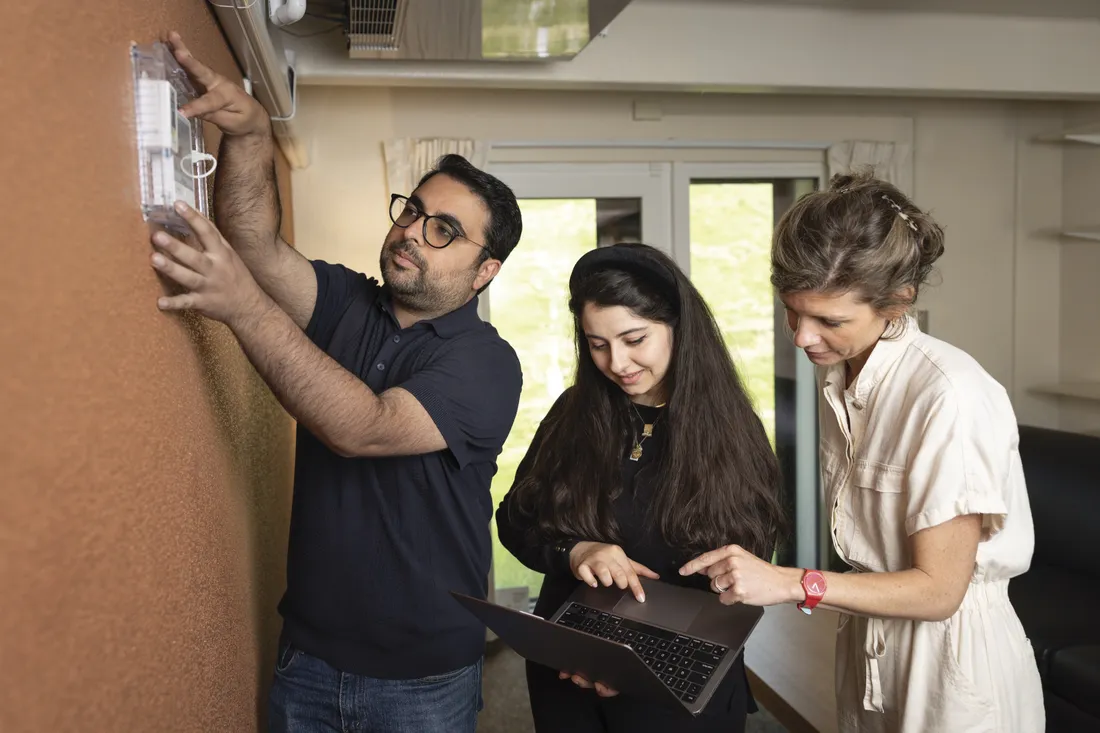
Researchers Shayan Mirzabeigi (left), Sameeraa Soltanian-Zadeh and Bess Krietemeyer check a smart thermostat.
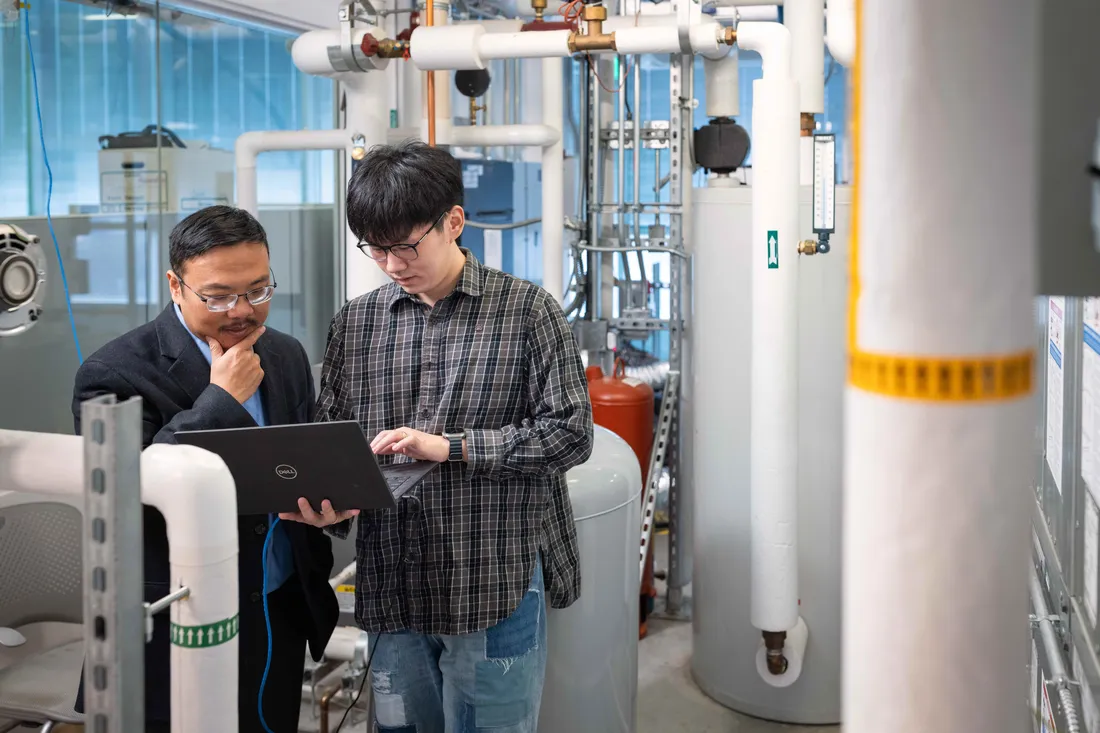
One standout innovation is the HydroPod, an outdoor HVAC module developed by Tom King of TKFabricate. The compact units handle heating, cooling, hot water and ventilation equipment, including air-to-water heat pumps and energy recovery ventilators that continuously draw in fresh outdoor air and exhaust stale indoor air through high-quality filters. The entire system is monitored in real time via a cloud-based system. Indoors, sensors collect performance data and track how residents interact with the systems.
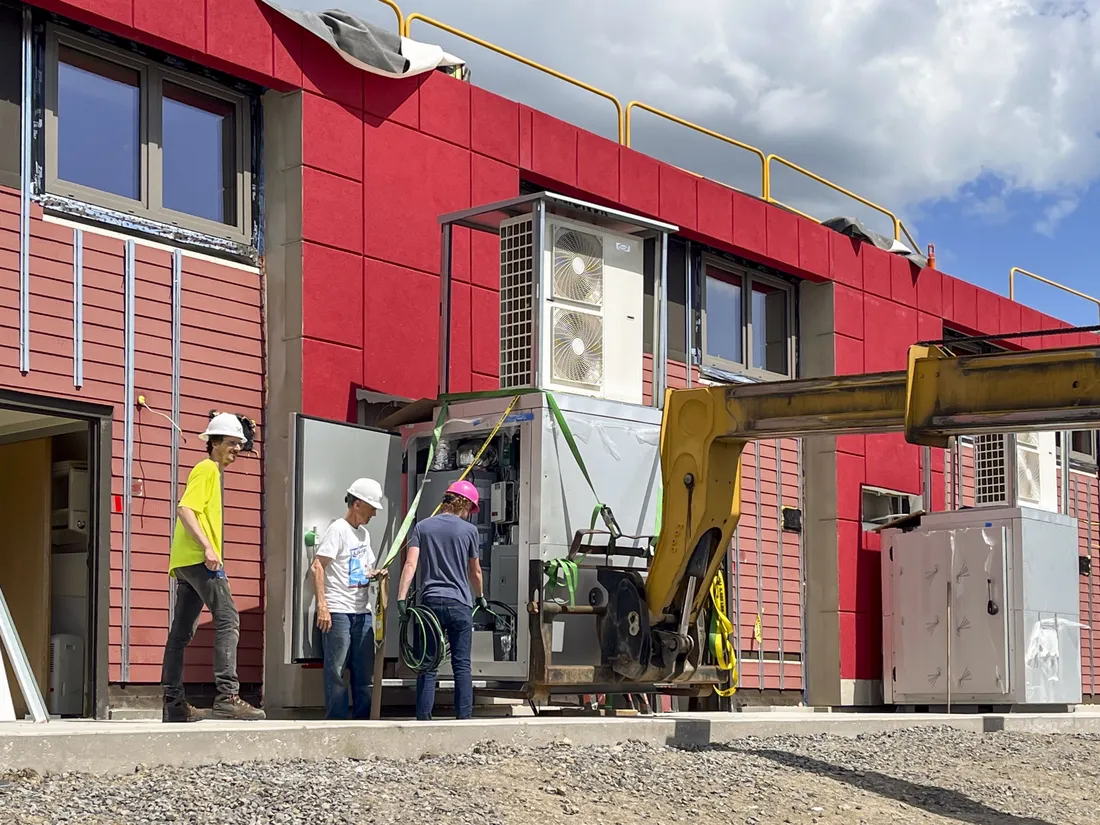
Workers prepare to install a HydroPod, an outdoor HVAC module developed by Tom King of TKFabricate in Syracuse. The entire system is monitored in real time via a cloud-based system. Photo courtesy of Bess Krietemeyer.
Apartments are equipped with smart thermostats and sensors in the living rooms that collect real-time data on temperature, relative humidity, indoor air quality and electrical use, as well as motion detectors that indicate occupancy. “In the two research units, we have installed additional sensors to better understand how occupants use different spaces, how their behavior impacts building performance and how they themselves are impacted by the building systems,” says Shayan Mirzabeigi, an ECS doctoral candidate and an assistant professor at SUNY College of Environmental Science and Forestry (ESF) specializing in sustainable construction. “It’s not just about the system or enclosure, it’s also about the people’s living behavior, which is one of the greatest uncertainties in a building’s efficiency.”
Along with collecting and analyzing the data and studying how residents interact with the thermostats, Mirzabeigi and ECS doctoral student and DOE IBUILD Fellow Sameeraa Soltanian-Zadeh troubleshoot issues with the smart thermostats and teach the student residents how to use them. Applied data analytics major Diamone Cromer ’28, who was awarded a Syracuse Office of Undergraduate Research and Creative Engagement Fellowship to do research on the project, gained a better understanding of predictive maintenance and how the project “connects data, sensors and real building systems in a way that matters,” she says. “It has made me more curious about how data science can be applied to improve real-world environments in everyday life.”
Making a World of Difference
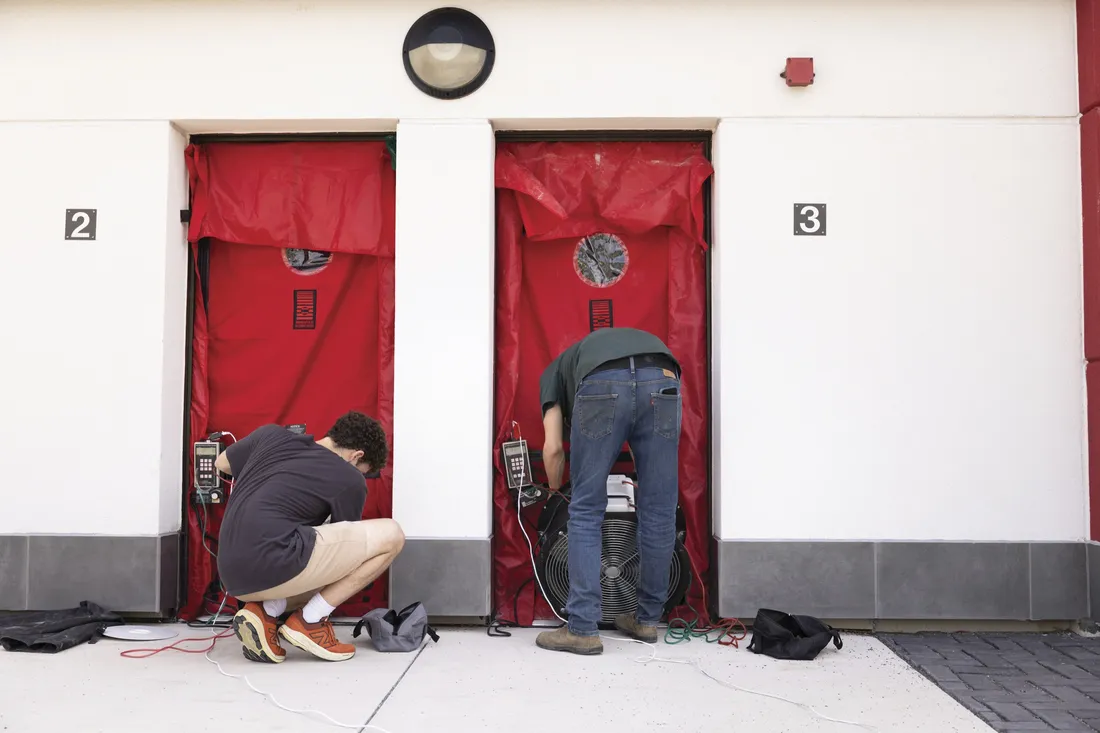
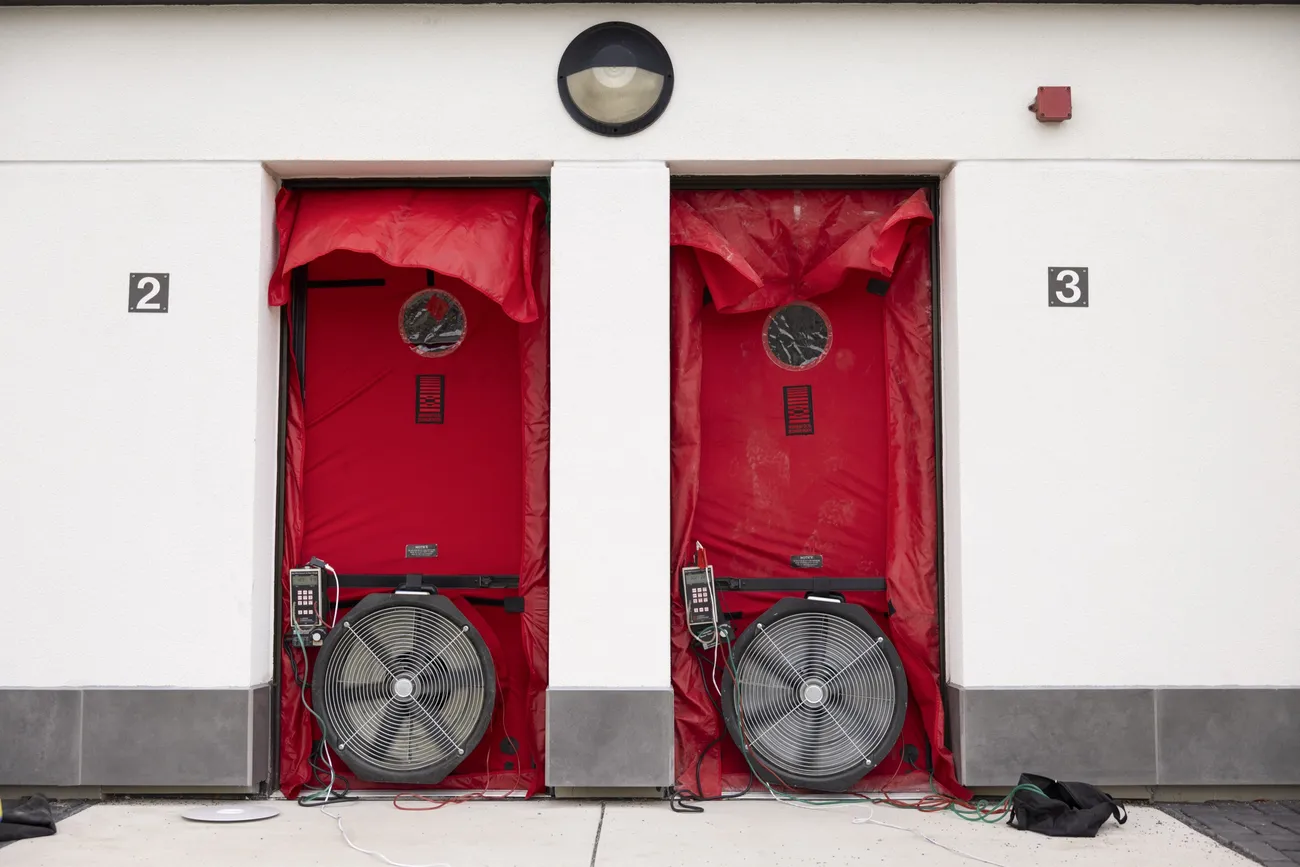
In summer 2025, blower door tests were done on the apartments to monitor and measure air leakage.
Architecture major Isaac Chin ’27 experienced the pre- and post-retrofit conditions while living in an apartment at 221 Lambreth Lane for two years. “It was really fun to see the transition because it represents everything I’ve learned,” says Chin, who became interested in sustainable architecture in one of Krietemeyer’s classes and added a minor in sustainable construction through SUNY ESF. “It’s what I love about architecture.”
He says the upgrades not only saved energy, but enhanced comfort, improved kitchen ventilation and provided more stable temperatures. He cites how the project’s scalability and retrofitting can be applied to older buildings, making them more viable and well-suited for the environment, rather than using valuable resources to destroy them. “It’s a monumental step in showing how we can use this technology to re-adapt buildings to become more sustainable using quick and efficient technology and expert planning,” Chin says.
Becoming a Hub for Sustainable Retrofits
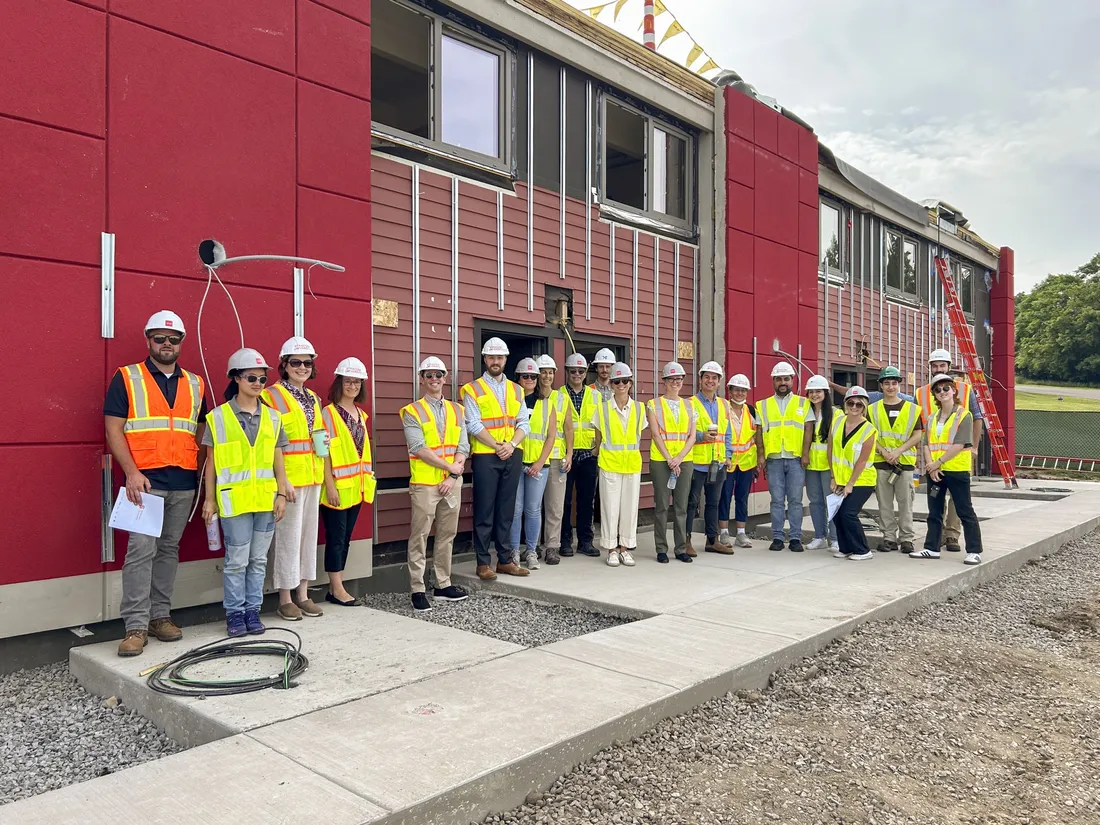
The Sustainable South Campus project is a collaborative initiative that features industry partners, researchers from the School of Architecture, the College of Engineering and Computers Science and the Syracuse Center of Excellence in Environmental and Energy Systems, as well as members from Campus Planning, Design and Construction. Photo courtesy of Tammy Rosanio.
Syracuse stands at the forefront of the DOE-funded ABC projects, the first to complete the retrofit and incorporate monitoring. As the project continues, more research questions arise to explore—such as the impact of solar radiation and insulation acoustics—and team members are collaborating on other grants to build retrofits. “We’re expanding this network and this cohort, and Syracuse is really a hub now—recognized as one of the leaders in this area,” says Krietemeyer, acknowledging the collaborative teamwork and contributions of team members throughout the project. “We’re all in this together and will keep moving this forward in different projects, different applications—it’s setting up an interesting trajectory for years to come.”