
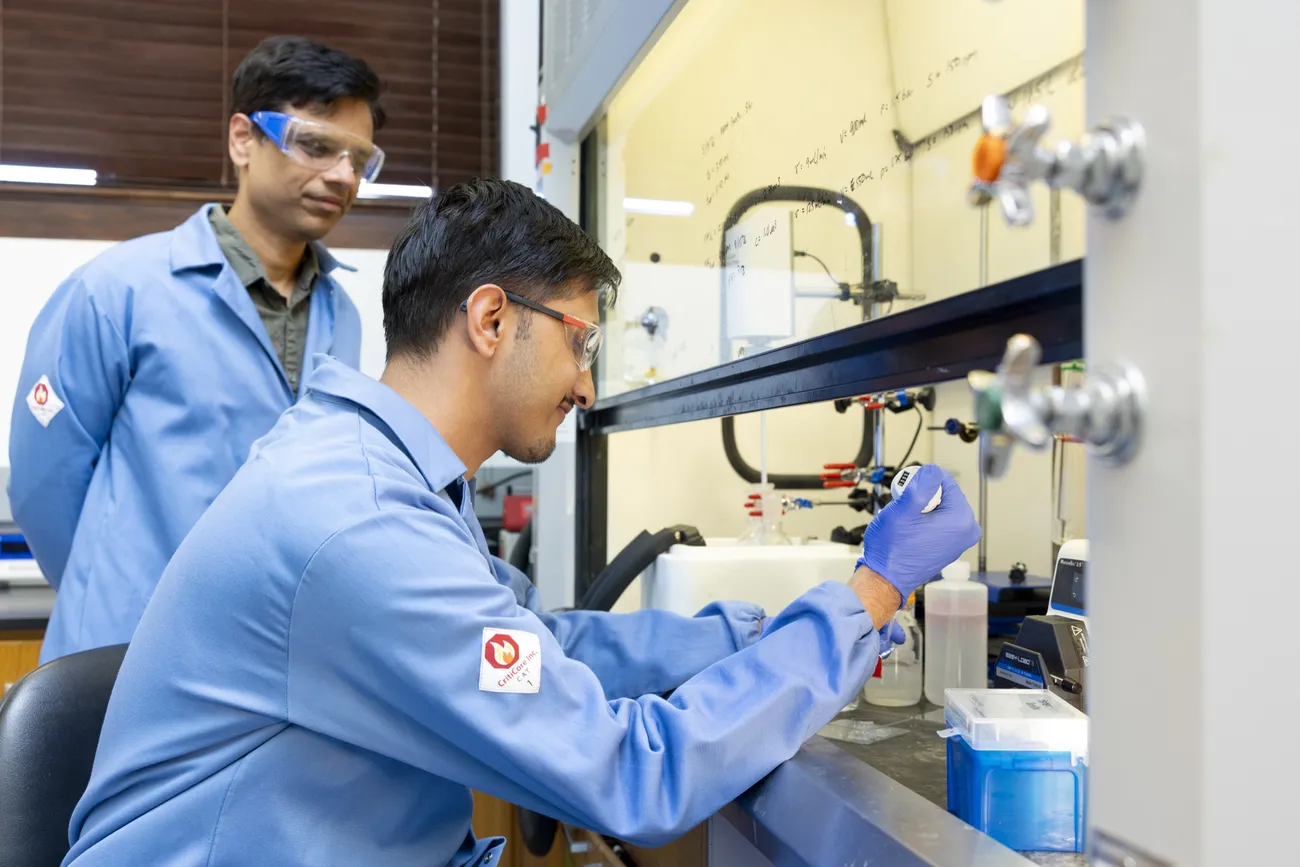
Every eight minutes, someone is added to the U.S. organ transplant waiting list. And while 49,000 such transplants are performed annually, demand outstrips supply.
“Behind every number on the list is a person and a family hoping for a second chance,” says Pranav Soman, professor of biomedical and chemical engineering at Syracuse University. “Around the world, the organ transplant gap is even wider. We feel a strong sense of urgency to find new solutions.”
One solution is arguably the holy grail of regenerative medicine: a fully functional, 3D-printed human organ.
Alongside researchers at South Dakota State University (SDSU) and SUNY Upstate Medical University, Soman is developing modular “bio-blocks” that are assembled, upon request, into functional human tissue and organ grafts.
“The problem with printing a complex organ in a single structure is that the cells run out of blood and oxygen,” says Soman, whose project is funded by a $2.26 million grant award from the federal Advanced Research Projects Agency for Health (ARPA-H). “Printing a large piece of tissue takes a long time, and the longer it takes, the more cells that are lost along the way.”
Hence his optimism about a simpler approach—printing small bio-blocks that can be assembled like LEGOs and then seeded with living cells. “It’s a viable option until we have the methods to create a fully functional, 3D-printed human organ,” he says.
The Building Blocks of Bioengineering
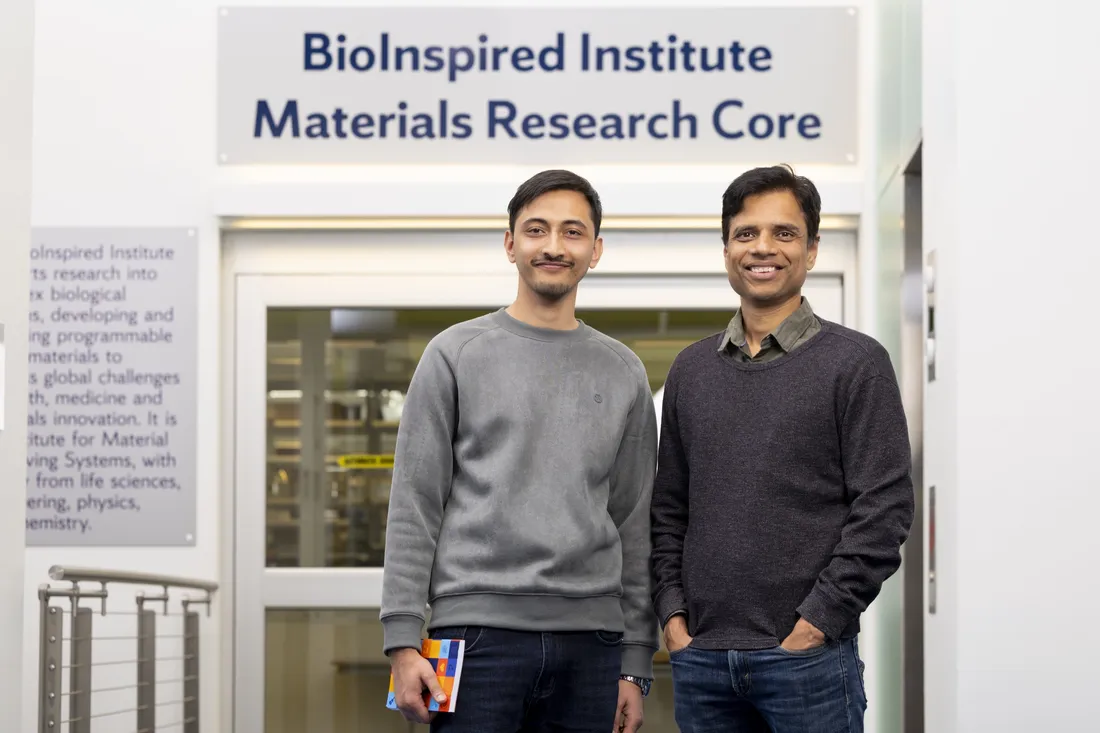
Pranav Soman (right), professor of biomedical and chemical engineering, and his advisee, Sharad Timilsina, who is a Ph.D. candidate in biomedical engineering.
A faculty member of the College of Engineering and Computer Science since 2013, Soman likens bio-blocks to structural parts of a scaffolding system.
In reality, the blocks are small networks of proteins, enzymes and other molecules called Extracellular Matrix (ECM) cubes, which provide structural and biochemical support to surrounding cells.
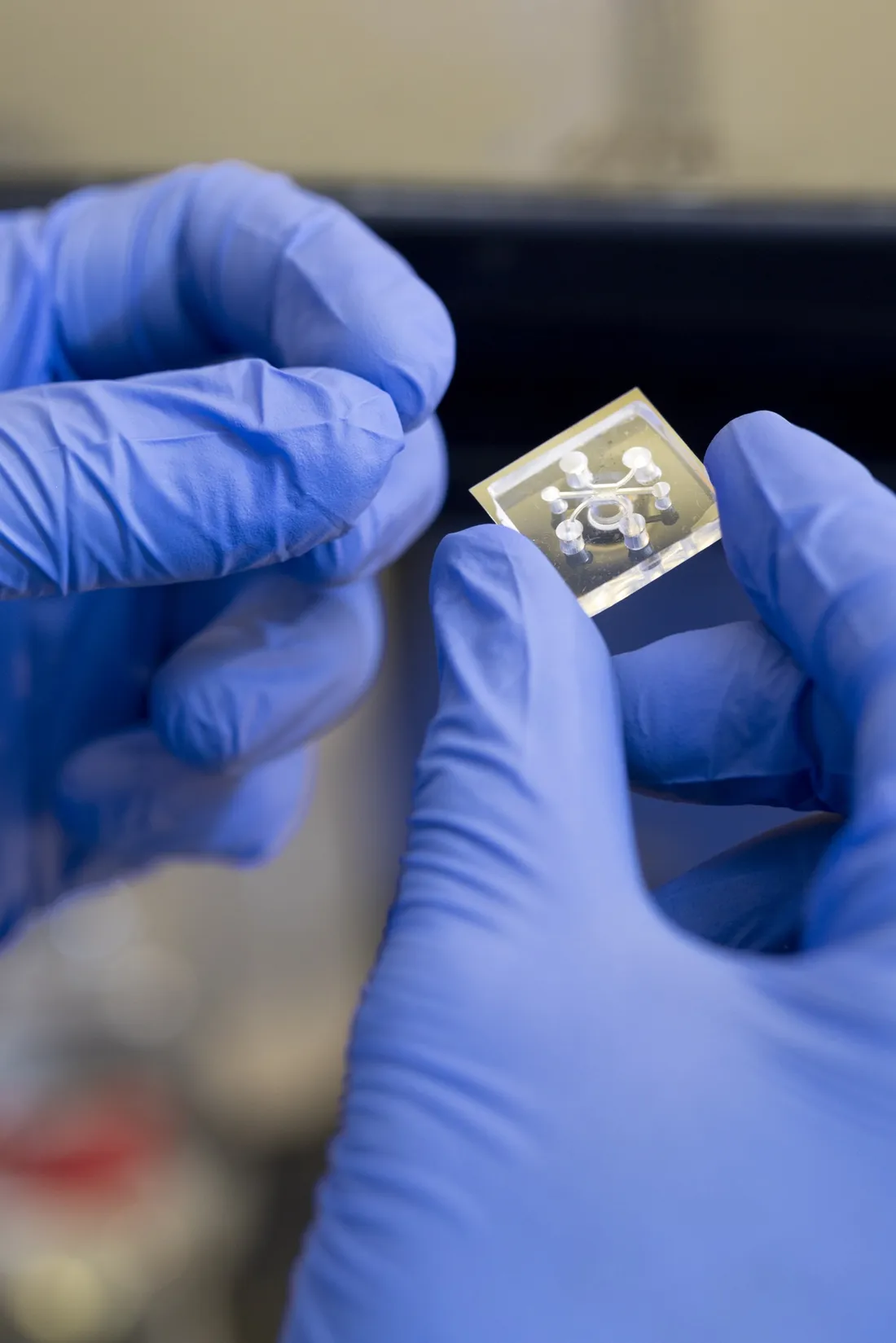
A miniature bio-block on a chip.
“ECM cubes are porous and water-rich, allowing for the flow of oxygen, nutrients and waste materials among cells and tissue,” says Soman, whose expertise spans 3D printing, tissue engineering and biomaterial processing. “Bone is our first test case, but we’re hopeful that this approach works for any large tissue or organ.”
Sharad Timilsina, a Ph.D. candidate in biomedical engineering, is a member of Soman’s lab. One of his jobs is to scale down bio-blocks to microfluidic chips, so that he can test “many conditions in parallel” within a vascular system.
“We’re at the frontier of vascularized tissue engineering,” says Timilsina, who hopes to go into industry, developing bio-fabrication and tissue-engineered products. “Dr. Soman’s guidance and the lab’s collaborative, interdisciplinary environment both have taught me to think about how each experiment fits into the larger goals of the project.”
BioInspired Research
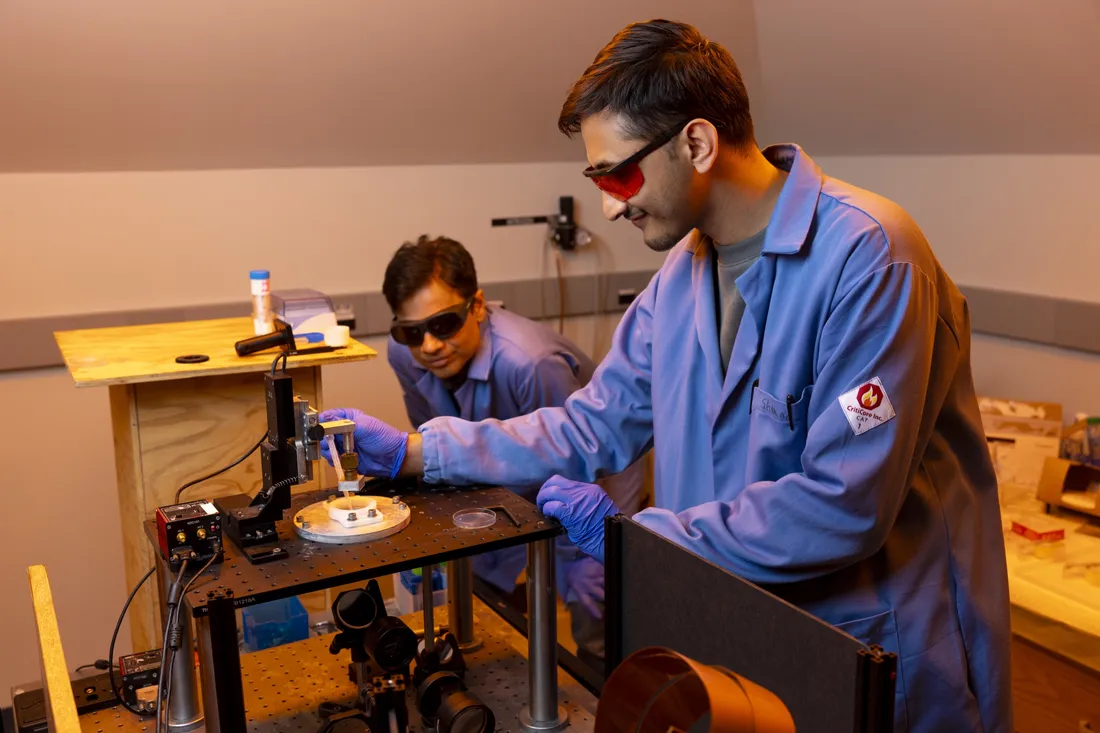
“We’re at the frontier of vascularized tissue engineering,” says Timilsina, shown operating a bio-based optics printer at Syracuse.
While Soman is an experimentalist interested in bioprinting ECM cubes, his work is largely informed by Saikat Basu, an associate professor of mechanical engineering at SDSU, who focuses on the cubes’ fluid mechanics.
“Each cube has tiny, branched channels, like blood vessels. Saikat’s computational modeling shows us how to design these channels so that cells get all the nutrients they need to survive,” says Soman, whose team includes Jason Horton, assistant professor of cell and developmental biology at SUNY Upstate.
It’s the interplay between theory and practice that informs Soman’s research and his leadership of the University’s BioInspired Institute. In August, he was named director of the seven-year-old institute, which addresses global challenges in health, medicine and materials innovation.
“I am optimistic about securing center-scale and collaborative funding as well as championing new entrepreneurship and industry partnerships,” says Soman, a former National Science Foundation program director.
Syracuse University has a rich, innovative and ever-evolving research culture. It’s an exciting time to be here.
Pranav Soman, Professor, Biomedical and Chemical Engineering, and Director, BioInspired Institute
That his bio-block project marks the first time the University is the prime awardee of an ARPA-H grant is noteworthy.
Modeled after the Defense Advanced Research Projects Agency (created in response to the Soviet Union’s launch of Sputnik 1 in 1957), ARPA-H invests in innovative projects that are “too complex, risky or long-term” for traditional commercial industries or standard academic grants, Soman explains.
No doubt that his ARPA-H research, with its inter-university collaborative ethos and strong commercial potential, suggests where BioInspired is headed.
“Syracuse University has a rich, innovative and ever-evolving research culture,” Soman says. “It’s an exciting time to be here.”

