In the predawn hours of May 21, 2023, U.S. Air Force Staff Sgt. Sascha Reese was involved in a two-vehicle collision in southern Germany. She and another driver approached a curve outside a small Rhenish town, where they crashed headlong into one another.
Reese’s SUV struck the guardrail in her lane. The other vehicle, containing a driver and three passengers, rotated 180 degrees in the middle of the road. Both drivers sustained minor injuries.
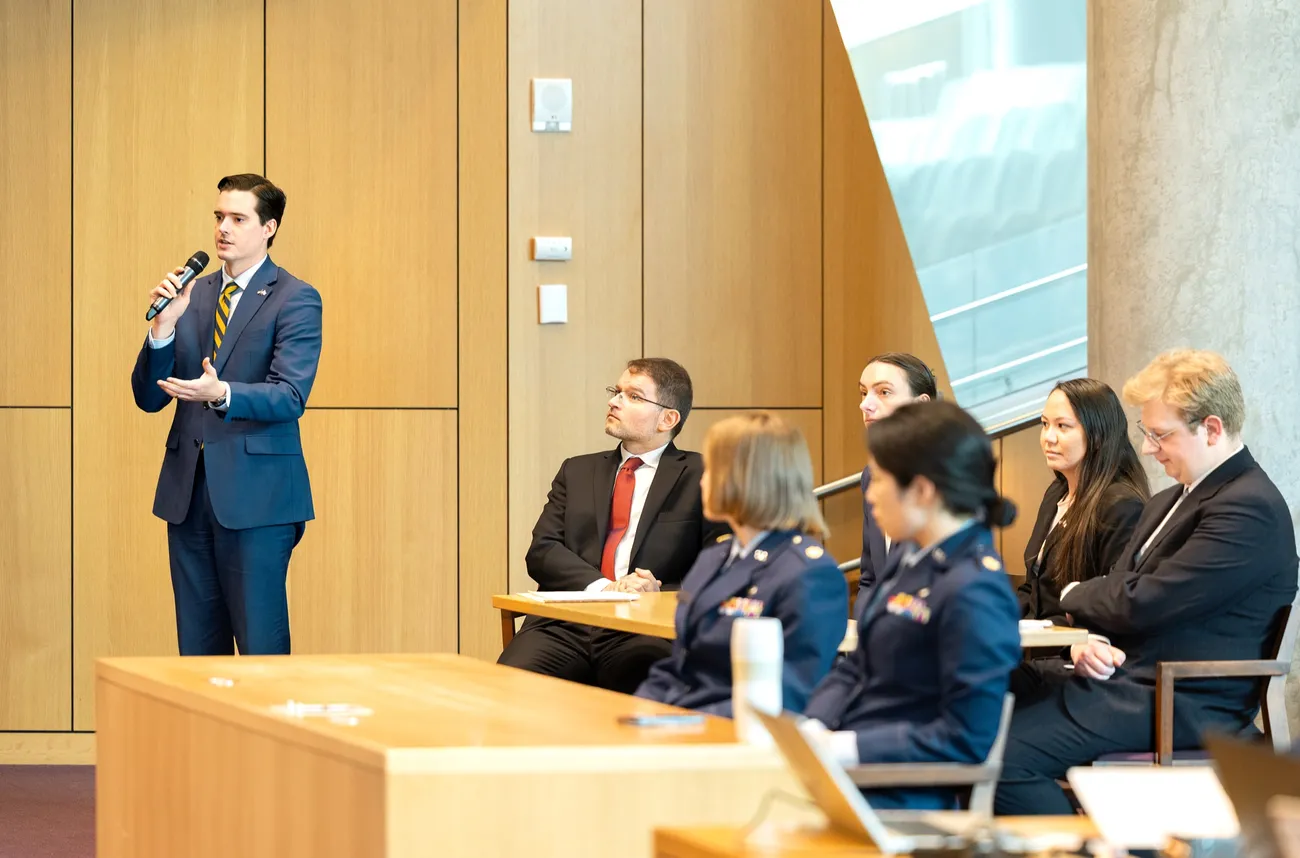
Bess Murad L’26 (far left), a member of the amicus curiae for the appellant, lauds Project Outreach for being “surreal in the best way.”
While Reese was found guilty of reckless driving, the issue of factual sufficiency of the evidence was presented to the appellate court for review. Another sticking point was withheld evidence from an ongoing civil case involving the accident.
The dispute—thousands of miles away and years in the making—found its way to Syracuse University, placing College of Law students at the center of a live, high-stakes appeal.
“We have a close relationship with the U.S. Air Force Court of Criminal Appeals [AFCCA],” says Beth Kubala, executive director of Syracuse’s Office of Clinical Legal Education. “AFCCA’s Project Outreach program conducts live oral arguments in pending courts-martial cases at select colleges and universities. It enables our students to gain a meaningful advocacy experience and the public to learn more about the military justice system.”
I was grateful for the opportunity to step into this world that has been a dream of mine for such a long time and work with an amazing team of students, professors and practitioners in the field.
Ava Dussmann L’27
Earlier this year, four parties to an appeal convened in the Melanie Gray Ceremonial Courtroom of Dineen Hall to investigate the ruling for procedural, legal or factual errors. The goal was not to provide new facts or retry existing ones but, rather, to address potential errors in the record.
Part of the allure was who was in the room. Students, faculty and alumni from Syracuse Law. Courtroom sketch artists courtesy of the School of Art in the College of Visual and Performing Arts. Curious observers.
Bess Murad L’26 was part of a small cohort of students selected to participate. A member of the amicus curiae (“friend of the court”) for Reese, she provided information designed to sway the court’s decision in the appellant’s favor.
“I’ve spent years learning how appellate courts work,” Murad says. “But when I got to argue the case on record, everything clicked. It was surreal in the best way.”
A Full-Circle Moment
Project Outreach is one of many military justice opportunities available to Syracuse Law students. Others include the Betty and Michael D. Wohl Veterans Legal Clinic; the National Military Trial Competition, which the University hosts; and the Military and Veterans Law Society, to name a few.
Experiential learning, alongside unique joint-degree combinations and distinct pedagogical approaches, distinguishes Syracuse Law from its peers, explains Kubala, who organized a visit by the U.S. Army Court of Criminal Appeals in 2023.
A retired Army lieutenant colonel and esteemed military lawyer, she exemplifies the faculty’s blue-chip pedigree.
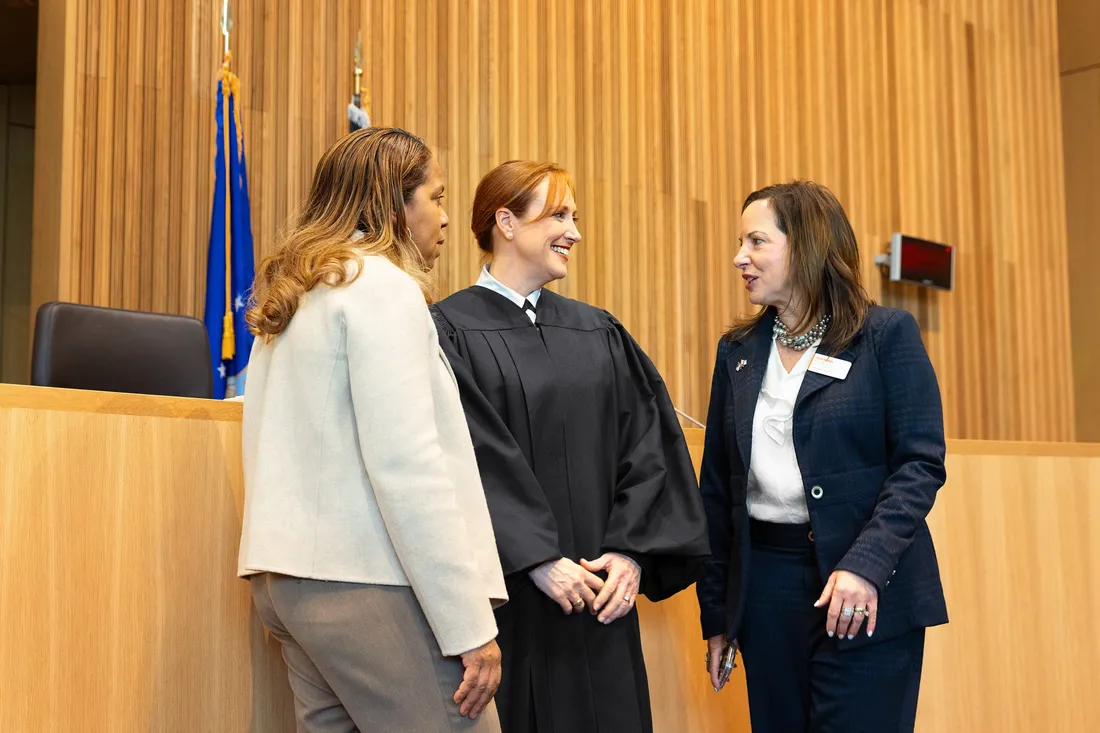
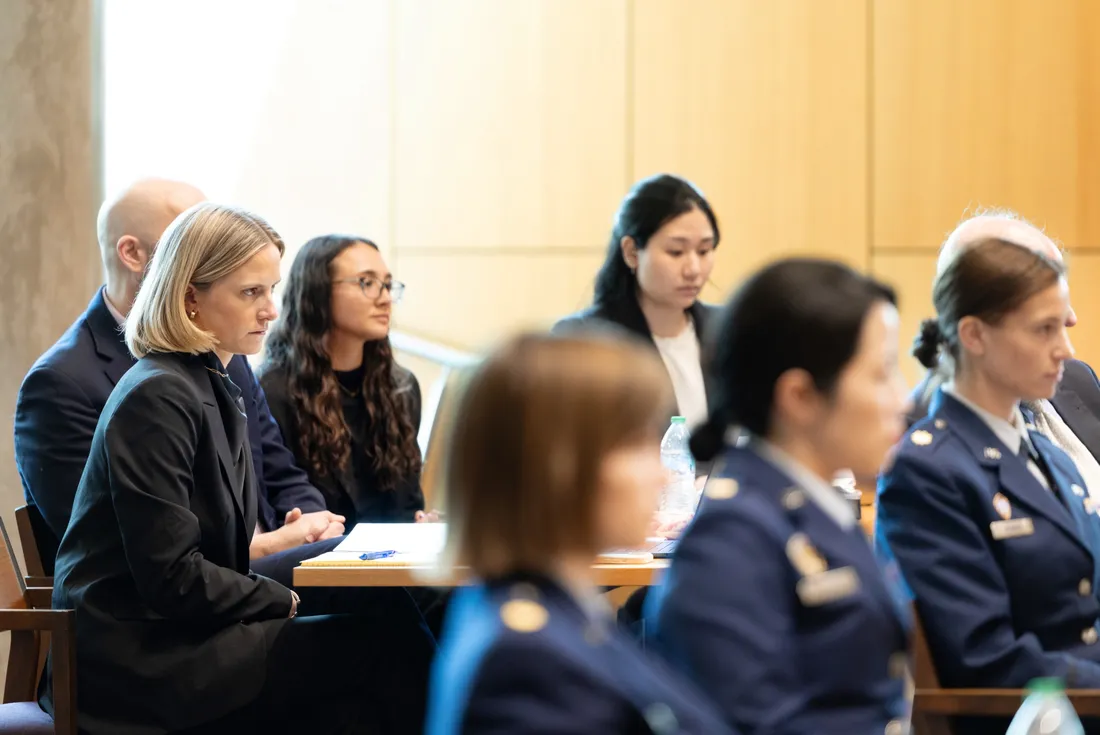
From left: Army Col. Pia Rogers ’98, G’01, L’01; Air Force Col. Cynthia Kearley G’01, L’01; and Syracuse Law’s Beth Kubala. An active-duty judge advocate (JAG) and former classmate of Kearley’s, Rogers was among the alumni in attendance.
In fact, it was Kubala’s reputation as one of the nation’s top advocates for military-connected personnel that impelled Air Force Col. Cynthia Kearley G’01, L’01 to bring AFCCA to campus. An appellate military judge at Joint Base Andrews in Maryland, the alumna was part of the court’s three-judge panel.
“The event was a full-circle moment,” recalls Kearley, who earned a J.D./Master of Arts in International Relations from the Maxwell School of Citizenship and Public Affairs and the College of Law. (She also earned a certificate of advanced study in conflict and collaboration from the Maxwell School and was commissioned through Syracuse’s Air Force ROTC Detachment 535). “Presiding as an appellate military judge at my alma mater, where I found my footing as a lawyer, is something I’ll never forget.”
Real People. Real Cases.
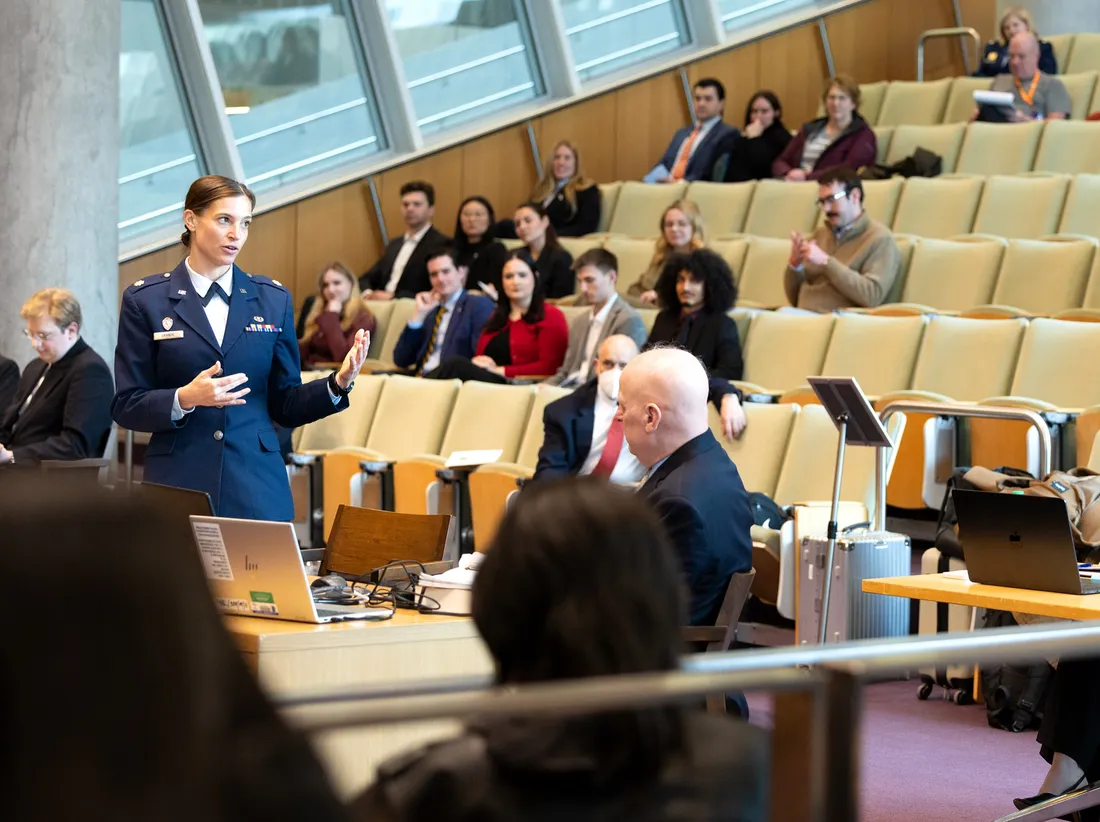
Project Outreach enables aspiring JAGs to work alongside experienced ones, like Air Force Maj. Jordan Grande (standing). The Feb. 27 event was when “theory turned into practice,” says Hannah Rice L’27.
Those who participate in Project Outreach write amicus briefs and present live oral arguments, duties that help them make the leap from classroom to courtroom.
Second-year law students Ava Dussmann and Hannah Rice were part of the amicus curiae for the U.S. Government (i.e., the appellee). On track to become Air Force judge advocates, or JAGs, they found the experience eye opening. Real people. Real cases. No room for error.
“I was grateful for the opportunity to step into this world that has been a dream of mine for such a long time and work with an amazing team of students, professors and practitioners in the field,” Dussmann says. “Through this opportunity, we got to research and learn about the contours of the Uniform Code of Military Justice.”
Rice adds that sitting before three Air Force colonels, arguing a real case with classmates who might someday be her colleagues, is when “theory turned into practice.”
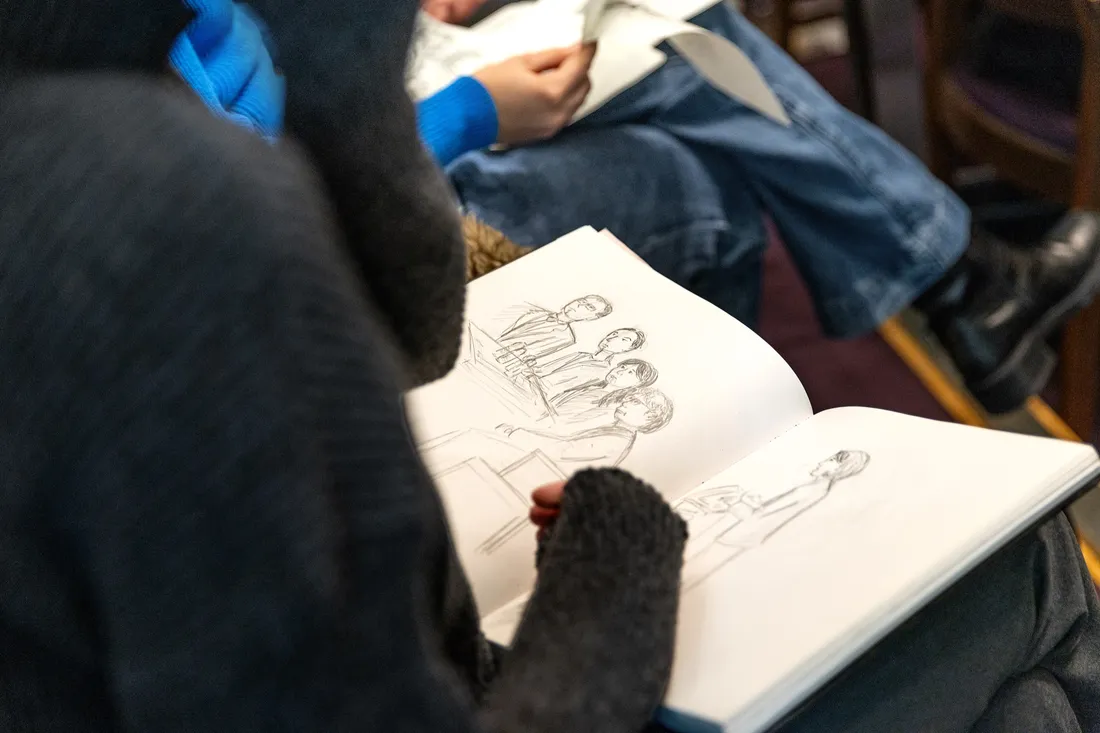
An illustration major in the School of Art displays her drawings of the proceedings. Involving students as courtroom sketch artists spoke to the interdisciplinary nature of the hearing, Kubala explains.
Associate teaching professor Thomas M. Leith supervised Reese’s amicus curiae. He says countless hours of “intensive writing, sustained supervision and multiple moot sessions” went into readying for the event.
“The students were ultra-prepared,” says Leith, who also directs Syracuse’s Criminal Defense Clinic. “Like an iceberg, the brief reflected only a fraction of the work beneath the surface.”
Even though a decision may not be made until after some of the participants graduate, their names will become part of the official record.
“The most powerful teaching came less from anything I said and more from the experience itself,” Leith continues.
That’s the idea behind Project Outreach, to give students “firsthand exposure to real appellate advocacy,” Kearley adds. “Syracuse Law delivered an exceptionally professional and welcoming event.”