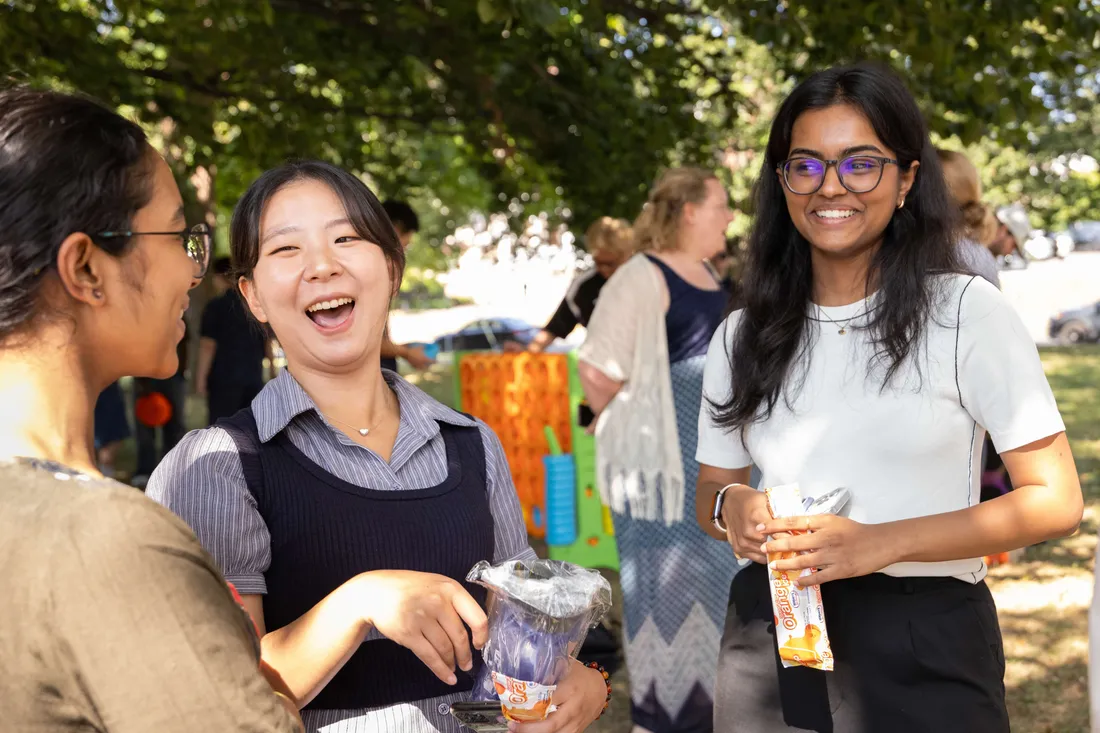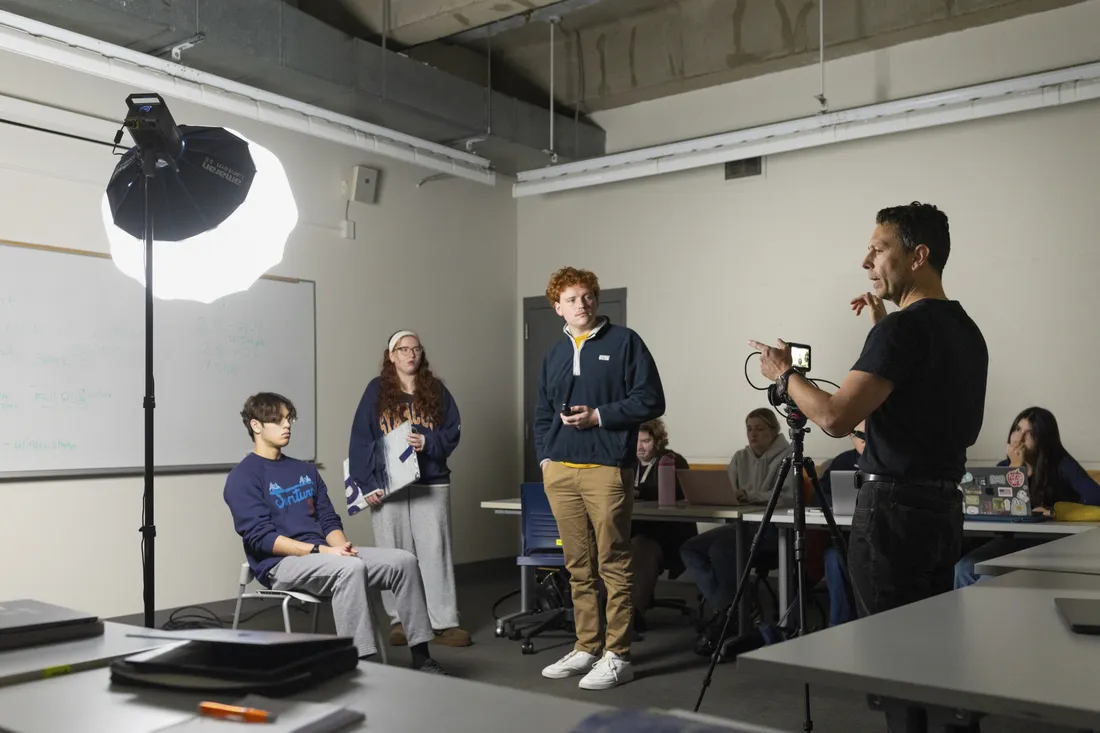
For many international students, gathering for weekly conversations helps them bolster their confidence in their English skills. It’s also a chance for them to find belonging, share cultures and build friendships with people who understand the experience of being far from home. With the support of facilitators, students navigate pronunciations and accents, learn American slang and phrases and ask questions about American customs and etiquette in a relaxed and encouraging setting.
With a desire to continue improving her communication, especially with faculty and classmates, Hua “Ava” Fan G’26 regularly attends an English Conversation Group hosted by the Center for International Services (CIS) at Syracuse University. “The conversation group is very helpful for me,” says Fan, a master’s student in accounting from China. “Talking with the group gives you confidence. We all have a similar story, but different backgrounds and cultures.”
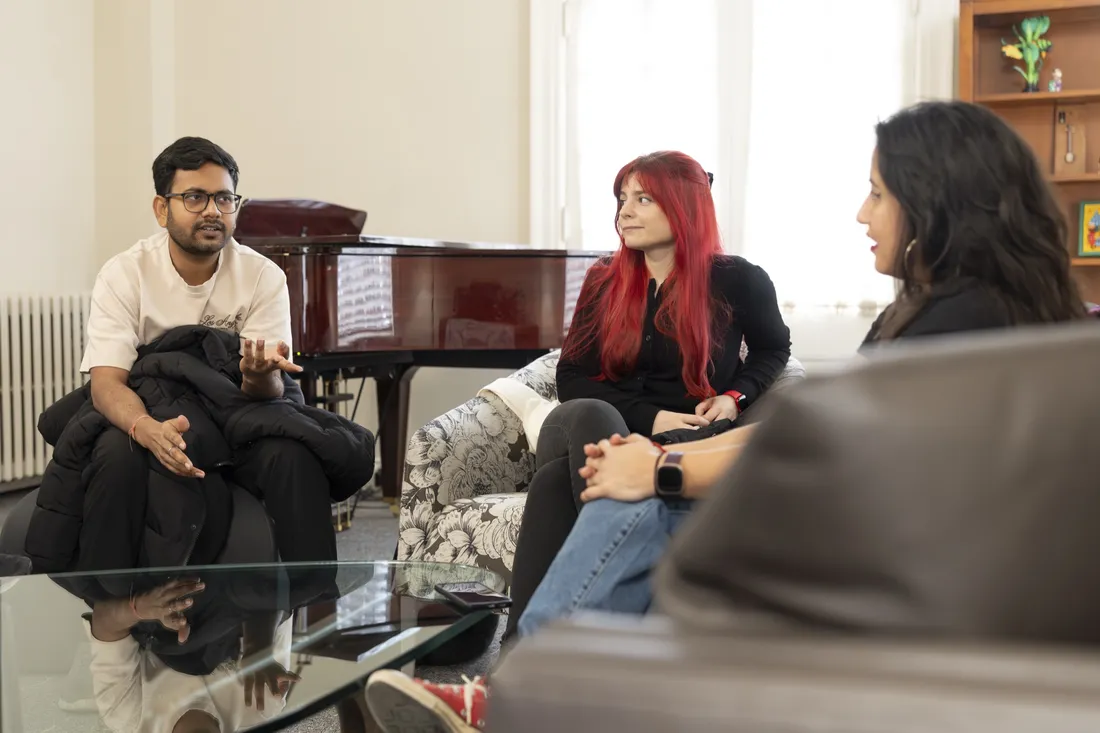
English Conversation Group facilitator Maddy Ledesma G’14 (right) talks with Jayesh Mohan G’26 (left) and Alena Litskevich. The group discussions are informal and touch on numerous topics.
Jayesh Mohan G’26, a master’s student in computer science from India, echoes those thoughts, saying the gatherings build confidence and courage. “Here we can speak about anything,” he says. “If you make a mistake, it’s fine. Everyone is making mistakes and learning.”
On Thursday afternoons in the CIS, Maddy Ledesma G’14, who has been a group facilitator for a decade, welcomes international participants with a relaxed, informal approach. The conversations draw undergraduate and graduate students, visiting scholars and family members who represent a host of countries, helping them create community. Ledesma invites the group to introduce themselves, share their interests, talk about anything on their minds and just have fun. “I always want to encourage students that you can talk and share,” she says. “The more they talk, the more relaxed and less afraid they are, and the more they gain. It’s about confidence.”
In welcoming members of the international community, the University offers a variety of programs to help them acclimate to campus life, build community, share their cultures and learn about American culture. CIS, for instance, hosts Mix It Up, Friday get-togethers that promote intercultural understanding. The International Living Learning Community invites first-year international and domestic students to explore cultures together. Student organizations represent a diverse range of races, ethnicities, regions and countries. And through Culture and Conversation Tables, students practice language skills and share cultures in numerous languages—from Turkish, Tamil and Italian to Hebrew, French and Japanese.
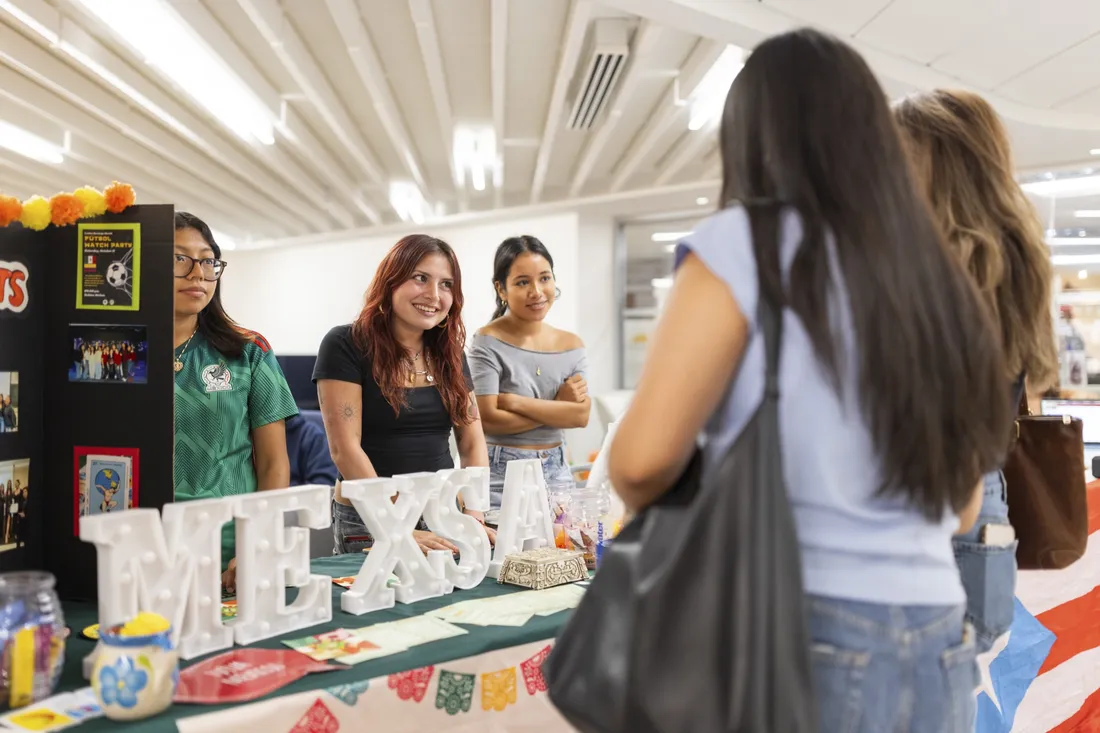
At the 2025 Welcome Week Fête, international student organizations were among those that invited new students to learn about their activities at an involvement fair.
“I would really like students to leave the English Conversation Group feeling more comfortable and confident speaking English, knowing this is a safe, supportive space where everyone is rooting for each other,” says Jamie Kasza, student activities coordinator for CIS. “Along the way, I hope they form meaningful connections and friendships that go far beyond just practicing their English.”
Where Conversations Build Confidence
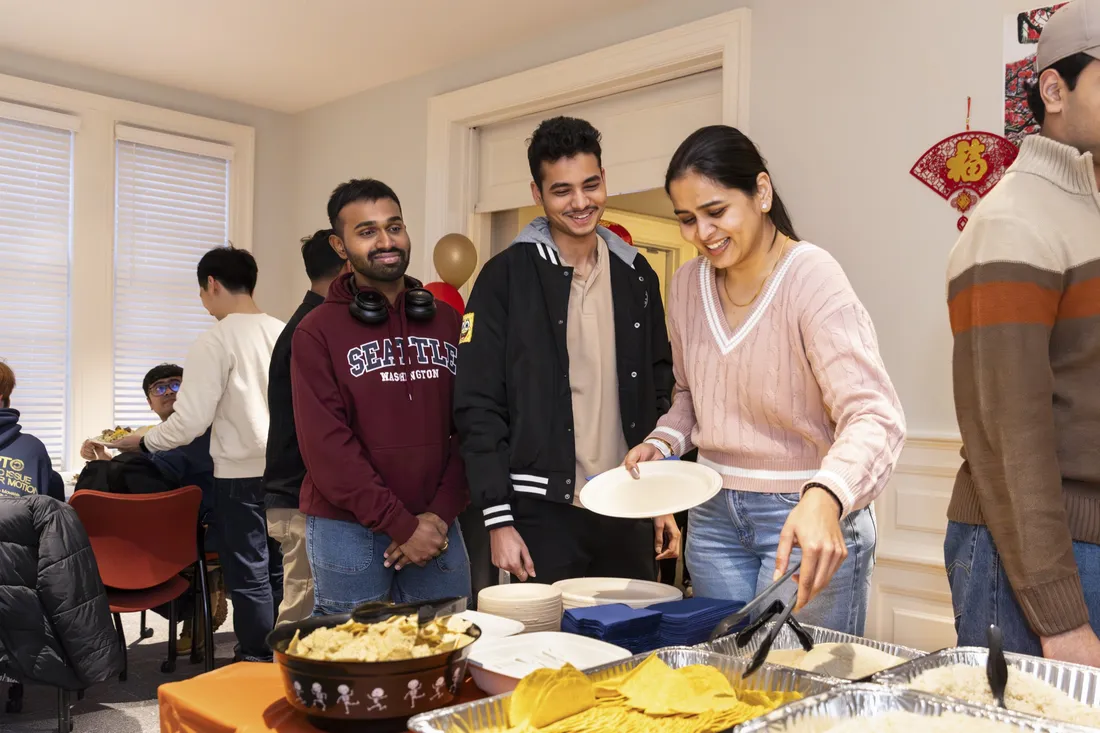
The Center for International Services invites students to meet, share food and conversation at Mix It Up events, Friday get-togethers that promote intercultural understanding.
For Alena Litskevich—a Belarus native whose husband, Maksim Litskevich, is a postdoctoral researcher in quantum physics—the meetings are an opportunity to meet people, socialize and improve her English. “This conversation group is one of the best places for me to practice,” says Litskevich, who worked as a software test engineer before coming to America. “It’s really helpful for me, and I’m grateful for this opportunity.”
The conversations are free flowing—naturally, snow and the weather are unavoidable topics, but travel, food, local attractions and sports are also popular. Ledesma invites the group to talk about unfamiliar phrases— “getting wires crossed,” for example—and the challenges they face in conversations. Job interviews, meeting influential campus guests and even interactions in restaurants can pose difficulties. Leo Chen ’26, a math major from China, shares that some words require practice and asks Ledesma to pronounce the number 1,003. “It’s a little tricky to use a thousand,” he says.
Navigating the Nuances of American Life
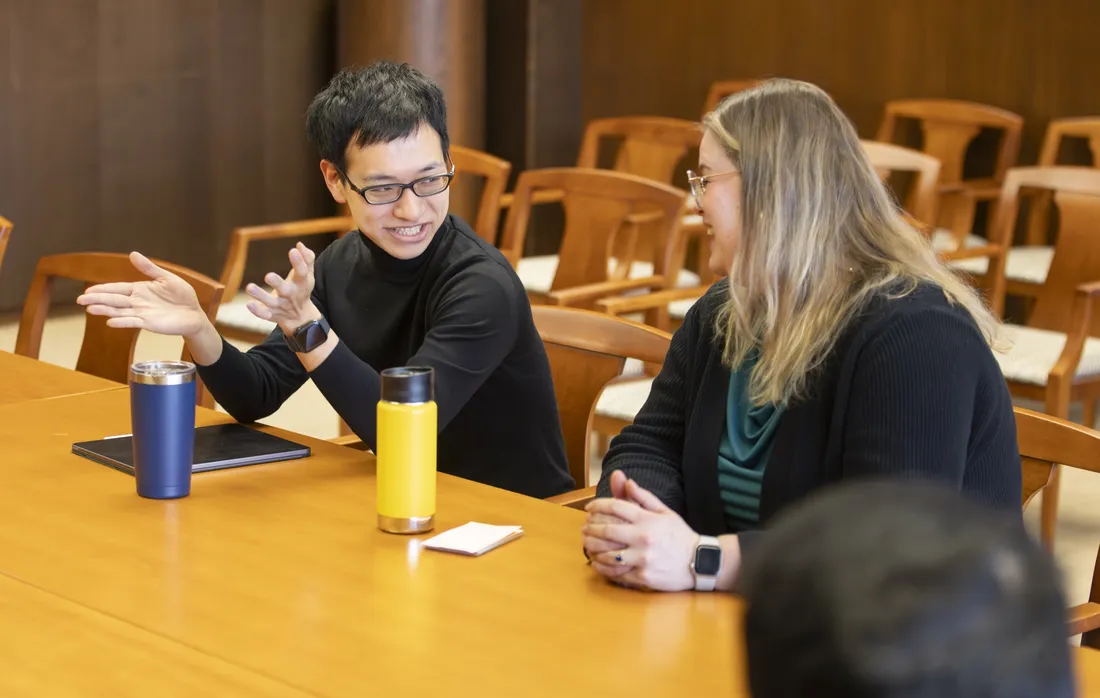
English Conversation Group facilitator Michelle Mitchell (right) enjoys a laugh with Kazumichi Nakagomi during a group discussion.
Michelle Mitchell, a reference and instruction librarian and Syracuse University Libraries liaison with the CIS, enjoys her interactions with international students, seeing her role as a good way to create a positive, supportive environment. “I learn so much from our international students,” she says. “Our conversation groups are a nice way to make our community more welcoming to their experiences.”
In one meeting, Mitchell guides her group through questions about American customs, such as opening doors for others, asking “How are you?” as a passing greeting and responding to compliments from strangers—acknowledging that it can “take a lot of courage” to interact with strangers and meet people, especially when you’re new to a place.
Talking with the group gives you confidence. We all have a similar story, but different backgrounds and cultures.
Hua "Ava" Fan G’26
Kazumichi Nakagomi, an executive master of public administration student from Japan, notes that complimenting strangers can feel somewhat unfamiliar in Japan, while Fulbright Scholar Agaichatou Dicko describes how Mali’s culture of warm, playful connection makes welcoming strangers second nature. Even so, Dicko, an executive master’s in international relations student, acknowledges that speaking up in formal settings can still feel daunting—but practicing alongside fellow international students has helped.
“We can speak openly,” she says, “and I think it is a good environment in which we are gaining more trust in ourselves, and this helps us keep going.”