Roughly 400 million years ago, Central New York was a warm, subtropical shallow sea, populated by an array of marine life. This past summer, Zoë Power ’28 stepped back in time to explore the remnants of those ancient marine organisms. Some of what’s left of the Middle Devonian Epoch survives in the Edgecliff Member of the Onondaga Limestone as bioherms—fossilized coral reef mounds embedded in limestone.
“It’s super cool to be able to hold rocks that have a variety of organisms that once lived together,” says Power, a geology major in the College of Arts and Sciences at Syracuse University. “They don’t necessarily look like what we have today because they’re long extinct, but they fill some of the same ecological roles that reef animals do now.”
Documenting Ancient Marine Life
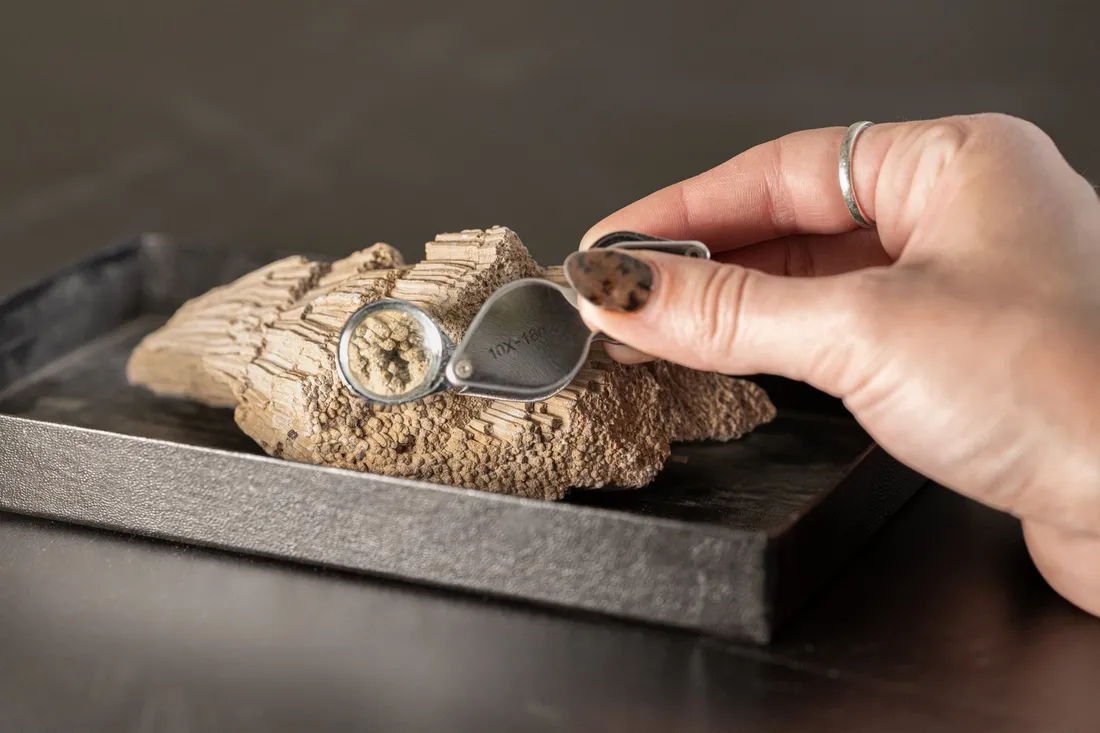
Zoë Power ’28 shares an up-close look of Favosites hemisphericus, an extinct tabulate coral that she found at the Oxbow Quarry in Canastota, New York.
Power, who says she has “always loved the idea of deep time, evolution and animals,” set out to document a bioherm discovered last year during rock blasting at the Oxbow Quarry run by Callanan Industries in Canastota, New York. Backed by a SOURCE (Syracuse Office of Undergraduate Research and Creative Engagement) Bridge Award and a continuing grant this fall, she works on the Oxbow Reef project alongside Earth and environmental sciences professor Linda Ivany, an expert in evolutionary paleoecology and paleoclimate. “This is the first actual research project I’ve done, and it’s definitely challenging,” Power says.
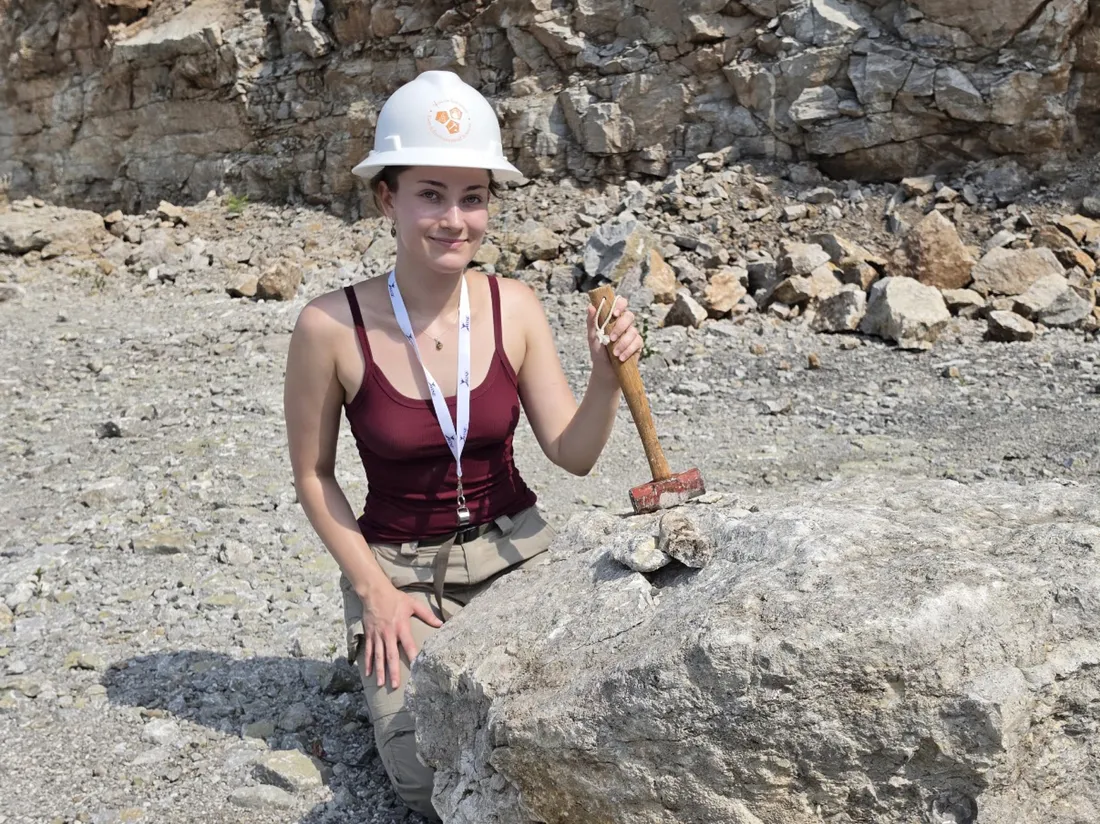
Power first visited the Oxbow Quarry last fall on a field trip in the geology course Exploring the Fossil Record.
Power’s interest in paleontology was ignited last fall, when she took Ivany’s course Exploring the Fossil Record. The class joined Ivany and others on a New York State Geological Association field trip to the Oxbow Quarry. As a mentor, Ivany invited Power to work in her lab—where she has helped identify and label fossil specimens from New York and beyond—and encouraged her to pursue the SOURCE project.
In addition to working on the Oxbow Reef project, Power gained hands-on paleontological experience participating in a Department of Earth and Environmental Sciences (EES) field research trip to Scotland, where they visited famous geological sites studied by James Hutton, the father of geology.
Researching and Gathering Fossils
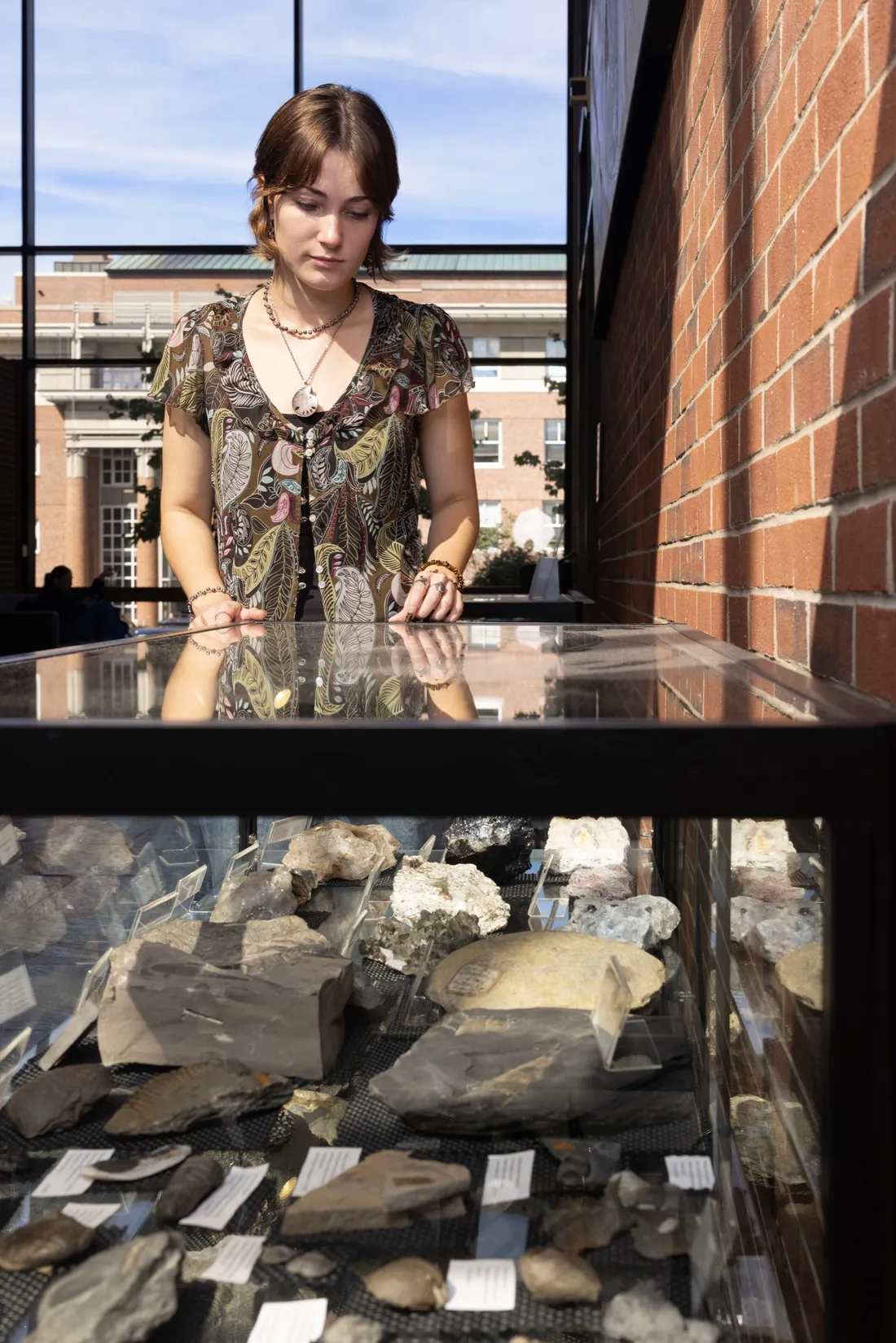
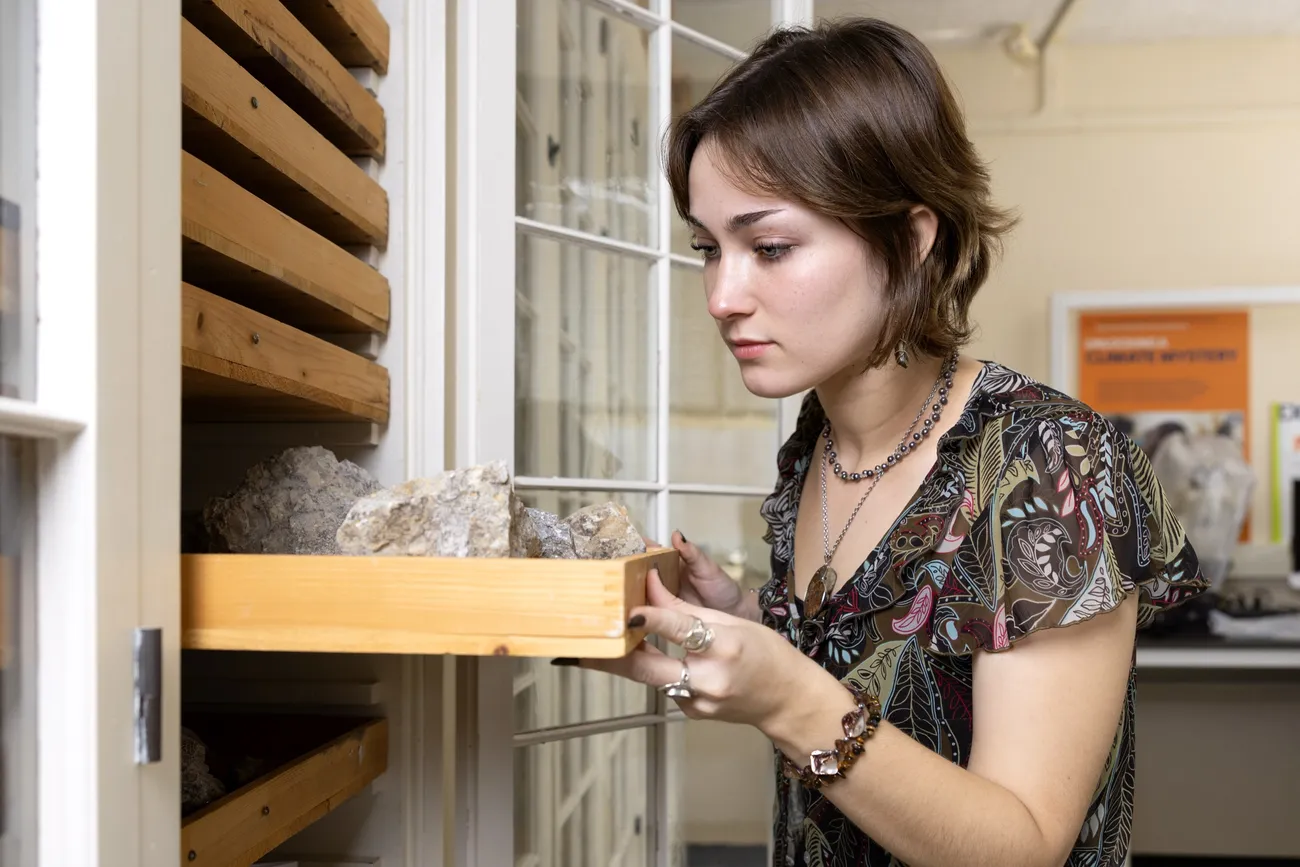
Power examines a display in the lobby of the Heroy Geology Laboratory.
The quarry is an active worksite, which means Ivany and Power are working against the clock to collect all their samples before the bioherm is destroyed. While the Oxbow Reef is not the first known from rocks of this age in New York, it may be the best preserved. “It’s rare to be able to see a perfect cross section through an entire reef in the fossil record and to have the corals preserved in such exquisite detail,” Ivany says. “Having it preserved in 3D is a real treasure.”
In July, they gathered samples at the bioherm and brought them back to Ivany’s lab. “All of the rocks blasted from this bioherm in the quarry wall were just littered with fossils. It was really great,” Power says. “Now I have a lot of the fossils identified down to at least the genus level.”
Among the findings were rugose and tabulate corals, both extinct today. One tabulate species that caught Power’s eye was Favosites hemisphericus—made up of honeycomb-like structures that may break apart like matchsticks when perfectly preserved. They also found samples of trilobites, crinoids, bryozoans, bivalves, brachiopods, cephalopods and gastropods. “Among so many beautiful fossils, it’s interesting to find my own specimens and decide if they’re good enough to bring back to the lab,” she says.
Highlighting the Reef’s Species
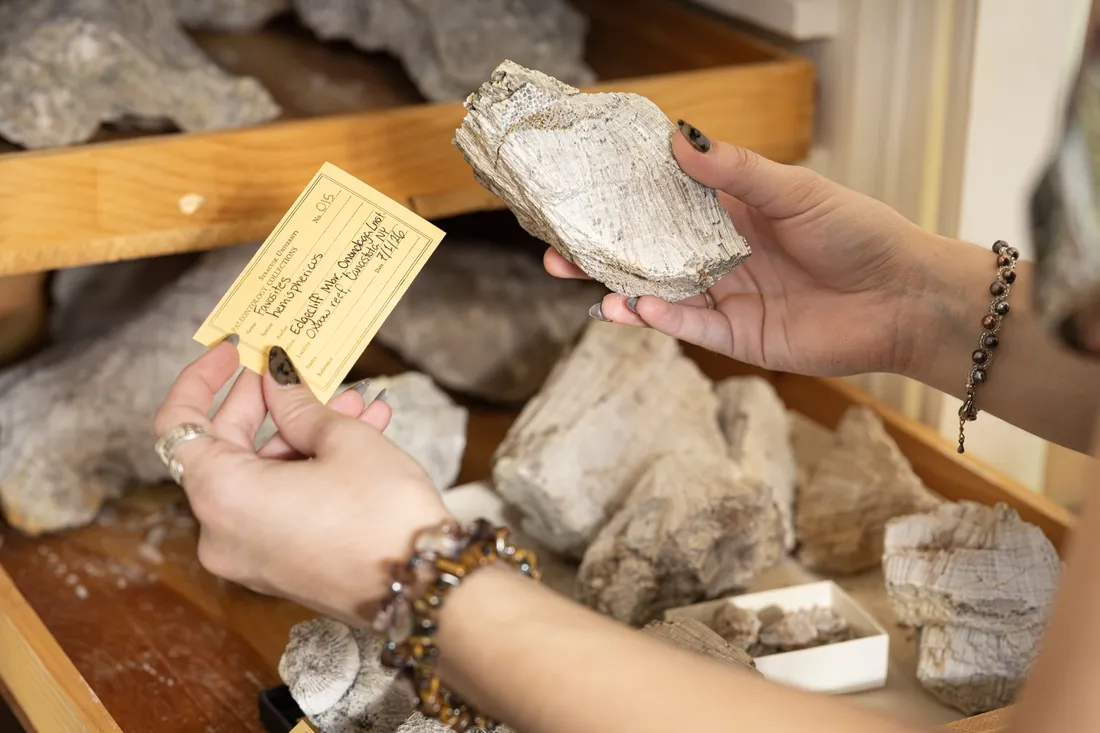
Power shows samples of Favosites hemisphericus collected at the Oxbow Quarry in July.
This semester, Power and Ivany hope to map out the distributions of fossil species in the reef as it grew over time and to put constraints on the bioherm’s size and how high it rose above the Devonian seafloor. To aid in this effort, they’re teaming up with EES graduate student Mary LePere and her advisor, Professor Jessica Mejia, this fall to carry out 3D drone mapping of the bioherm. “Each different type of section in this bioherm will have different ecologies—what existed there and what they did,” Power says.
The result of Power’s work will be a field guide highlighting the different species of fossils with photographs and descriptions and an analysis of where they are found in the reef. Some of Power’s specimens are also headed to an exhibition of fossil reefs slated to open next spring at the Paleontological Research Institution’s Museum of the Earth in Ithaca, New York. All Power’s fossil specimens and the drone imagery will be permanently archived in the institution’s research collection.
“Zoë has done a great job identifying the various fossil species present in the reef,” Ivany says. “And her collection of fossils from our Oxbow Reef will figure prominently in that exhibition—very exciting!”