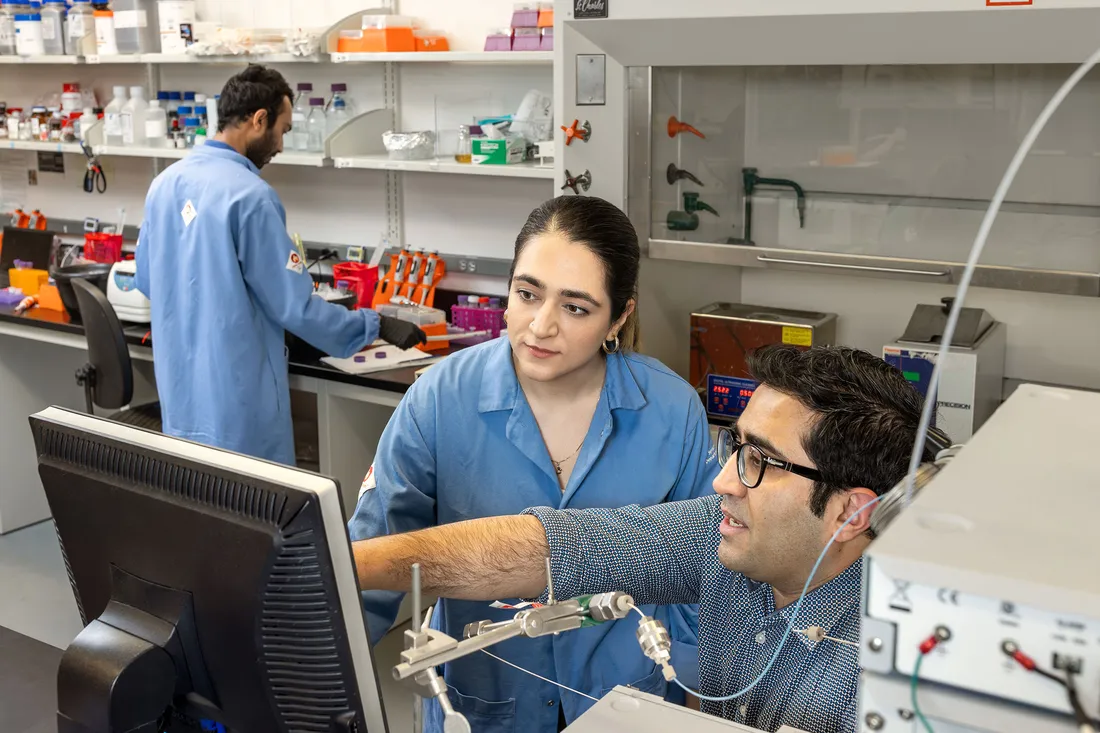
- Fatigue is one of the most overlooked consequences of stroke and Syracuse University researchers are working to change that.
- An NIH-funded clinical trial at the Syracuse University Aphasia Lab pairs language therapy with noninvasive brain stimulation to improve outcomes for stroke survivors.
- Undergraduate and graduate students are contributing to research that directly impacts people living with aphasia in their community.
Ellyn Riley was in high school when her grandmother had a stroke. A writer, she had built a life around language—but afterward, struggled with the very thing that had defined her.
“Language wasn’t just a skill for her, it was how she thought and how she expressed who she was,” explains Riley, an associate professor in the Department of Communication Sciences and Disorders. “I didn’t have the vocabulary for it at the time, but what I was watching was aphasia—and the frustration it caused her has never left me,” Riley says.
Aphasia, a language disorder that affects about one-third of stroke survivors, impacts word finding, sentence formation and language comprehension.
I want our research to be part of building the evidence base that demands better. More targeted treatment, longer duration of care and real attention to the invisible burdens like fatigue that make recovery so much harder.
Dr. Ellyn Riley, Associate Professor
Riley now leads the Syracuse University Aphasia Lab, one of the only research programs in the country focused not just on aphasia, but the fatigue that impedes recovery.
“Fatigue is one of the most debilitating consequences of stroke, yet it’s very often overlooked in rehabilitation,” Riley explains. “We’re talking about a pervasive lack of energy that affects both physical and cognitive functioning—not simply feeling tired at the end of a long day. People come to therapy already depleted, and we’re asking them to do cognitively demanding work.”
That disconnect has driven a new set of research questions: Where does this fatigue come from, what intensifies it, and what would it mean to treat it directly?
Fighting Fatigue
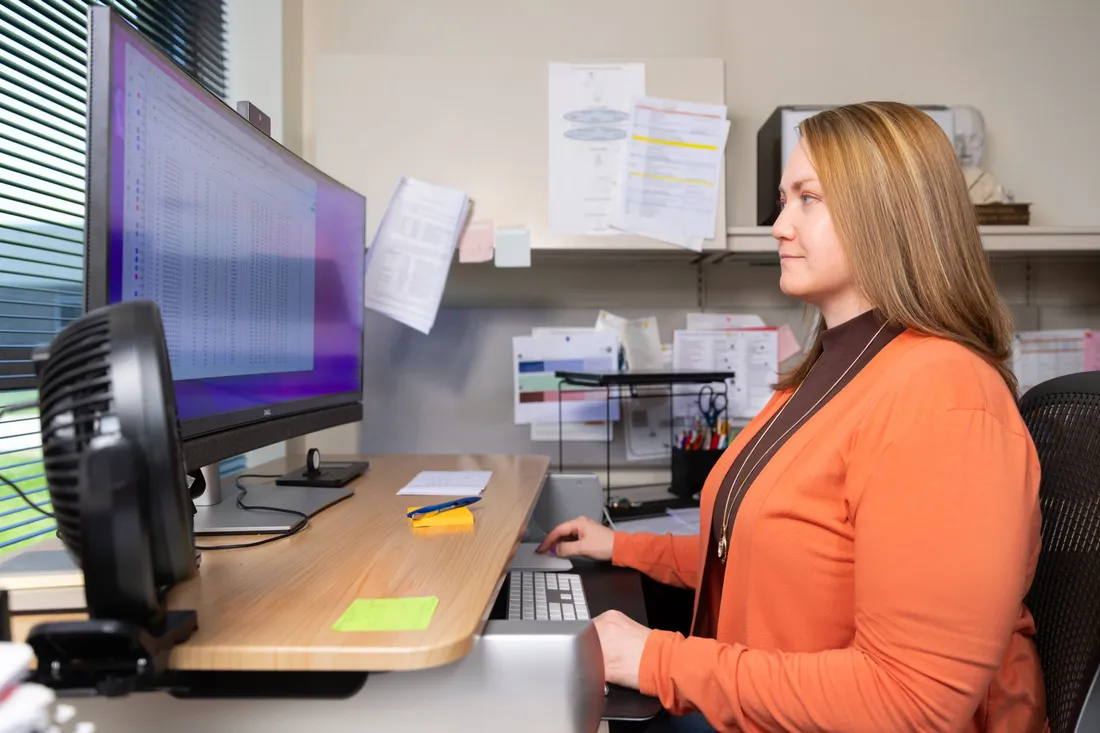
Associate professor Ellyn Riley leads the Syracuse University Aphasia Lab, one of the few research programs in the country focused on how fatigue impedes stroke recovery.
For Riley and her team, some of the answers have been counterintuitive. People with milder aphasia sometimes report greater fatigue than those with more severe impairments.
“We think this may reflect the enormous cognitive effort required when you’re aware of your deficits and pushing hard to compensate,” Riley says. “That finding alone tells us we might be underestimating what these individuals are dealing with every day.”
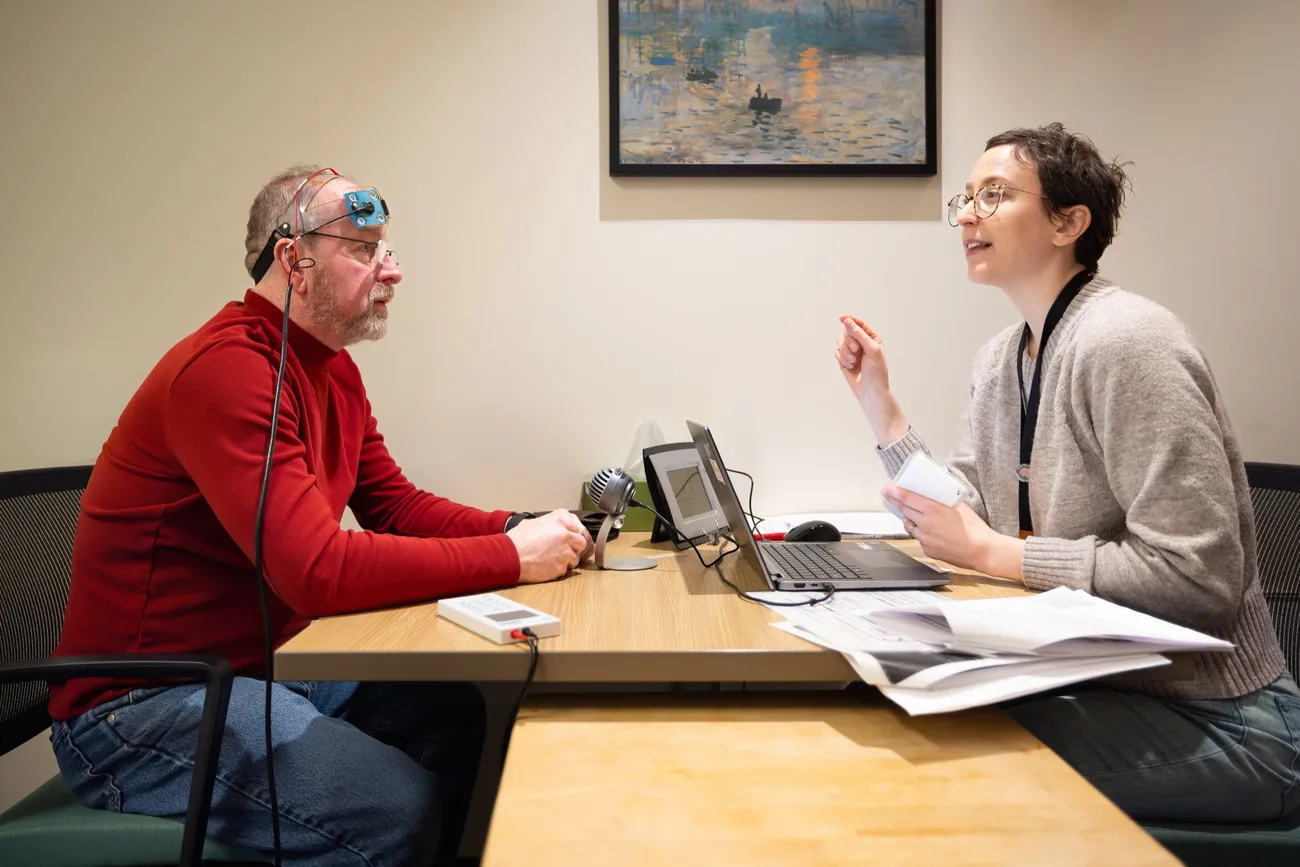
To address both language and fatigue, Riley’s lab is running a National Institutes of Health-funded clinical trial that pairs language therapy with transcranial direct current stimulation (tDCS)—a noninvasive technique that delivers a mild electrical current to specific regions of the brain.
“The idea is that tDCS may prime the brain to be more responsive to therapy by modulating neural excitability, essentially making the learning environment more favorable,” Riley explains.
Participants complete sentence comprehension tasks while receiving either active stimulation or a sham condition, allowing researchers to isolate the technology’s effect.
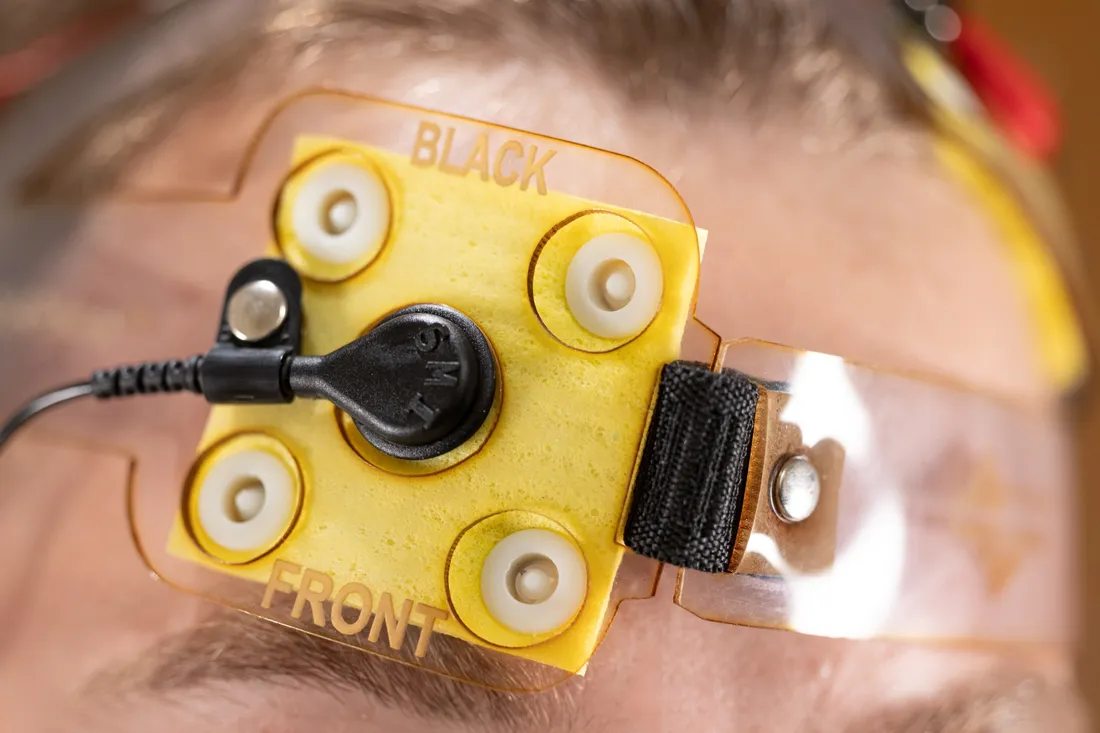
Transcranial direct current stimulation delivers a mild electrical current to targeted brain regions, helping prime the brain to be more receptive to language therapy.
“What makes our trial distinctive is that fatigue is a primary outcome, not an afterthought,” Riley says. “We’re hoping to find that this combined approach not only improves language but also reduces the fatigue burden—and we gather enough data to start understanding who responds and why.”
“This research, like other clinical trials, could form the backbone of a new treatment option in traditional clinical settings,” says Jenny Fortin, one of the lab’s clinical research speech-language pathologists who works directly with participants.
Ph.D. student Hannah Rembrandt, who runs testing sessions for the trial, is also examining how fatigue shapes narrative ability. Participants watch a video and then retell the story under varying levels of induced fatigue.
“I’m measuring their language and also using eye tracking and pupillometry as a physiological proxy for fatigue,” explains Rembrandt, “looking at pupil diameter changes, blinks and eye movement.”
The work quantifies what patients and clinicians have long observed: “People have always said, ‘When I’m more tired, talking is harder,’” Rembrandt explains. “Now we can measure that.”
The Human Stakes
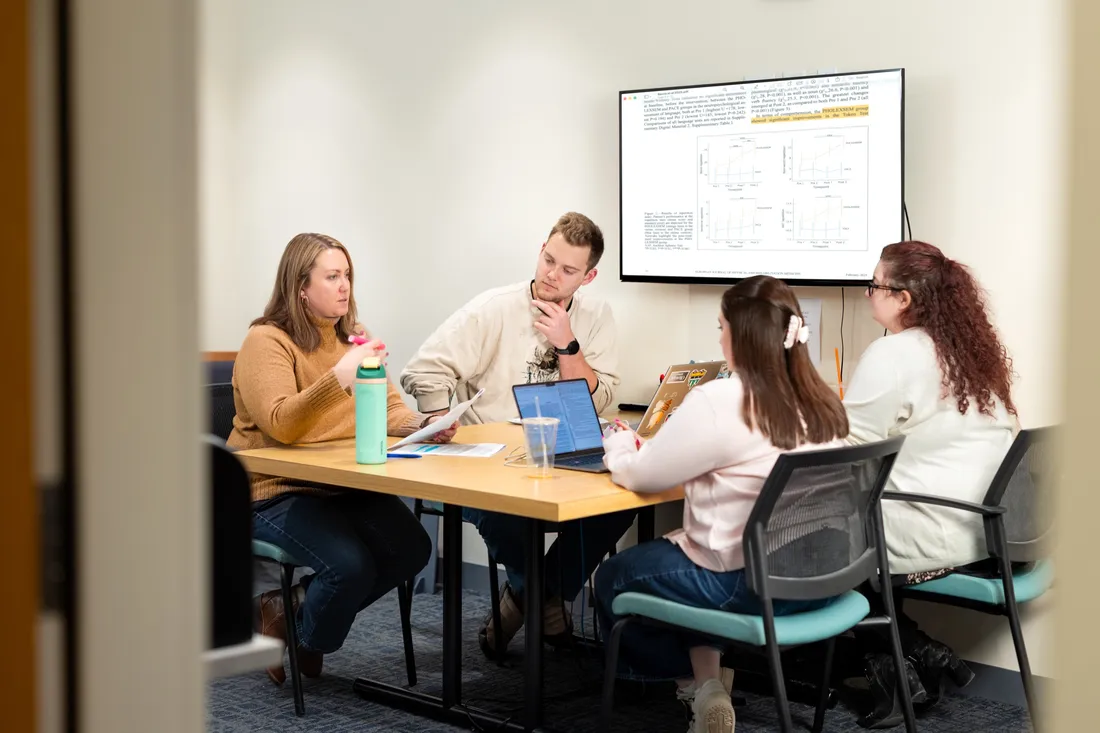
Ph.D. student Hannah Rembrandt (far right) and undergraduate researcher Luke Sippel ’26 (center) review research with Riley (left). “Ellyn has been a really excellent mentor—not just for me in my Ph.D. program, but also for undergrads and graduate students,” says Rembrandt.
The implications extend well beyond clinical metrics. “If we only measure whether someone can name pictures more accurately after treatment, we’re missing almost everything that matters to that person,” Riley says. “They want to have a conversation with their spouse. They want to go back to work, or call their grandchildren, or feel like themselves again.”
Luke Sippel ’26, a triple major in economics, biology and neuroscience on the pre-med track, has been involved in the Aphasia Lab as an undergraduate researcher for the past two years. “Seeing the severity, and the varying severity, in what someone has to deal with in daily life—I can definitely feel the purpose right in front of me,” Sippel says.
The experience has also clarified his career aspirations: “It solidifies the fact that I want to do research,” he says.
Fortin has found many participants are motivated not only by their own recovery but by the chance to help future survivors. “Many participants tell me they want to help others who have had a stroke by taking part in the study—they want to contribute to the knowledge base.”
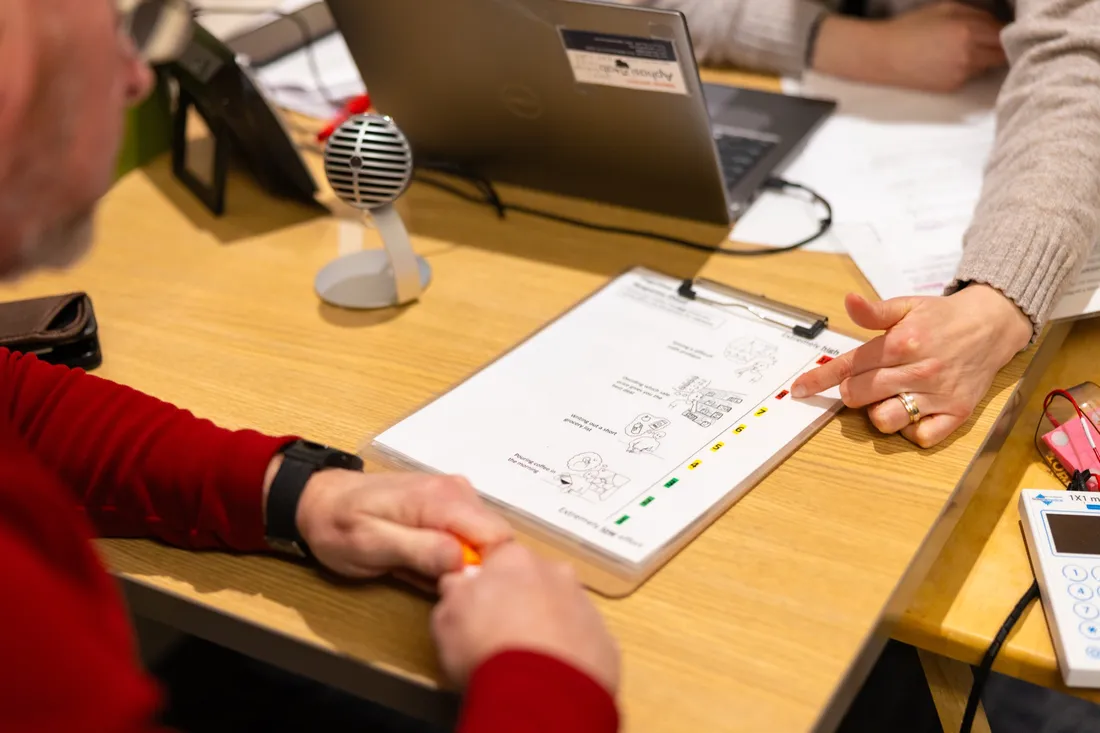
A participant completes a language therapy task during the lab’s National Institutes of Health-funded clinical trial, which pairs speech therapy with brain stimulation to improve outcomes for people with aphasia.
It’s a dynamic Riley also sees clearly. “The stroke survivors we work with are navigating something most of us can’t imagine, and they do it with extraordinary resilience and often a real generosity toward research,” she says.
For Riley, the work is still rooted in that early, formative experience—watching someone she loved struggle to hold onto language as a way of being in the world. What has changed is the clarity of the questions, and the growing sense that answers are within reach.
“I want our research to be part of building the evidence base that demands better,” Riley says. “More targeted treatment, longer duration of care and real attention to the invisible burdens like fatigue that make recovery so much harder.”
“Aphasia sits at this remarkable intersection of neuroscience, cognition and profoundly human experience,” Riley says. “Language is so central to who we are, how we connect, how we think, how we tell our own story, and when it’s disrupted, the impact ripples through every part of a person’s life.”