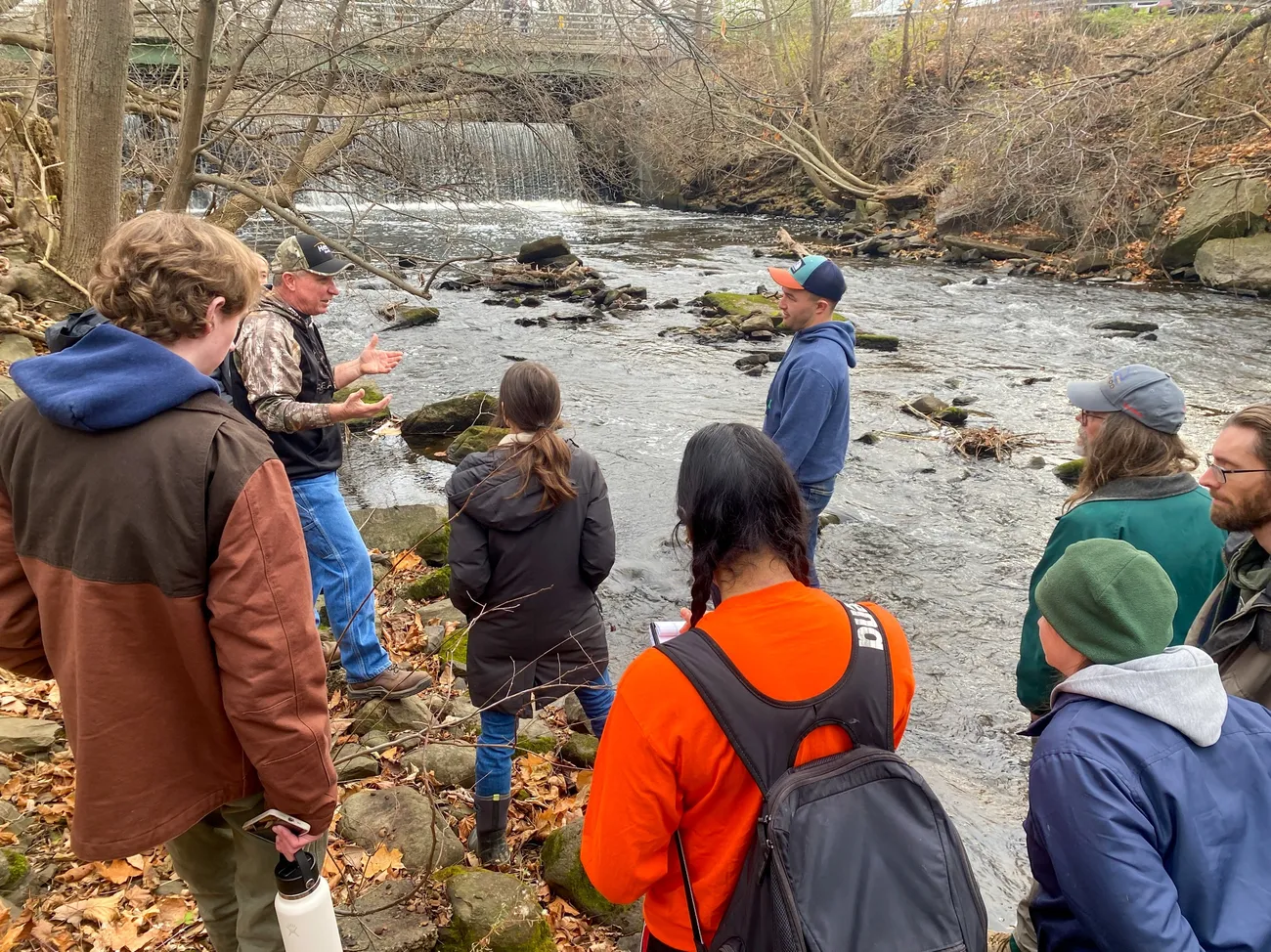
Since 1895, the Little Salmon River dam in the Village of Mexico, New York, has managed the flow of water through the community on its way to Lake Ontario. The 11-foot-high laid stone and concrete structure—which stretches for 140 feet beneath a Route 104 bridge—has seen better days. It is not alone. New York has more than 5,700 state-regulated dams and many—built at the turn of the 20th century—have aged past their intended lifespan and need remediation.
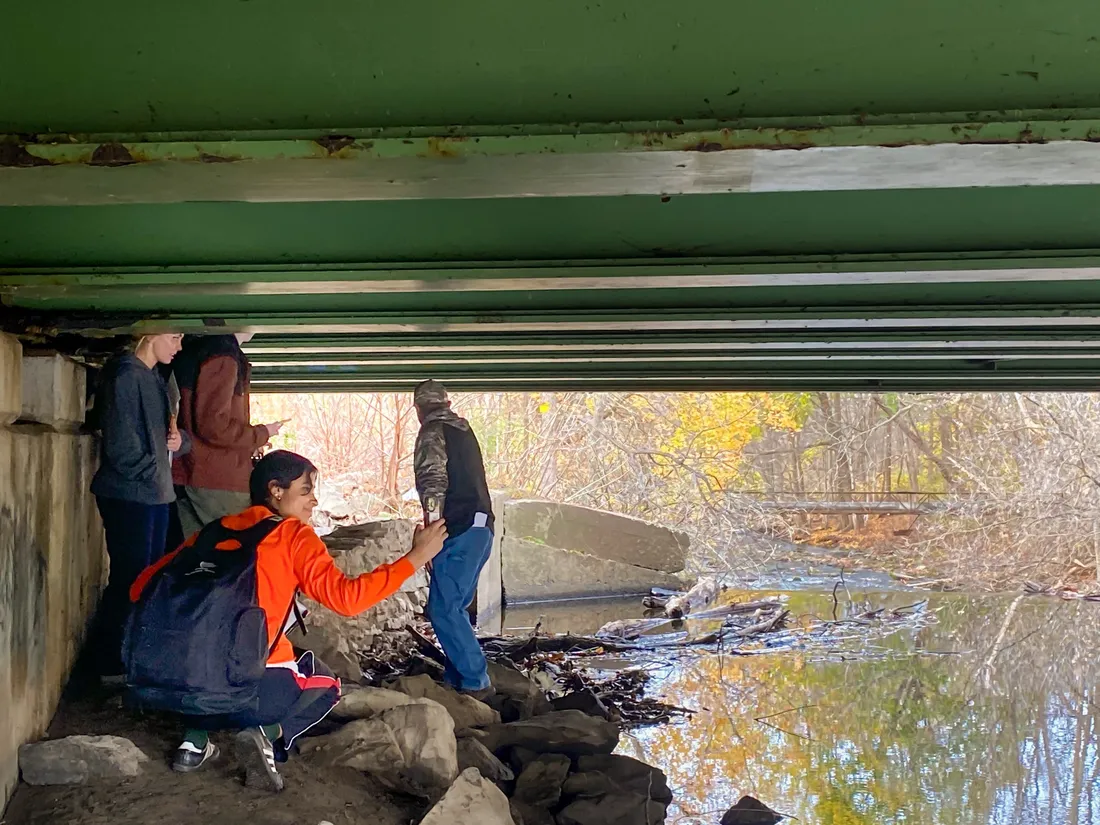
Members of Syracuse University’s chapter of Engineers Without Borders USA (SU-EWB) join Village of Mexico public works superintendent John Power (right) to observe the condition of the highway bridge over the Little Salmon River dam. In 2020, a partial breach of the dam compromised the village’s water main, requiring a costly emergency restabilization of the pipeline.
In exploring options for taking down the dam—which was partially breached in 2020—Mexico has partnered with students involved in Syracuse University’s Engineers Without Borders USA (SU-EWB) chapter and with faculty from the civil and environmental engineering (CEE) department to develop a design for the dam’s removal. “Right now, we’re in the early consulting stages,” says SU-EWB vice president Connor Moulton ’26, an environmental engineering and policy studies major.
For many communities, dam remediation is a costly undertaking that requires professional engineering assistance in the grant application process. “The inability to access engineering design services to apply for grants is a big barrier to many New York communities that need state or national funds for infrastructure projects,” says Elizabeth Carter, assistant professor of civil and environmental engineering in the College of Engineering and Computer Science who serves as a faculty advisor to SU-EWB. “The EWB team is working to overcome this inequity by doing design work required for grant applications. We are also hoping to engage two of our senior design teams from CEE in this initiative during the spring semester.”
Building Collaborative Partnerships
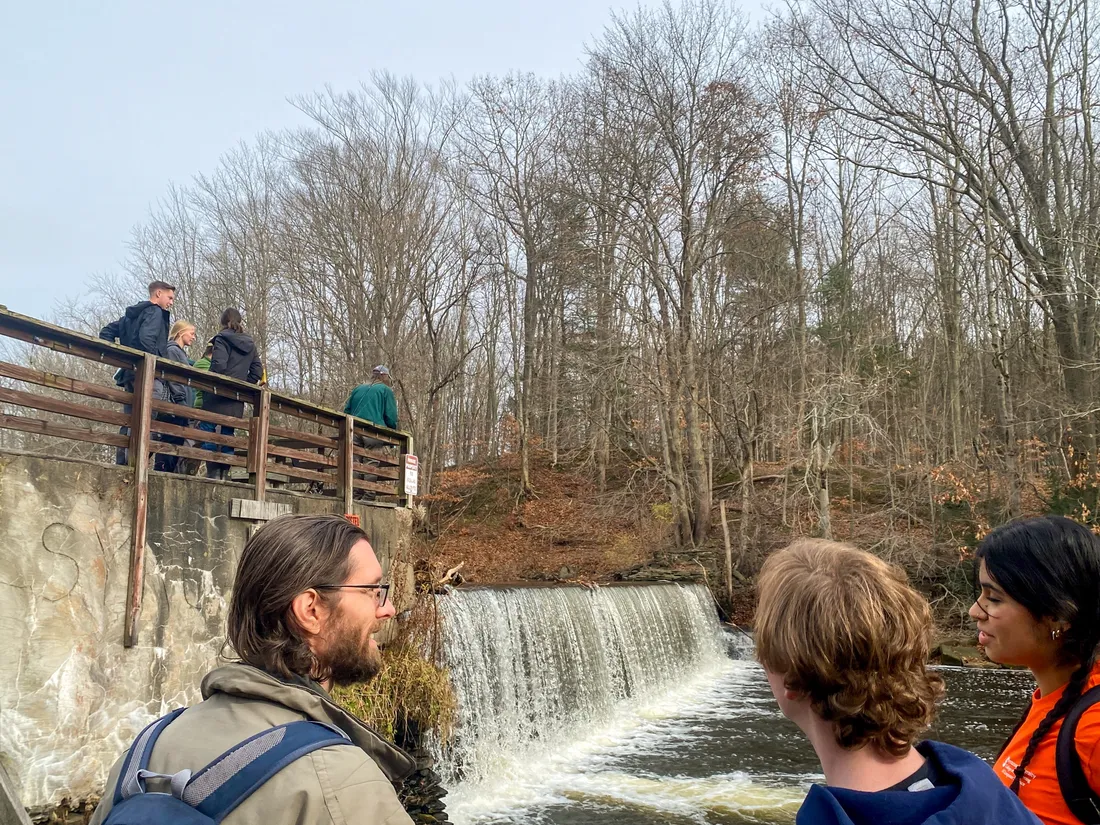
At the Ames Mill dam in Mexico, civil and environmental engineering professor John Trimmer (left), who is also a faculty advisor to SU-EWB, discusses some of the dam’s visual challenges with SU-EWB secretary Spencer Wentland ’26 (center) and project manager Gabby Terry ’26.
For SU-EWB members, the project provides real-world, hands-on experience, communicating with a variety of stakeholders, networking with engineering professionals, assessing ecological and structural conditions, performing geotechnical surveys and researching records and documents. The students are collaborating with local government officials and representatives from the New York State Department of Environmental Conservation (DEC), which regulates dams; the New York State Water Resources Institute (NYSWRI) at Cornell University; and the Tug Hill Commission, a nonregulatory state agency that works with local residents and governments.
Two other dams in the Little Salmon River watershed are also part of the village's history: the Ames Mill dam, which is on property owned by the Syra-Canadian Fish and Game Club, and the Youngs Mill dam on Black Creek, a tributary that joins the Little Salmon River downstream of Ames Mill.
The Youngs Mill dam, owned by the Mexico school district, was removed in 2024 and replaced with a series of step pools that allow salmon to migrate upstream during the fall spawning season. In addition, a barrier that prevents parasitic sea lamprey from moving upstream was installed. The barrier mitigation serves as a model and case study for the Little Salmon River dam. SU-EWB is also working with the Syra-Canadian club to address its concerns about removing the Ames Mill dam and to weigh remediation options. The dam is similar in size to the Little Salmon River dam and over 100 years old. Its removal would allow fish passage farther upstream but alter a prime fishing spot for the club.
Designing a Solution
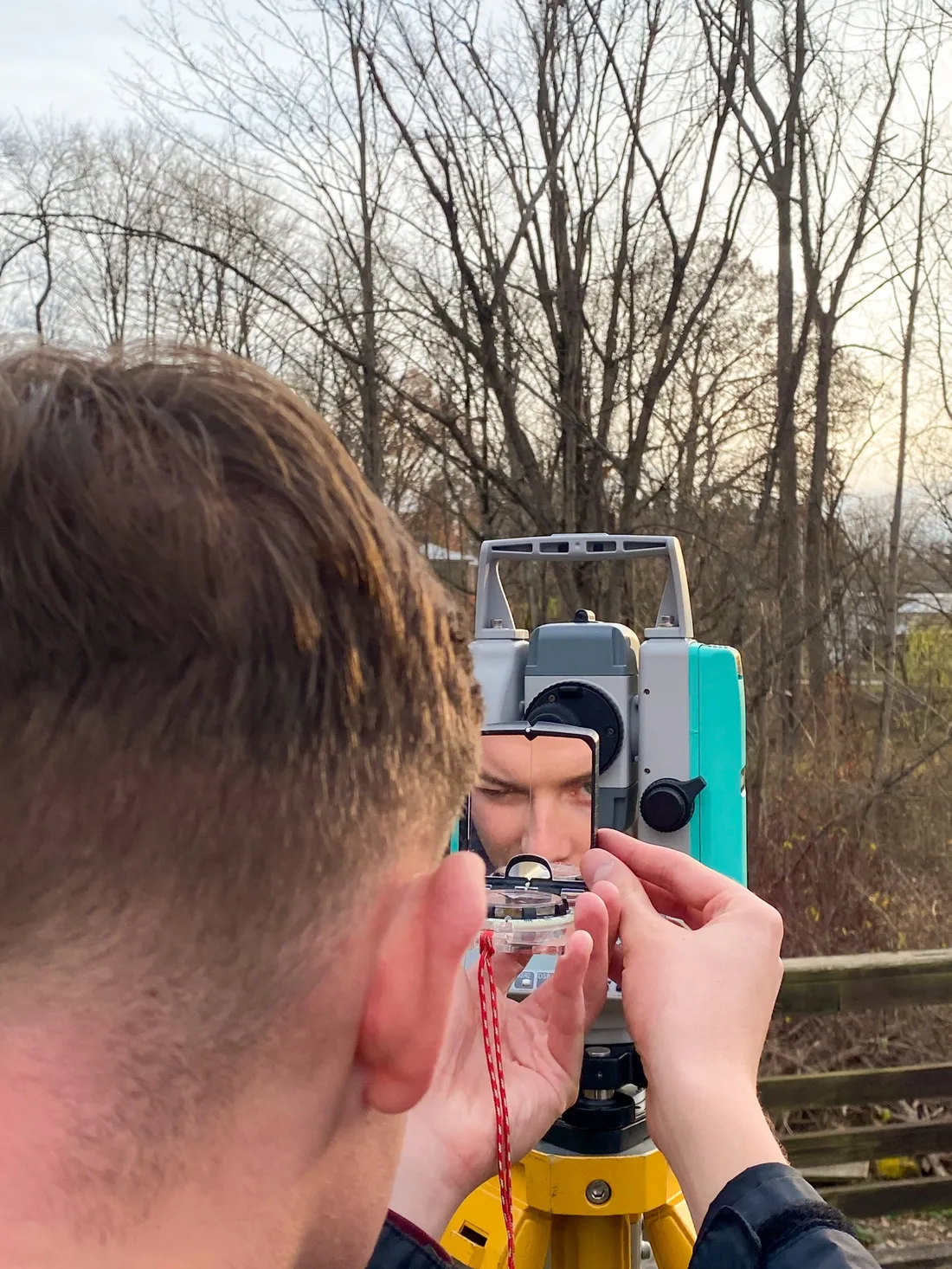
SU-EWB vice president Connor Moulton ’26 surveys an area near the Little Salmon River.
In November 2024, SU-EWB members toured the dam sites, and this August, they gave a presentation to stakeholders and community members, outlining services they can contribute to the project. “We wanted to emphasize to the community, ‘We’re here for you. We want what you want,’” says SU-EWB president Rylee Smith ’26, an environmental engineering major.
In support of the work, the CEE department received a DEC grant via NYSWRI in 2024 to engage student design teams in a pilot project for dam removal. “The objective is to demonstrate that student designs can be used to support capital investment funding applications in under-resourced communities. Not only does this improve the ability to fund projects, but it provides invaluable real-world humanitarian design opportunities for emerging engineers,” says Carter, who developed the proposal. CEE supervising faculty will also work with the DEC “to outline best management practices for monitoring, design and implementation of dam decommissioning in New York state,” according to the proposal.
Smith and Moulton have been taking steps to improve their understanding of the project and ensure SU-EWB moves forward with its work. They got SU-EWB approved as a recognized student organization on campus and are actively recruiting new members. They also registered with the EWB-USA New York professional chapter, which will help SU-EWB receive official recognition under EWB-USA, the national organization that supports sustainable engineering projects in under-resourced communities around the globe.
Our EWB team is a remarkable showcase of Syracuse University’s culture of exceptionalism in engineering.
Elizabeth Carter, SU-EWB faculty advisor
Mexico and the Syra-Canadian club may have the option to apply for engineering assistance from EWB-USA. If approved, SU-EWB would submit its designs to EWB-USA for legal and technical review.
“Meeting people and everything we’ve been learning—the political process, the history, the ecological monitoring and even the legal stuff—has been good to experience as a college student,” Smith says. “It puts things into perspective because we will be dealing with all of it in the real world.”
Exploring Issues
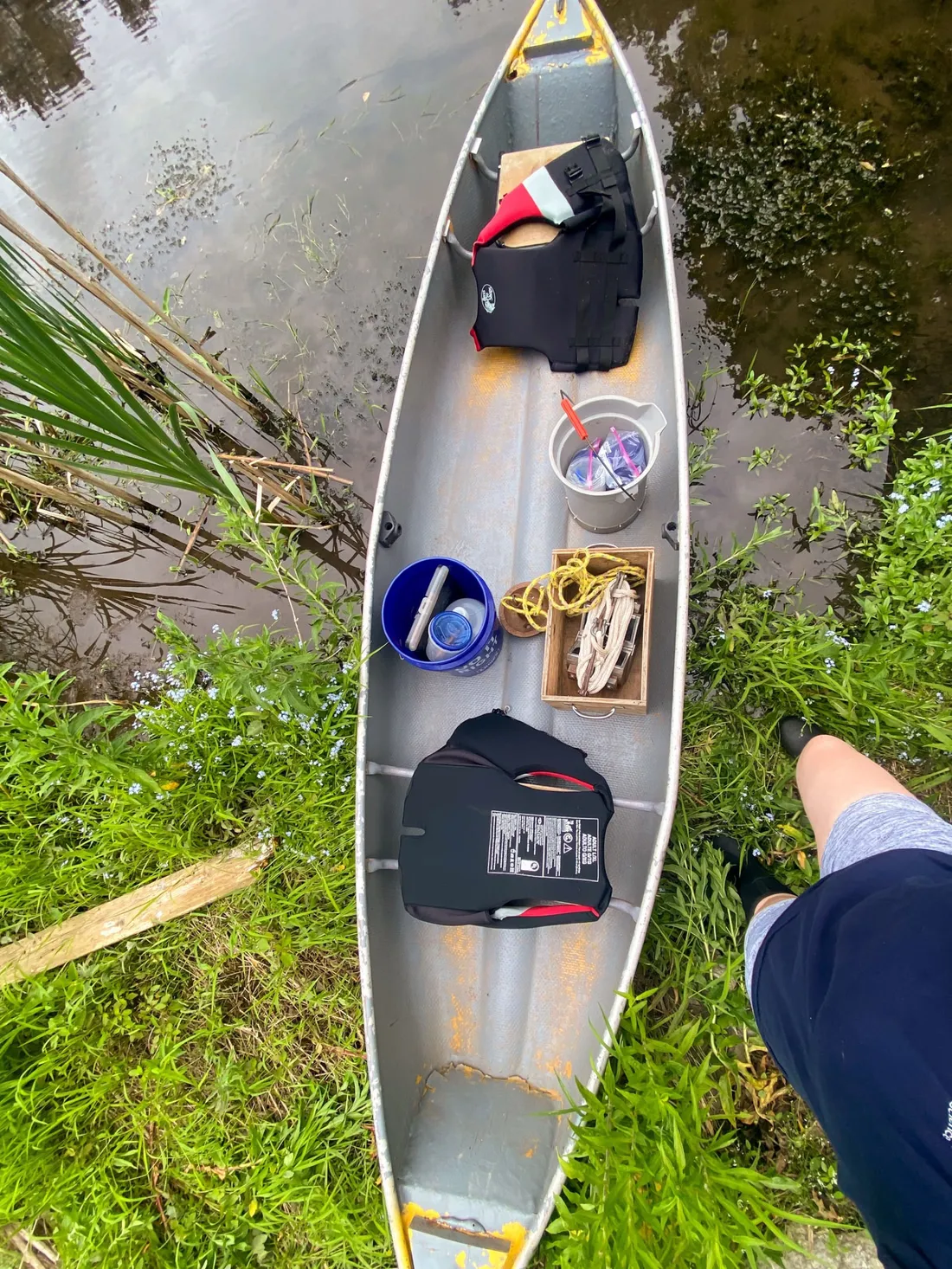
SU-EWB president Rylee Smith ’26 participated in a summer internship that involved ecological monitoring of Black Creek in Mexico. Smith used the canoe to collect samples of invertebrates in the creek.
Smith and Moulton realize restoring natural water flows can improve habitat for aquatic life and passage for migratory fish. They also understand the role of dams in flood control, public safety and water quality—and the challenges that outdated dams present. This semester, they’re doing a technical development series to teach SU-EWB members about ecological monitoring and how to use computer-based tools for the project. They’ve reviewed flood plain studies, attended a webinar on the management of invasive sea lampreys and learned about fish ladders.
Through a summer internship with Jeremy Dietrich, principal aquatic ecologist with NYSWRI, Smith did ecological research on Black Creek and became aware of how barriers cause variations in upstream and downstream conditions as well as how low water conditions can be troublesome for migrating fish. Moulton emphasizes the importance of working with the community, providing education and outreach, and understanding the social context of the dams in local culture and recreation. “We have great opportunities to enhance our technical and professional soft skills through Engineers Without Borders,” Moulton says. “At the same time, you have to put in a lot of work to reap a lot of reward.”
Carter considers her work with SU-EWB a highlight of her career. “The SU-EWB team has demonstrated a high level of independence, adaptability and professionalism in their engagement with our clients since this program has begun,” she says. “Our EWB team is a remarkable showcase of Syracuse University’s culture of exceptionalism in engineering.”